


I. Why is the wiper motor the “heart” of commercial vehicle safety systems?
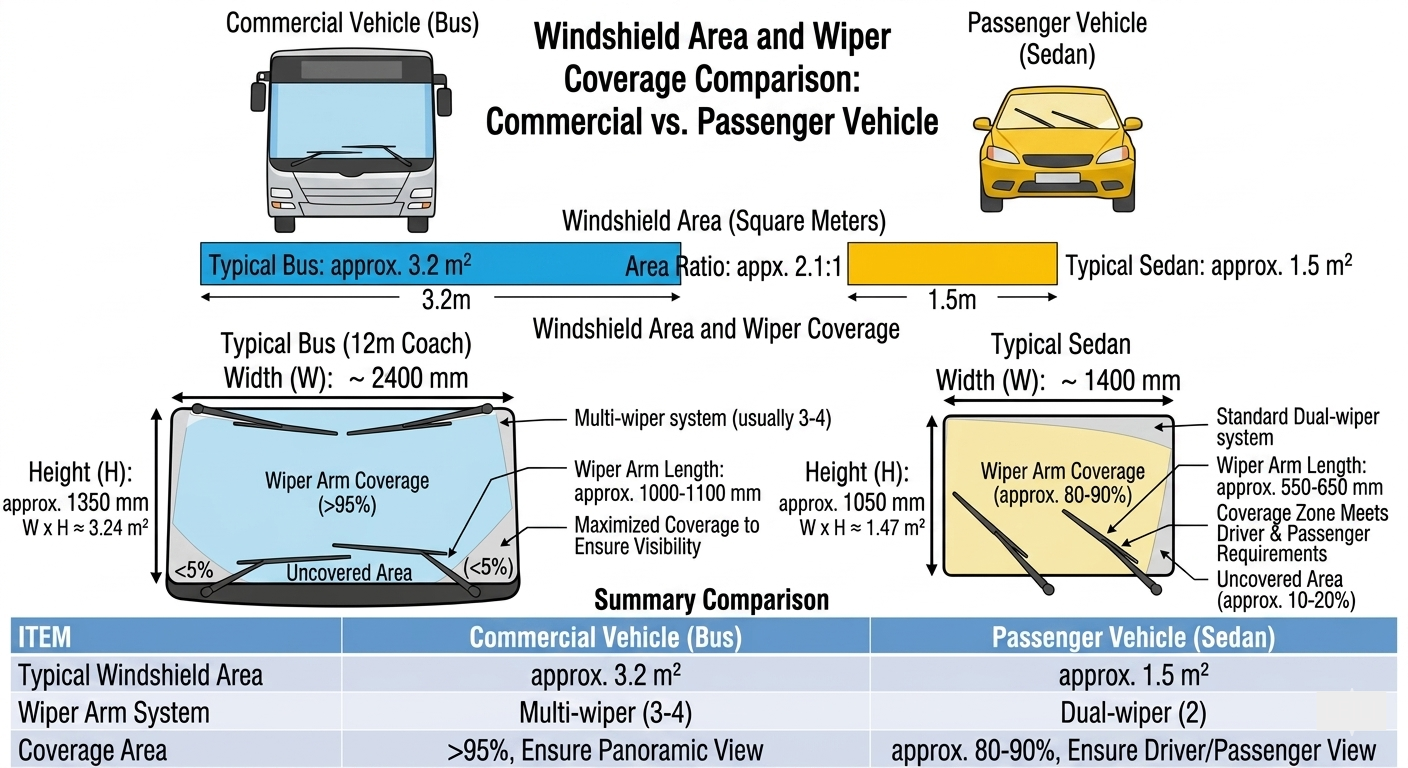
The windshield wiper motor of a commercial vehicle has to handle a far heavier load than that of a passenger car. The front windshield area of commercial vehicles (buses, trucks, engineering vehicles) is much larger, and the wiper arms are much longer, so the wiper load is far beyond the level of passenger cars. Once the motor torque is insufficient, it will cause the brush to vibrate and leave blind spots, or the motor will overload and burn out, which is enough to cause an accident in heavy rain or snow. Where the drive is destined for machinery rather than a windscreen, we supply custom DC geared motors on the same platform.
Motor failure is one of the most common failure modes of commercial vehicle wiper systems. Therefore, choosing the right motor is the first barrier to ensure the reliability of the entire wiper system.
commercial vehicle wiper motor
II. Break down the 4 core parameters one by one
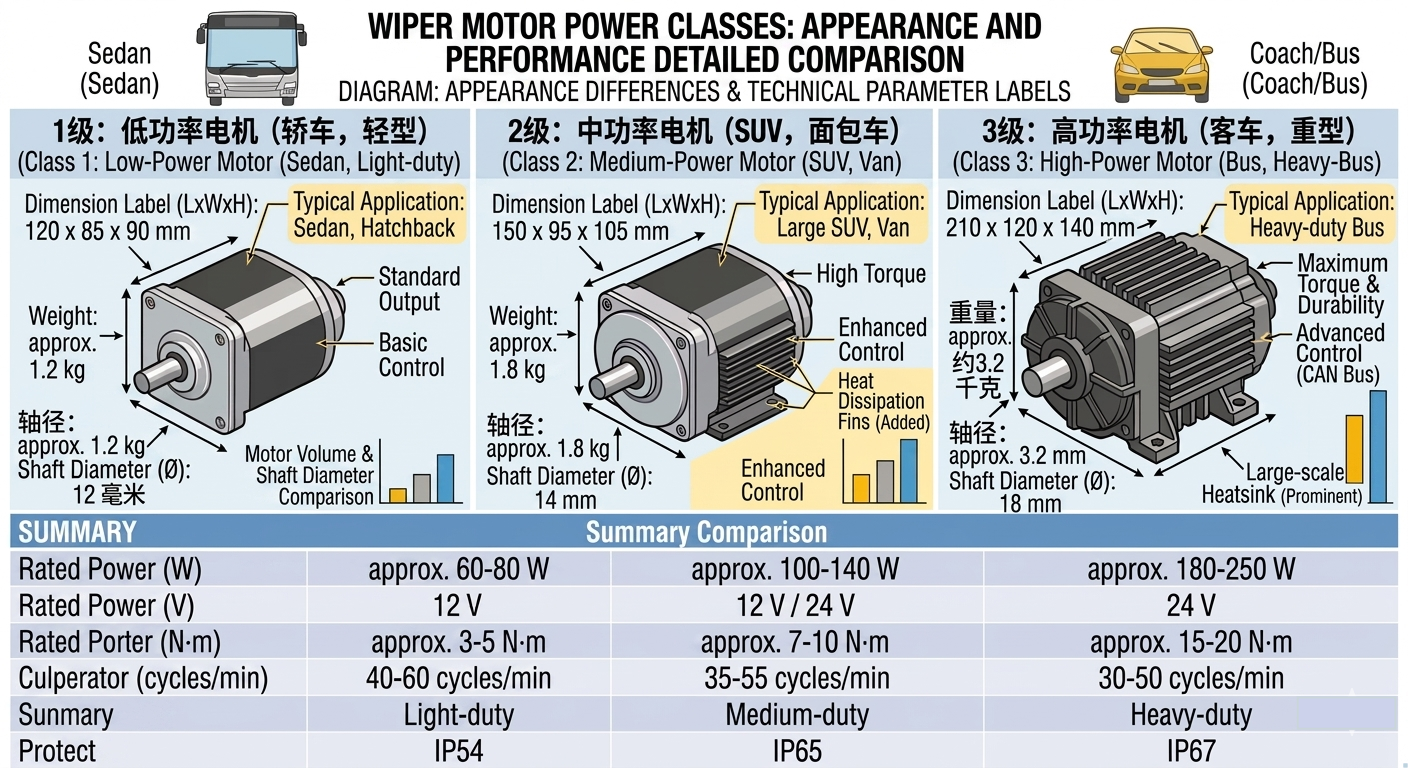
2.1 Torque and power: Do you have enough power? Look at these two numbers.
Torque is the core performance indicator of the wiper motor. The selection logic of commercial vehicles is completely different from that of passenger vehicles:
| Parameter | Typical value for passenger cars | Typical values for commercial vehicles | Introductions |
|---|
| Rated power | Lower level | Higher level | Commercial vehicles require significantly higher power than passenger cars |
|---|---|---|---|
| Rated torque | Lower level | Higher level | The torque directly determines whether the suction pressure of the scraper arm is sufficient |
| Deadlock torque | Lower level | Higher level | The ability to overcome the initial resistance when ice and snow stick to the windshield |
| Working voltage | 12V | 24V | Commercial vehicles generally have 24V electrical systems |
Selection suggestions:
Select the power and torque according to the vehicle size and operating conditions. Larger vehicles and harsher conditions (such as mining vehicles) require higher power and torque, especially a higher blocking torque to handle ice and snow stuck on the windshield.
One common cognitive misconception is that “the larger the power, the better.” In fact, excessive power will cause the motor temperature to rise and energy consumption to increase. Professional manufacturers balance torque and heat dissipation during the motor design stage. The duty-cycle maths behind those numbers is worked through in our construction vehicle wiper motor selection guide.
motor
2.2 Protection class: can’t understand the IP code? Remember these two numbers
The operating environment of commercial vehicles is far worse than that of passenger cars – heavy rain washes, high-pressure water guns wash cars, mud splashes, and salt corrosion are the norm. The degree of waterproof and dustproof (IEC 60529 standard) is the proof of the “survival ability” of the motor:
| Protection class | Dust-proof ability | Waterproof ability | Applicable scenarios |
|---|
| IP52 | Limited dustproof | Water drips at an angle of 15° | Ordinary highway bus |
|---|---|---|---|
| IP54 | Dustproof | Splash in any direction | City bus, tourist bus |
| IP56 | Totally dust-proof | Strong water spray | Engineering vehicles, mining area |
| IP67 | Totally dust-proof | Short-term immersion (1m/30 minutes) | Wet conditions, high humidity areas |
The key to selection: the material of the motor casing also affects the protection effect. Compared with the iron shell or plastic shell, the die-casting aluminum shell has three advantages – higher heat dissipation efficiency, greater impact strength, and natural corrosion resistance. The sealing ring at the joint of the shell is a key observation point to judge the level of technology, and it is recommended to pay special attention to it during on-site factory inspection.
2.3 Winding material: pure copper vs copper-clad aluminum, the difference is not just the price
The material of the motor winding is the key to closing the gap between cost and life:
| Comparison dimension | Pure copper enamelled wire | Copper-clad aluminum wire |
|---|
| Resistivity (20°C) | 0.0172 Ω·mm²/m (standard value of copper) | About 60% higher than pure copper |
|---|---|---|
| Temperature grade | Grade H (180°C) or above | Usually below F-class (155°C) |
| Life performance | Longer service life | Prone to oxidation and early failure |
| Cost | Higher | Lower |
The core difference between pure copper and copper-clad aluminum lies in the coefficient of thermal expansion – the coefficient of thermal expansion of the aluminum core differs noticeably from that of the copper layer. After repeated heating and cooling cycles, microcracks are generated at the interface, causing the contact resistance to surge and the interturn short circuit. This is a non-negotiable bottom line for buses with high operation intensity.
On-site identification skills: You can make a preliminary judgment by observing the copper color of the stator winding end and the uniformity of the wire diameter. The formal manufacturer will clearly indicate “pure copper enameled wire” in the product specification. For export programmes, the paperwork side is covered separately in our wiper motor compliance requirements.
2.4 Wide temperature range adaptability
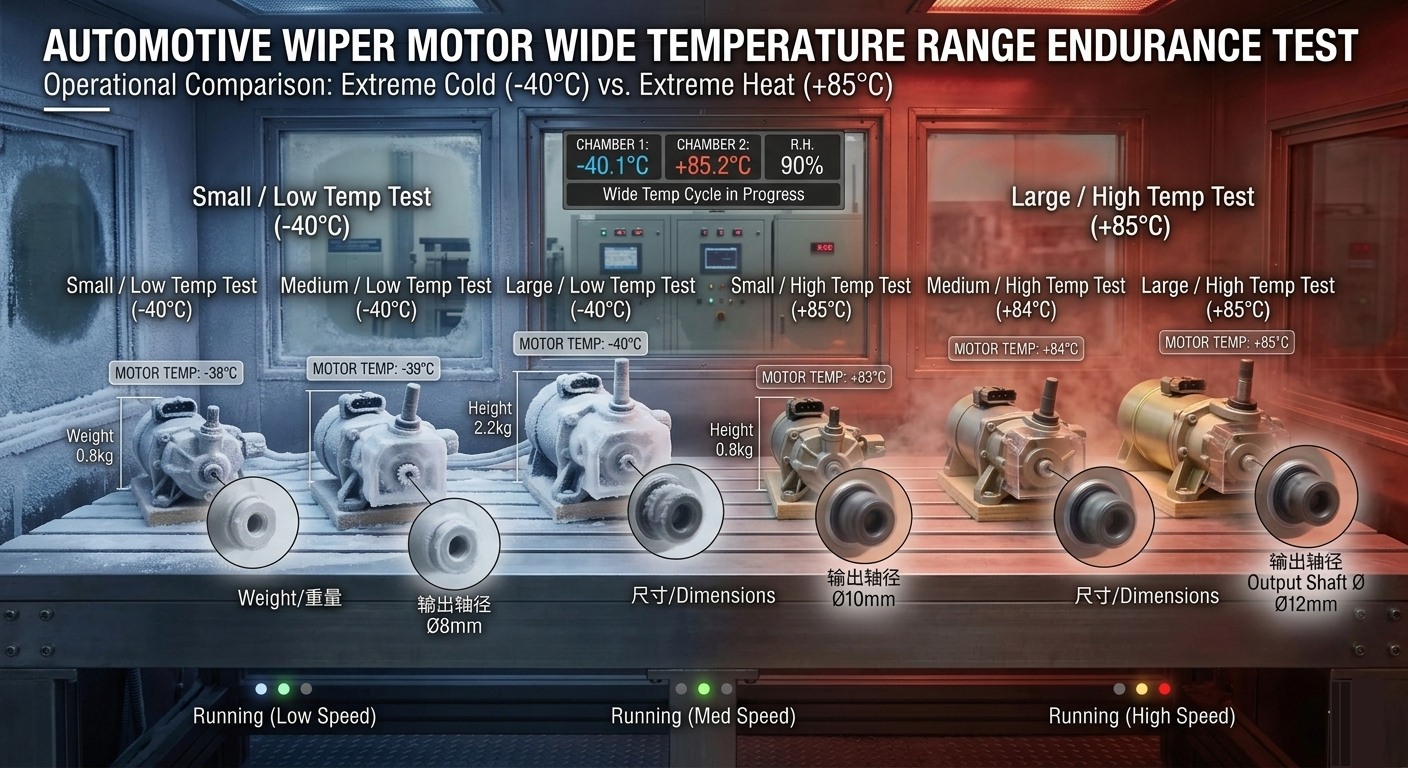
The operation range of commercial vehicles covers the whole country, from the extreme cold in the northeast to the high temperature in Hainan. The motor must work stably in all temperature ranges:
| Environmental conditions | Technical requirements | Risk points |
|---|
| Extremely low temperature | The low-temperature starting torque does not decay, and the lubricant does not solidify | Permanent magnet demagnetization risk, gearbox jamming |
|---|---|---|
| Extremely high temperature | Continuous operation temperature rise stays within a proper range, insulation does not age | The winding overheats and burns out, and the brushes wear out abnormally |
| High altitude | The heat dissipation efficiency has decreased, and the design needs to be reduced | The thin air causes the arc to intensify |
Technical bottom line: The regular commercial vehicle wiper motor should pass the following reliability verification:
- Continuous load test over alternating temperature cycles
- Scraping test according to SAE J903 standard
- Vibration test (refer to ISO 16750-3 standard)
wiper motor
.png)


