


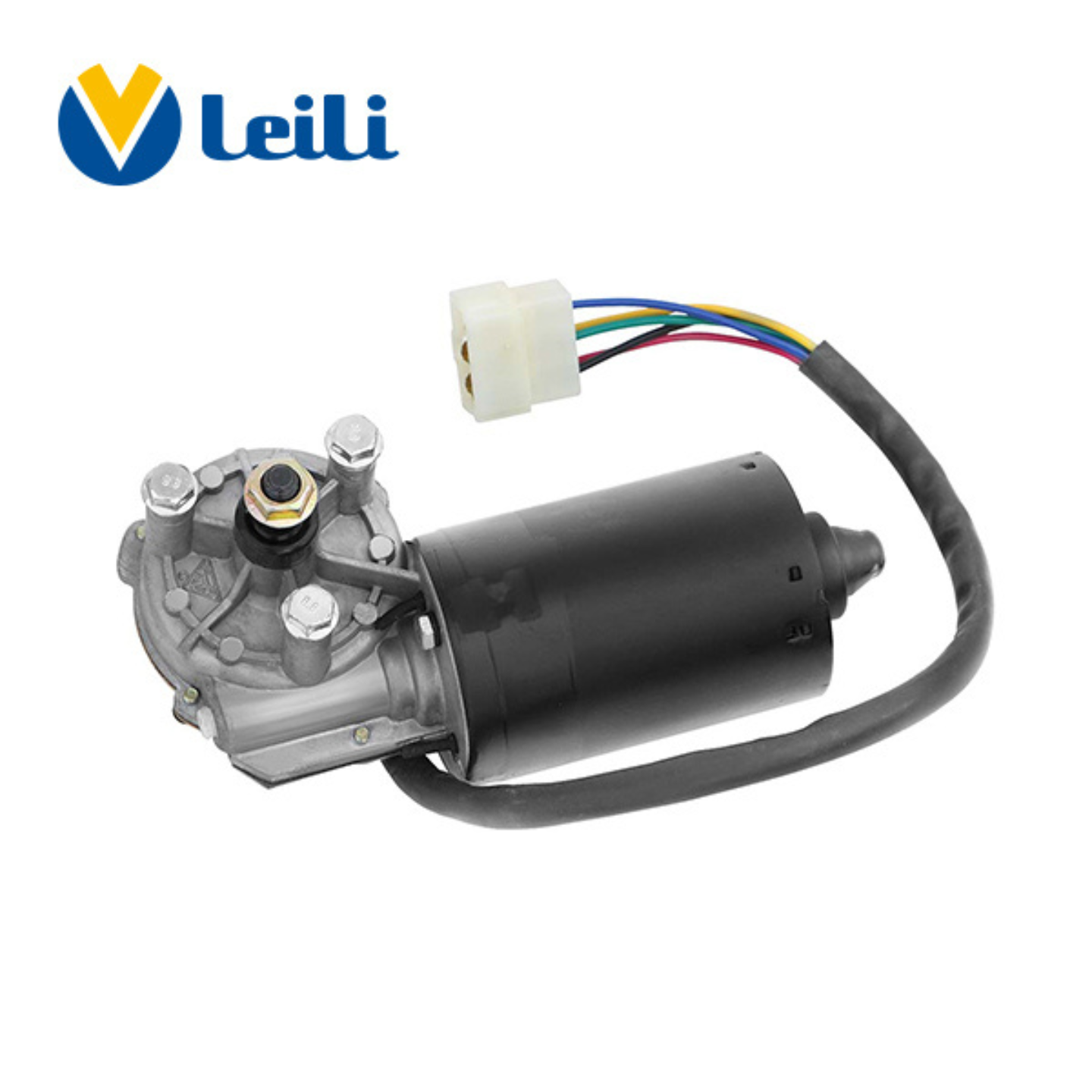
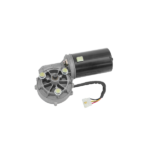
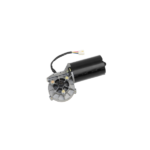
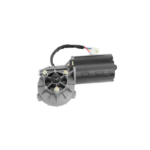
A wiper motor drives the mechanism that moves the windshield wiper arms. When selecting or replacing one, match the electrical supply, output performance, mounting dimensions, connector and parking function—not just the shape of the motor housing.
This guide explains how to check common faults, approach wiper motor wiring and compare 12V and 24V units for buses, trucks and construction equipment. Use the vehicle service manual and the exact motor drawing for installation and testing. For available products, see our commercial vehicle wiper motors.
How does a windshield wiper motor work?
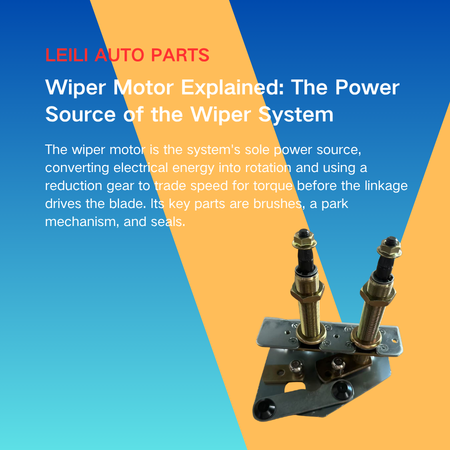
In a conventional linkage-driven system, an electric motor and reduction gearbox drive a crank and linkage, which move the wiper arms across the windshield. The motor supplies rotation; the linkage converts that movement into the required wiping motion. Other designs use electronically controlled reversing drives, so the mechanism and control method must be identified before replacement.
A wiper system may include the following components. They are not necessarily supplied together as one motor assembly.
| Component | What it does | What to confirm |
|---|---|---|
| Motor and reduction gearbox | Supply the required output torque and speed | Rated voltage, output ratings and operating conditions |
| Crank, linkage and pivots | Transmit movement to the wiper arms | Crank geometry, mounting and freedom of movement |
| Parking switch or position electronics | Help return the wipers to their specified rest position | Parking circuit and controller compatibility |
| Switch, relay or electronic controller | Operate the available wiping modes | Control method, connector and wiring diagram |
12V vs 24V wiper motors: what should you compare?
Select the rated voltage specified by the vehicle or equipment manufacturer. A motor's housing, connector shape or number of wires does not establish its voltage or compatibility. Do not substitute a 12V motor for a 24V unit, or assume that a similar-looking motor has the same electrical characteristics.
Voltage alone is not a measure of suitability. Compare output torque and speed at the stated load, the allowed duty cycle, the linkage geometry and the required wiping coverage. Two motors with the same power rating may have different gearing and mounting arrangements.
| Selection item | Information to obtain before ordering |
|---|---|
| Electrical supply | Rated voltage and the vehicle's specified operating range |
| Output performance | Torque and output speed, including the conditions under which they are rated |
| Operating modes | Single-speed, dual-speed or electronically controlled operation |
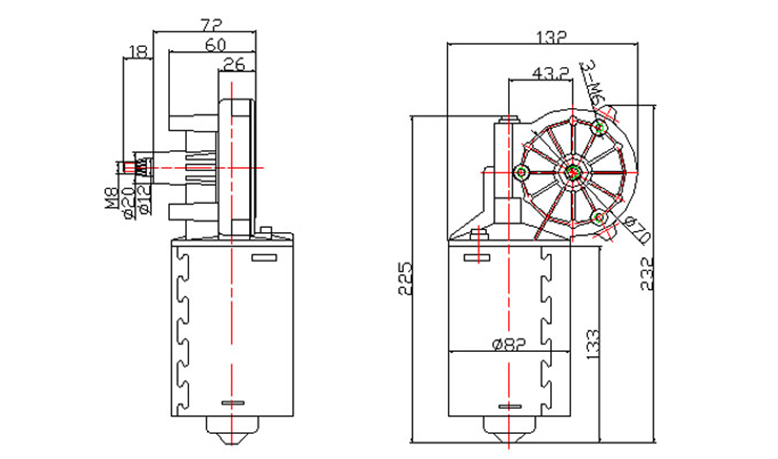
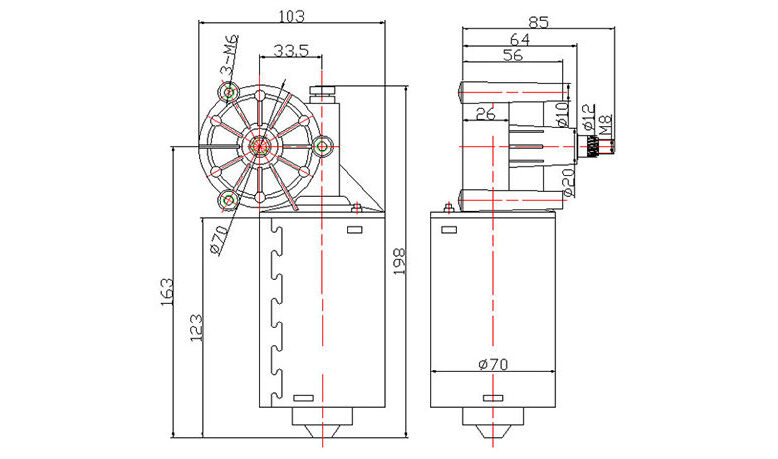
| Mechanical fit | Mounting-hole spacing, shaft dimensions, spline or thread details and crank position |
| Electrical fit | Connector drawing, terminal functions and parking/control requirements |
| Environment | Required protection, temperature and exposure conditions for the installation |
| System load | Arm and blade configuration, linkage arrangement and operating duty |
Common wiper motor symptoms and first checks
A symptom is a starting point, not proof that the motor needs replacement. Wiring faults, poor connections and mechanical resistance can produce symptoms similar to motor failure.
| Symptom | Possible causes | First checks |
|---|---|---|
| Wipers do not move | Supply, fuse, relay, controller, wiring or motor fault | Check the specified fuse, connectors, supply and ground using the service procedure |
| Motor can be heard but arms stay still | Disconnected linkage, loose crank or damaged drive components | Isolate power and inspect the mechanical connection |
| Wiping is slow or intermittent | Voltage drop, binding pivots, linkage resistance or motor wear | Compare supply under load and inspect the mechanism |
| Only one speed works | Switch, relay, wiring, controller or motor speed-circuit fault | Use the model-specific diagram to check the affected circuit |
| Wipers stop in the wrong position | Parking circuit, controller, crank or arm alignment problem | Check the specified park sequence and mechanical alignment |
| Grinding or knocking | Loose mounting, worn pivots or damaged gears/linkage | Stop operation and inspect the moving mechanism |
Wiper motor wiring: use the exact connector diagram
There is no universal five-wire wiper motor wiring diagram. Wire colours, terminal positions and parking arrangements can differ between models. A connector that physically fits may still have a different terminal assignment.
Before testing or replacement, record the motor label, vehicle model and OE reference where available. Obtain a diagram that identifies the supply, ground, speed circuits, parking connections and any electronic control interface for that exact unit.
For a five-wire motor, identify each terminal from the manufacturer's documentation rather than assigning functions by wire colour. Keep supply and signal terminals distinct. Do not apply battery voltage to an unidentified terminal or to an electronic control connection.
If the wiring information is missing, send clear photographs of the motor label, connector face and mounting arrangement through our technical enquiry page. These details help establish the correct drawing; photographs alone do not prove electrical compatibility.
How to test a wiper motor
Start with the installed system before considering a bench test. Keep hands and tools clear of the crank, linkage and arms, which can move during operation or a parking cycle. Isolate power before disconnecting parts and follow the vehicle manufacturer's procedure.
- Identify the unit. Confirm rated voltage, connector functions and whether the motor uses conventional switching or electronic control.
- Inspect the installation. Check the specified fuse, loose or corroded connections, damaged wiring and signs of water ingress. Do not fit a higher-rated fuse to bypass a fault.
- Check the mechanism with power isolated. Inspect the crank, pivots and linkage for damage or binding using the service procedure.
- Check supply and ground under the specified operating conditions. A static voltage reading alone may not reveal a poor connection under load.
- Check the requested operating modes and park function. Record whether the fault affects one mode, all modes or only the return to park.
- Bench-test only when the exact procedure is available. A qualified technician should secure the motor and use the specified voltage, protection and test connections. Electronically controlled units may require their controller or diagnostic equipment.
A motor that runs without its linkage has passed only part of the check. It may still fail under load, at a particular speed or during parking. Compare results with the specification for the selected model. For a closer look at current measurements and load conditions, see our wiper motor current draw and electrical diagnosis guide.
How to reset a wiper motor's park position
There is no single reset method for every wiper motor. First distinguish an electrical parking fault from a crank or arm installed in the wrong position.
Check the park circuit and controller procedure for the vehicle. If mechanical realignment is required, follow the manufacturer's sequence for allowing the motor to reach its specified park position before setting the crank and arms. Some electronic systems also require calibration or initialization.
Do not reposition an arm simply to conceal an incorrect motor or crank setting. Verify wiping travel, clearance and return to park after the specified adjustment.
Can a wiper motor be repaired?
Repair depends on the design, condition, available service parts and the vehicle manufacturer's requirements. A loose connector or binding linkage may be repairable without opening the motor. Brush, gear or parking-component repairs should only be considered where a suitable service procedure and parts are available.
Severe corrosion, damaged windings, a failed sealed controller or extensive gearbox damage may make complete replacement more practical. Repairability varies by model; damaged gears or windings are not universally repairable or universally non-repairable.
Estimated repair cost
If you attempt to repair the carbon brushes yourself, the cost might only be a few tens of yuan for purchasing the carbon brushes and lubricant. However, if the issue is complex, it is recommended to replace the entire assembly.
Replacing a wiper motor: compatibility and installation checks
Use the vehicle's installation procedure and specified tightening values. The access route, removal sequence and park-alignment method vary by vehicle.
- Record the original motor reference, connector, mounting and park arrangement before removal.
- Isolate the electrical supply as instructed by the vehicle manufacturer.
- Compare the replacement motor's voltage, mounting, shaft, connector and control/park functions against the original specification.
- Check the linkage and pivots before installing the replacement motor; unresolved binding can overload the new unit.
- Set the crank and arms in the sequence specified for the vehicle, then verify clearance, the required operating modes and return to park.
Component cost
The price of the wiper motor assembly varies greatly depending on the vehicle model and brand. For ordinary passenger vehicles, aftermarket parts typically cost between 150 to 400 yuan, while original equipment or high-quality branded parts may range from 400 to 800 yuan or more.
Labor costs
If it needs to be replaced at a repair shop, labor costs typically range from 100 to 200 yuan, depending on the region you’re in and the difficulty of disassembling the vehicle. Replacing it yourself can save you this expense.
How to select a commercial vehicle wiper motor
For a replacement, begin with the existing motor number or OE reference and verify its dimensions and electrical functions. For a new bus, truck or construction-equipment project, begin with the complete wiping-system requirements rather than selecting a motor by power rating alone.
Prepare these details for the supplier:
- Vehicle or equipment model and the original part number, if available.
- Required supply voltage, operating modes and parking/control arrangement.
- Mounting drawing, shaft dimensions, crank geometry and connector specification.
- Required torque and speed with their load conditions, or the system information needed for an engineering review.
- Wiper arm/blade arrangement, operating duty and environmental requirements.
- Expected quantity and any sample-validation requirements.
Ask for the proposed model's specification sheet, dimensional drawing and wiring diagram. Confirm compatibility and agree the sample checks before a bulk order. A vehicle brand name or a visually similar housing is not enough to establish interchangeability.
Browse LEILI commercial vehicle wiper motors or send your motor reference and drawings for selection. Where the project requires a complete mechanism, see our bus and coach windshield wiper systems.
Frequently asked questions
Are 12V and 24V wiper motors interchangeable?
Not simply because they look alike. Use the rated voltage specified for the vehicle and confirm torque, speed, mounting, connector and parking/control compatibility. Any alternative requires technical confirmation for the application.
How many amps does a wiper motor draw?
There is no single current value for all wiper motors. It depends on the model, supply, speed and load conditions. Use the selected motor's specification and the prescribed test method rather than treating another motor's reading as a pass/fail limit.
How do you test a five-wire wiper motor?
Identify the exact unit and obtain its terminal diagram first. Check the supply, ground, operating modes and park circuit using the manufacturer's procedure. Do not infer the pinout from wire colours or apply power to an unidentified terminal.
What should I send to a wiper motor supplier?
Send the vehicle model, motor or OE reference, voltage, label and connector photographs, mounting dimensions and expected quantity. New projects also need information about the wiping mechanism, load, duty and control requirements.
Technical reading
- HELLA wash/wipe interval control units and circuit terminology.
- Bosch EC wiper drive: an example of electronically controlled reversing-drive architecture.
These references describe their respective manufacturers' systems; they are not LEILI model specifications or universal wiring instructions.

Zhejiang Lei Li Auto Parts Co., Ltd.
Hello! Welcome to our blog platform! I am the editor responsible for creating content for the LEILI blog. At LEILI, we firmly believe that only when you have a thorough understanding of the performance and purpose of each automotive component can you make more rational and appropriate choices. Whether you are a professional or a DIY enthusiast who enjoys hands-on activities, mastering the correct knowledge of installation, maintenance, and repair will greatly enhance your driving experience.
As a result, we will continue to provide in-depth analyses and practical guides on automotive parts and the broader automotive industry, helping you to continuously enhance your knowledge and skills. If you have any suggestions or ideas while browsing and learning, please feel free to share them with us at any time.

.png)


