
In-depth analysis of the bus wiper motor’s waterproof and dustproof function: from bus daily washing to sealing the line of defense in heavy rainwater

wiper blade guide

I. Why Bus Wiper Motors Require High-Level Protection

Compared to passenger vehicles, bus wiper motors face significantly harsher operating conditions:

ScenarioRisk characteristicsDirect threat to motor
Daily bus washingHigh-pressure water jets from multiple angles, 1–2 times per dayWater ingress through shaft end gaps and connectors
Heavy rain drivingContinuous heavy rainfall lasting 1–3 hours, water accumulation in the front cowlMotor housing exposed to prolonged high humidity or semi-submerged conditions
Flooded road sectionsDeep standing water, instantaneous water levels may submerge the motor mounting positionShort-term complete submersion, water pressure directly acting on sealing surfaces
Coastal/salt spray areasHigh-salt fog air corrosion year-roundAccelerated seal aging, electrochemical corrosion of metal housing

Conventional commercial motors only meet lower protection ratings (splash-proof) and cannot guarantee long-term reliability in the above scenarios. Bus operators require wiper motors with high-level protection to match the all-weather operational demands of public transit buses.

II. Understanding the IP Protection Rating System: Engineering Implications Behind the Numbers

The IP code defined by IEC 60529 consists of two digits. The first digit represents the dust protection level (0–6), and the second digit represents the water protection level (0–9K). For bus wiper motors, the critical thresholds are IP65, IP67, and IP68:

Protection RatingDust ProtectionWater ProtectionSuitability for Bus Applications
IP65Dust-tight (IP6X)Protected against low-pressure water jetsCan handle heavy rain and general washing, but cannot guarantee safety in flooded conditions
IP67Dust-tight (IP6X)Protected against immersion at specified depth and timeCovers daily bus washing + heavy rain + routine flooded-road conditions
IP68Dust-tight (IP6X)Protected against immersion at depth/time specified by manufacturer (typically deeper)Extreme flood conditions, prolonged submersion scenarios

From IP65 to IP67, while it appears to be just one step up, the engineering difficulty increases exponentially. IP65 only requires blocking directed water jets, with sealing design focused on “deflecting” water. IP67, on the other hand, demands resistance to static water pressure—sealing must upgrade from “deflecting” to “sealing off.” Any tiny leakage path, no matter how small, will be quickly penetrated under static water pressure.

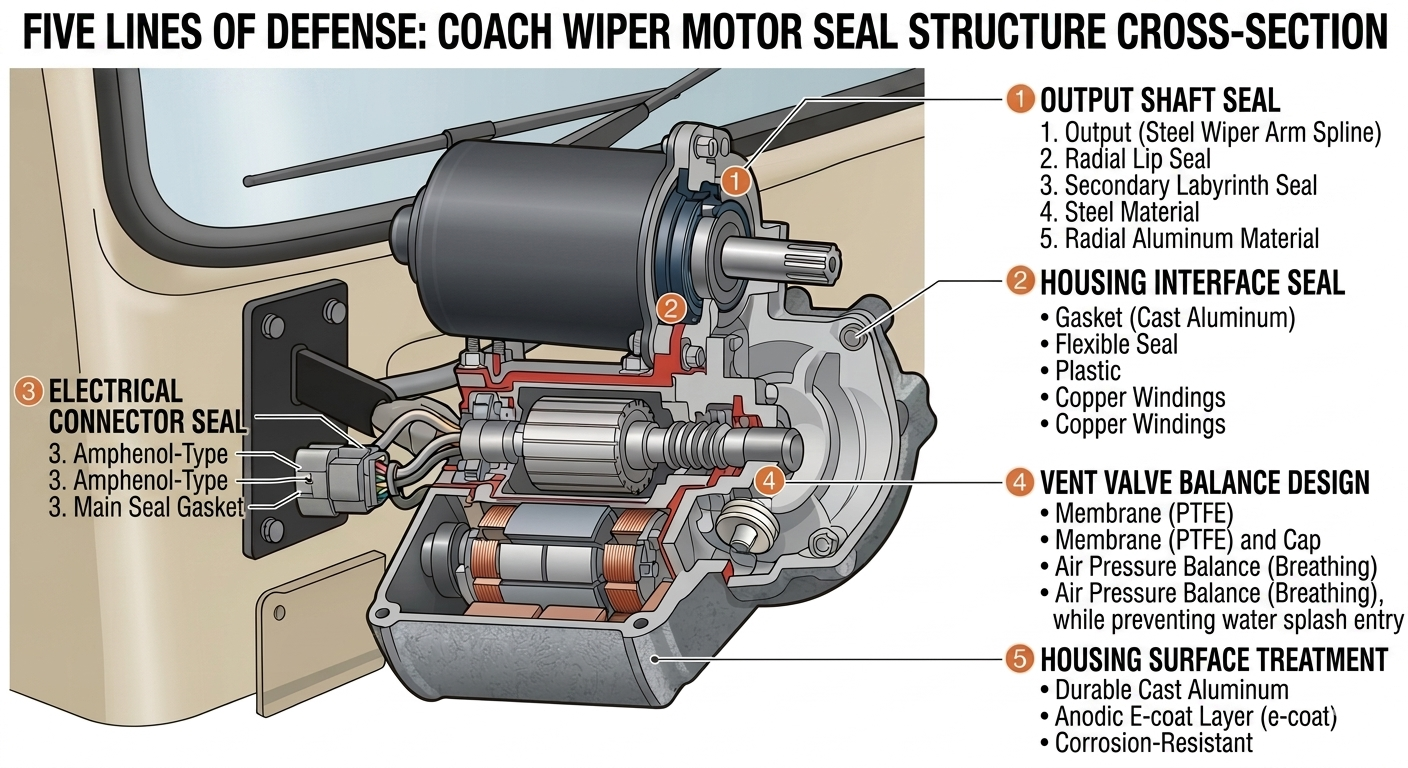
III. Multi-Layer Sealing Architecture: The Five Lines of Defense for Bus Wiper Motors

Achieving high-level protection relies not on a single sealing ring, but on an integrated multi-layer sealing system. A typical bus wiper motor sealing architecture encompasses five critical points:

Line 1: Output Shaft Seal

The motor output shaft is a rotating component, making it the most challenging to seal. A common industry solution is a double-lip oil seal structure—the outer layer uses a fluororubber (FKM) primary sealing lip, offering a wide temperature range and ozone resistance; the inner layer serves as an auxiliary dust lip, forming a labyrinth barrier. The shaft surface, treated by nitriding, achieves significantly increased hardness, ensuring that the sealing lip does not wear the shaft surface during long-term operation. A water-resistant grease is filled between the dual oil seals, providing a cushion even if the outer layer fails.

Line 2: Housing Joint Surface Seal

The joint between the motor end cover and the housing is a typical static sealing application. High-level protection designs employ an O-ring groove + silicone rubber seal solution: a precision O-ring groove is machined into the end cover to house a weather-resistant silicone rubber (VMQ) O-ring, which, under bolt preload, creates a uniform surface pressure distribution. Compared to traditional gasket solutions, O-ring seals are less prone to gaps caused by thermal expansion and contraction during repeated temperature cycles.

Line 3: Electrical Connector Seal

The power and signal connectors of bus wiper motors are high-risk entry points for moisture—water can penetrate through the capillary gaps between the wire strands inside the cables. High-level waterproof connectors incorporate radial seals at the mating face and cable sealing sleeves at the tail end, forming a “mating face + cable end” double seal. Some designs further inject potting compound inside the connector to completely block capillary penetration paths.

Line 4: Breathable Valve for Pressure Equalization

In a completely sealed motor, the thermal cycling between operation (heating) and shutdown (cooling) causes drastic pressure fluctuations inside the cavity, accelerating seal fatigue. The solution is to install a waterproof breathable valve (also called an air vent or breather) on the housing—using an expanded polytetrafluoroethylene (ePTFE) microporous membrane with micron-sized pores that allow gas molecules to pass while blocking liquid water droplets. The breathable valve equalizes internal and external pressure while maintaining high-level waterproof capability.

Line 5: Housing Surface Treatment

Even the best seals are useless if the housing itself corrodes and perforates. Bus motor housings are typically made of aluminum alloy die-castings, with exterior surfaces treated with anti-corrosion coatings that demonstrate good resistance in neutral salt spray tests. Cast iron end covers use a dual-layer anti-corrosion system of cathodic electrodeposition primer + polyurethane topcoat to withstand long-term corrosion in coastal high-salt areas.
motor

motor

IV. Material Selection Logic for Key Sealing Components

The choice of sealing material directly affects the longevity of the protection rating. Bus wiper motor seals must simultaneously withstand water, washing fluid (alkaline environment), ozone, UV radiation, and wide temperature cycling:

Material Temperature Rangewater ResistanceEvaluation for Bus Applications
NBR (Nitrile Butadiene Rubber)Moderate rangeGoodLow cost, but poor low-temperature elasticity; unsuitable for northern buses
HNBR (Hydrogenated Nitrile)Wide rangeGoodGood overall performance, common choice for bus motors
FKM (Fluororubber)High-temperature rangeGoodExcellent high-temperature performance; low-temperature elasticity requires special formulation; suitable for output shaft seals
VMQ (Silicone Rubber)Extremely wide rangeFairExcellent low-temperature elasticity; suitable for O-ring static seals

The industry standard is to use HNBR or FKM for dynamic sealing applications and VMQ silicone rubber for static sealing, with differentiated material selection based on temperature, movement, and media conditions at each location.

V. From Lab to Real-World Operation: Validating Seal Reliability

High-level protection is not designed on paper—it is validated through testing. Seal verification for bus wiper motors follows industry standards and ISO 16750 environmental test standards. Core test items include:

2026.7.18
Immersion test

After immersion of the finished motor at a specified depth for a specified time, insulation resistance is measured immediately—requiring that insulation resistance meets specifications and the motor starts and runs normally

2026.7.18
Thermal Shock

Alternating cycles between extremely low and high temperatures; after multiple cycles, the compression set of the sealing rings must remain within acceptable limits

2026.7.18
High-Pressure Water Jet

Simulates bus washing conditions with continuous spraying from multiple angles

2026.7.18
Salt Spray + Immersion Combined

Salt spray exposure (per ISO 9227 NSS) followed by immersion testing—simulating the combined operating conditions of coastal buses over long-term service

VI. Key Evaluation Criteria for Procurement Decision-Makers

For procurement decision-makers at transit authorities and bus operating companies, the following verifiable dimensions are recommended when assessing wiper motor waterproof performance:

Third-party IP rating certification

Require test reports from CNAS-accredited laboratories, not in-house self-declarations

Seal material type

HNBR or FKM offer superior weather resistance compared to standard NBR

Breathable valve as standard equipment

Motors equipped with waterproof breathable valves typically have longer seal service life in actual operation

Warranty coverage for water ingress failures

Suppliers willing to cover water damage under warranty generally have more thoroughly validated sealing technology

Heated shaft end option

For northern buses, shaft-end freezing after winter washing is a common failure point; some manufacturers offer shaft-end heating devices to thaw and restart in low-temperature conditions—a valuable extension of waterproof design

About Us

ZHEJIANG LEILI AUTO PARTS CO.,LTD has specialized in bus wiper systems for over 30 years, covering all components and major bus brands with international certifications. Its product line supports various segments, from urban buses to airport shuttles.

wiper blade
You might also enjoy
wiper

How to troubleshoot common faults of commercial vehicle wipers? 5 major issues explained in one go

background

Zhejiang Lei Li will bring its full range of bus wipers to the 2026 Wenzhou Auto Parts Exhibition, booth 8D20, and sincerely invite global customers.

Optimal solution for bulk purchase of wiper system for urban buses: from TCO to whole life cycle management