


Differentiated needs of the three major long-distance operation scenarios
Different routes require different wiper setups. One-size-fits-all raises fleet maintenance costs.
Scene 1: Plain Expressway
High-speed uniform operation with long one-way distances.
High-speed wind lifts wiper blades, creating a central unscraped zone.
Residual water film blurs vision and lengthens braking distance.
Key points for selection:
Aerodynamic guide vanes are a must-have—at high speed, a deflector keeps wiper coverage substantially higher than without it.
High torque motor reserve to handle heavy rain loads without speed loss.
Scene 2: Long-distance routes in mountainous/highland areas
Operational characteristics: Long uphill/downhill, large altitude changes, frequent rain/fog, and sharp temperature swings.
The core challenge of the wiper:
Rain, mist, and dust erode both blades and motors. Mountain curves demand clear vision—any streak can cause misjudgment of oncoming traffic.
Key points for selection:
The motor should have adequate protection against water splashing and condensation from temperature changes, and should pass cold starts at high altitude and low temperature.
Mountain sand wears ordinary blades, causing microcracks after repeated wipes, so choose blades with better durability and low-temperature flexibility.
For muddy mountain roads, use a sufficiently large washer tank with high-pressure nozzles to remove dried mud.
Scene 3: Night cross-provincial bus (e.g., Pearl River Delta → Yangtze River Delta night bus line)
Operational characteristics: high proportion of night driving, long continuous operation, passing through multiple climatic zones.
The core challenge of wiper: Long runs raise motor temperature and test reliability. Night buses face sun, then rain—wipers must switch gears and run continuously for long periods.
Key points for selection:
Long continuous operation raises motor temperature, so the motor should have adequate heat dissipation and durability for extended running.
Wipers run continuously for long periods, so blades should have good wear resistance to maintain clear vision throughout the trip.
Long cross-provincial routes pass through multiple climatic zones, so a sufficiently large washer tank is needed to handle various road and weather conditions.
Long-distance passenger bus windshield wiper system selection checklist
| Operation scenario | Recommended motor power | Protection class | Rubber strip type | Washing machine capacity | spoiler |
|---|
| Plain Expressway Express | 80–120W | IP55+ | Teflon-coated rubber | 5L | necessary |
|---|---|---|---|---|---|
| Mountain/highland route | 100–180W | IP65+ | Nano-coating silicone | ≥8L | necessary |
| Overnight cross-provincial bus | 100–120W | IP65+ | Teflon-coated rubber | 6L | necessary |
.png)
.png)
.png)
.png)
Full system matching: not just motors and blades
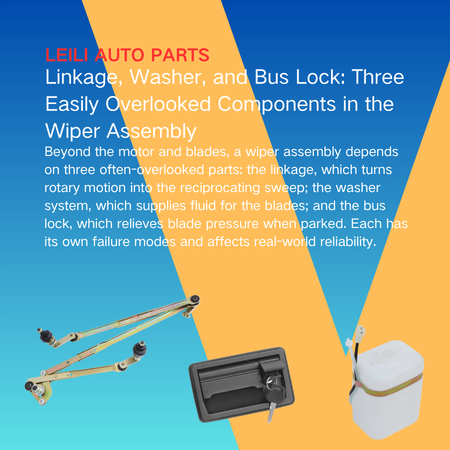
Long-haul selection needs more than just a good motor and blade. Three overlooked areas:
Connecting rod mechanism stroke matching
Bus windshields require adequate wiping coverage to meet relevant national standards. The linkage mechanism should provide sufficient sweep angle and coverage width to match the windshield dimensions of the target vehicle model.
Design of wiper arm tension force
Long-haul wiper arms need appropriate arm-end pressure. Too little causes lift; too much wears blades and motors.
Consideration of spare parts interchangeability
Using multiple incompatible blade types across a fleet raises spare parts inventory and maintenance costs. Choosing a design with good interchangeability helps reduce spare parts inventory.
Buying the parts separately is where long-haul fleets lose time, so LEILI quotes complete coach wiper systems with the linkage stroke and arm tension already matched.
About Us
Zhejiang Lei Li Auto Parts Co., Ltd. specializes in the research and development and manufacturing of bus wiper systems. Covers wiper systems for Yutong, Jinlong, BYD, and more – for transit, coach, school, and electric buses.
Related resources
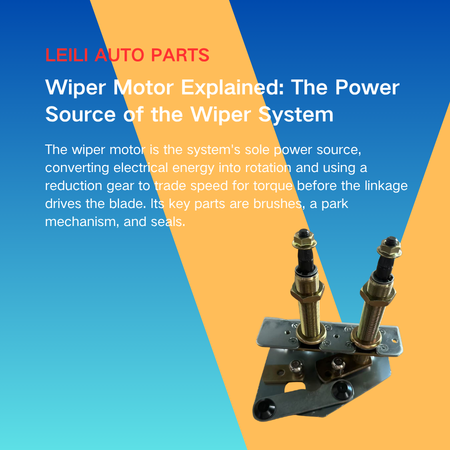
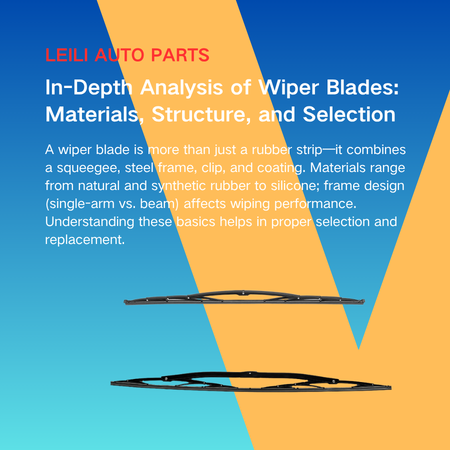
High-speed running punishes the motor and the blade first, so both are worth specifying together with the assembly:
.png)


