
I. Why Talk About Manufacturing?
Earlier discussions of wipers mostly start from the user end: how to choose, how to use, and how to judge when something goes wrong. But to understand why a wiper assembly lasts or doesn’t, it often helps to go back to the manufacturing stage.
With the same structure, selecting materials correctly and keeping processes under control—versus compromising on materials and cutting corners in production—may produce finished products that look much the same. Install them on a vehicle and run for two years, and the difference shows. The wiper assembly works in an environment of long-term sun and rain and frequent start-stop cycles, so any hidden risk in a single process step will be magnified over time.
II. How Each Component Is Made
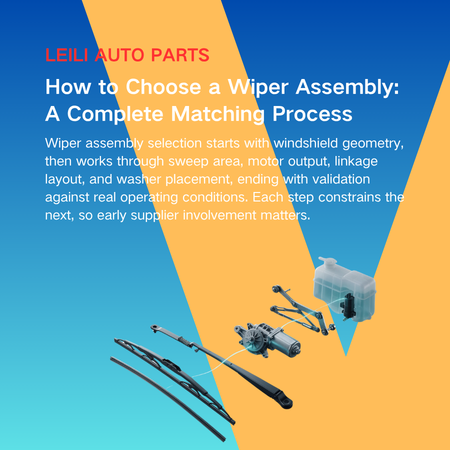
Motor: Windings, Assembly, and Sealing
Wiper motor manufacturing starts with winding the stator and rotor. The number of turns, winding layout, and tension directly affect output characteristics and running smoothness. Automated equipment usually handles this part. However, first articles and spot checks still require manual verification.
The wound stator and rotor then move to the assembly stage, where workers install the brush holder, commutator, and reduction gear set, and then encapsulate the housing. Housing sealing is a key process: the position of the seal rings, the press-fit force, and the amount of sealant all need control, because water ingress into the motor is one of the most common causes of failure.
After assembly, the motor usually undergoes a power-on test: no-load speed, current, noise, rotation direction, and parking function. Any abnormality must be intercepted before leaving the factory.
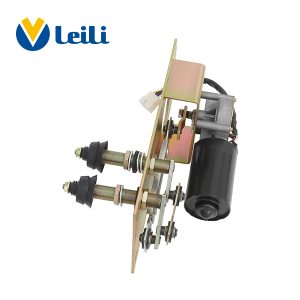
ZJC2631R/ZJC1631R 60W 12V/24 Wiper Motor
Wiper Arm: Stamping, Welding, and Surface Treatment
Manufacturers mostly stamp wiper arms. Workers cut the steel sheet, then run it through multiple stamping steps. These steps form the arm body and mounting features. Workers then join the sections by welding or riveting.
Surface treatment follows forming, usually electrophoretic coating plus painting. The purpose is not just appearance—more importantly, it is corrosion protection. Wiper arms sit outdoors for long periods, and if the coating has pinholes or missed areas, corrosion often starts at exactly those spots.
After surface treatment, workers check coating adhesion and film thickness, as these two factors directly affect weather resistance.
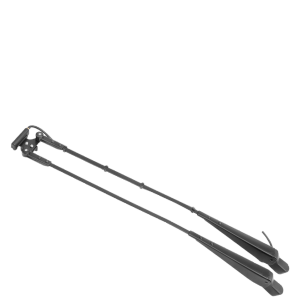
SG08-B Wiper Arm
Wiper Blade: Rubber Strip Extrusion, Frame Forming, and Assembly
Manufacturers form the rubber strip of a wiper blade by extrusion. After rubber mixing, the strip is continuously extruded through an extruder. It is then vulcanized and set, and finally cut to size.
The mixing stage determines the uniformity of the rubber compound. The vulcanization stage determines the rubber’s elasticity and hardness. Poor control of these two stages leads to uneven hardness. After installation, this shows up as wiper chatter and water marks.
For the frame, manufacturers stamp the steel strips of conventional wiper blades. The flexible steel strips of beam wiper blades need pre-forming to the curvature. Finally, workers assemble the rubber strip, frame, and clip, and perform a conformity check. They press the wiper blade onto a curved inspection fixture to see whether the entire rubber strip makes even contact.
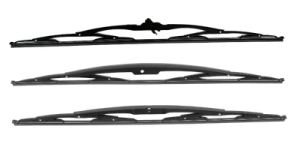
Windshield Wiper Blades
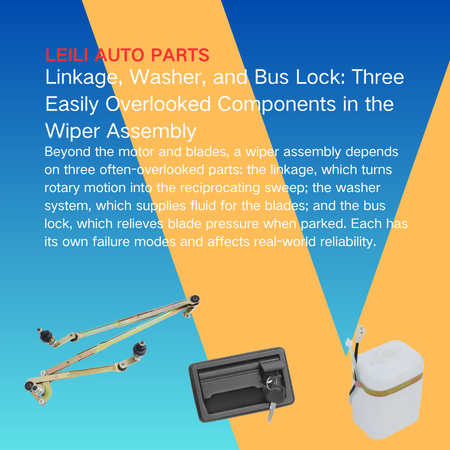
Linkage: Tube Forming and Ball Joint Assembly
The rod body of the linkage is mostly a tube or stamped part. Tubes need to be bent into shape according to the vehicle layout; the bend angle and position determine the wiper’s motion path, so dedicated fixtures are usually used for positioning.
The ball joint is a key assembly point. The force with which the ball stud is pressed into the socket needs to be controlled: too tight and rotational resistance is high, too loose and clearance and abnormal noise easily develop. After assembly, a swing force test and a water resistance check are generally performed.
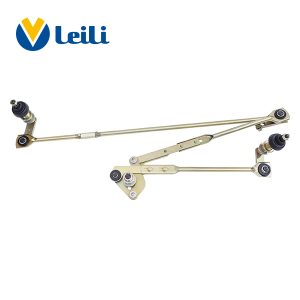
NLG-001 Wiper Linkage
Washer: Pump Assembly and Flow Rate Inspection
The washer pump consists of the pump body, impeller, motor, and seals. After assembly, inspection focuses on flow rate and sealing. It checks whether spray volume stays stable and whether the pump body leaks under pressure.
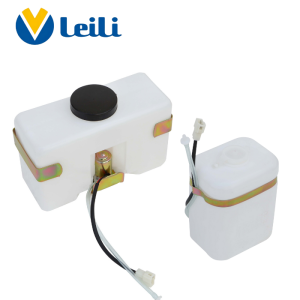
Washer Tank
Bus Lock: Mechanism Assembly and Durability Operation
The bus lock has a relatively simple structure, but it places high demands on the fit precision of the latch. After assembly, repeated open-and-close durability operations are required to confirm reliable locking, smooth unlocking, and no seizing.
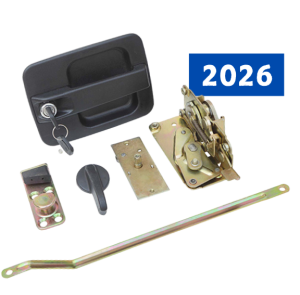
Bus Lock
III. Assembly: Details Determine Consistency
After all components are finished, they move to final assembly.
This step may look like simply putting the parts together, but assembly quality has a major impact on performance. Several key points:
- Installation phase of the linkage: the initial angular relationship between the crank and the linkage determines the synchronization of the left and right wipers and their parking position. An angular deviation during assembly directly shows up after installation as the wiper blade not reaching its intended sweep position or interfering with the other blade.
- Fastener torque control: too little torque causes loosening, while too much damages threads or causes deformation. Torque-controlled tools are usually used, with records kept.
- Lubrication of moving parts: the amount and type of grease used at ball joints, output shafts, and other points must be consistent. Too much overflows and attracts dust; too little accelerates wear.
- Routing and securing of tubing and wiring: washer tubing and electrical harnesses must be routed away from moving parts and high-temperature areas, with reasonable spacing between fixing points.
IV. Pre-Delivery Verification
After assembly is completed, products usually undergo two types of inspection before leaving the factory: unit-by-unit inspection and sampling verification.
Unit-by-unit inspection checks whether each individual product is qualified: power-on operation, whether the wiping action is normal, whether there is abnormal noise, whether parking is accurate, and whether spraying works properly. This type of inspection is fast and can catch obvious assembly defects.
Sampling verification focuses on batch consistency and long-term reliability: durability operation, high-low temperature cycling, salt spray corrosion, vibration testing, waterproof testing, and so on. This type of inspection is time-consuming and cannot be performed on every unit, but it can expose hidden risks caused by process fluctuations.
Neither can be dispensed with. Unit-by-unit inspection alone cannot catch batch-level process drift, while sampling verification alone cannot stop individual assembly errors.
V. Quality Control Focuses on Production, Not Inspection
A common misconception is that quality comes from inspection.
In reality, inspection can only screen, not improve. If the process parameters of a given step are themselves unstable, all inspection can do is pick out the nonconforming products, at the cost of lower yield and higher costs. Truly effective quality control focuses on fixing the parameters of each process step and keeping variation under control.
This is reflected in several aspects:
- Manufacturers must document the process parameters of key operations, and no one may adjust them arbitrarily when changing batches or operators.
- Workers must strictly carry out first-article confirmation to avoid batch-level directional errors.
- Manufacturers must control incoming materials from suppliers, especially rubber compounds and steel, because material variation is very difficult to correct in subsequent processes.
- Manufacturers must keep process data traceable so that when problems arise, they can trace them back to the specific batch and process step.
VI. What Does This Mean for OEMs?
As a supporting supplier, manufacturing capability ultimately has to show up in delivery: consistency between batches, stability of long-term supply, and the ability to quickly pinpoint the cause when problems arise.
For OEMs choosing a wiper assembly supplier, beyond product specifications and price, pay attention to how well the supplier understands its processes—whether it can clearly explain the key operations, where the control points lie, what problems have occurred, and how it solved them. These often reflect true capability better than a polished specification sheet.
VII. Conclusion
The manufacturing of a wiper assembly involves no particularly advanced individual technologies; the difficulty lies in the coordination and consistency across all stages. No matter how well a motor is made, if the linkage assembly phase is off, the overall system will still perform unsatisfactorily.
For vehicle models with high operating intensity, such as buses, construction machinery, and commercial vehicles, this consistency is especially important—they do not have much margin to accommodate fluctuations in the manufacturing process.


.png)