

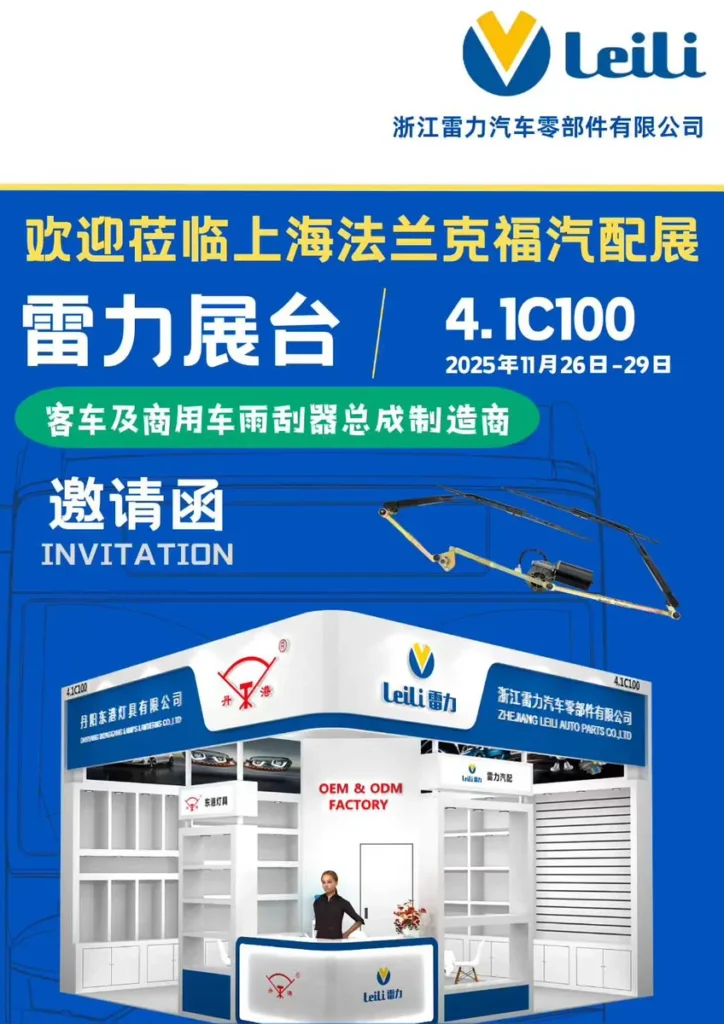
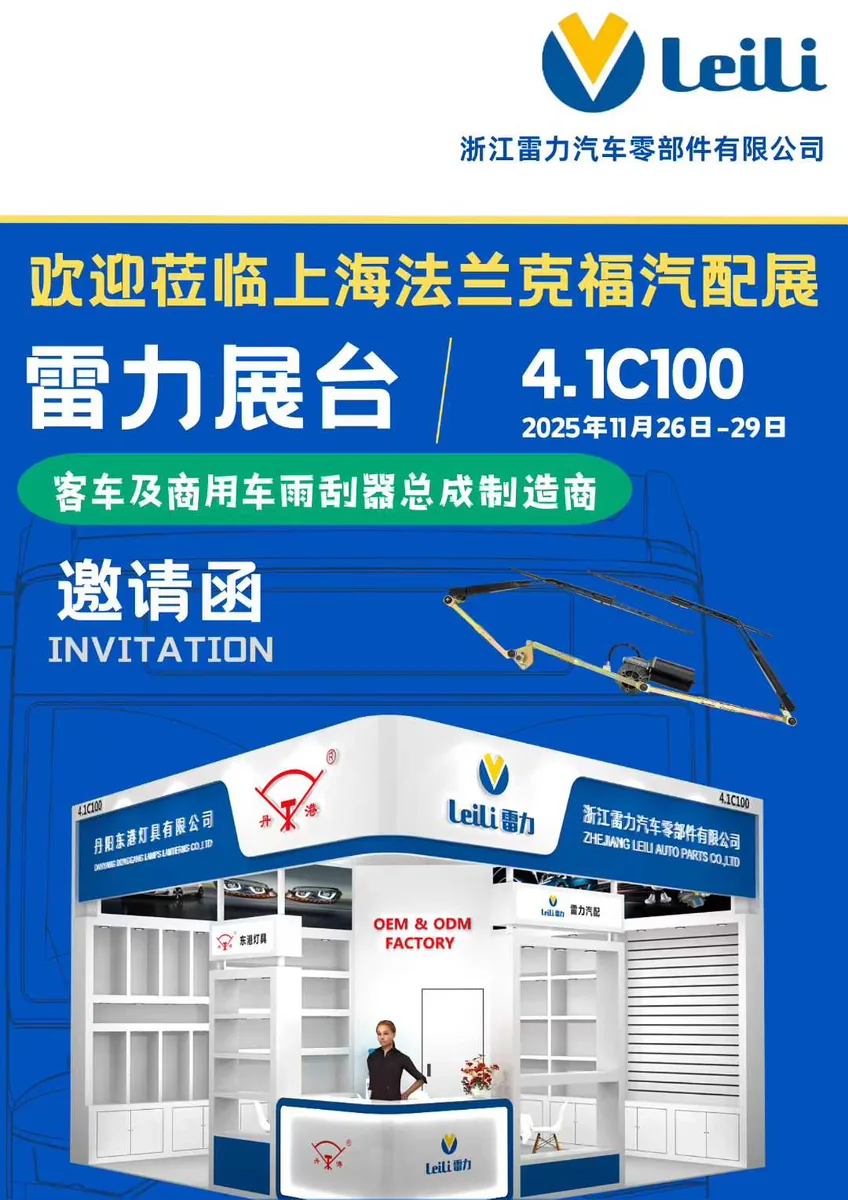
Shanghai, China — Zhejiang Leili Auto Parts Co., Ltd. (“LEILI”), a manufacturer of automotive windshield wiper systems and bus door locks since 1989, exhibited at Automechanika Shanghai 2025, held from 26 to 29 November 2025 at the National Exhibition and Convention Center (Shanghai). The company showed bus and coach wiper assemblies, wiper motors, linkage mechanisms and bus door locks at Booth 4.1C100.
A bigger show, and a different buyer mix
Messe Frankfurt (Shanghai) and China Machinery International Cooperation have staged this show every year since 2004, and it has always leaned towards the aftermarket — distributors, importers, workshop groups and channel buyers, not vehicle-maker project teams.
This edition filled 383,000 sqm across all 15 halls, 9% more than the year before, with 7,465 exhibitors from 44 countries (+10%) and 253,691 visitors from 190 countries (+14%). Two records, neither of them the one that matters to a component supplier.
Across the four days, engineering, R&D and purchasing staff from vehicle manufacturers and Tier 1 suppliers were present in clearly higher numbers than in 2024. The show’s sourcing pattern is shifting. Distribution still carries the volume, but forward-fit conversations have become a real part of the mix rather than a side current, and buyers now arrive able to talk about validation rather than only unit price.
For component suppliers that shift has teeth. A distributor asks whether you can ship. A vehicle maker asks whether you can hold steady — whether you validated the part, whether you control the process, and whether batch four hundred behaves like batch one.
None of those three can be bought. They take years inside a factory, so a fuller hall does not mean more business for everybody in it — each supplier still has to clear the bar on its own.
Sector-level change pointed the same way. The new-energy and intelligent connected vehicle zone and the tyres and wheels zone each grew by around 50%. The parts and components zone grew 10%. Roughly 40% of exhibitors brought products or solutions applicable to new-energy vehicles, and commercial vehicle content continued to expand.
A wiper maker now has to run two product logics at once. The existing parc needs replacement units built to the same mounting points and electrical specification as the parts being taken off. New platforms arrive with different screen curvature, different low-voltage behaviour under regenerative load, lower noise targets and tighter weight budgets — and they arrive long before the old parc has retired.
How this edition compared with 2024
LEILI also exhibited at the 2024 edition of Automechanika Shanghai, which makes the year-on-year picture easy to set out:
| Measure | 2024 | 2025 |
|---|---|---|
| Exhibition area | 350,000 sqm (14 halls) | 383,000 sqm (15 halls) |
| Exhibitors | 6,763 from 40 countries | 7,465 from 44 countries |
| Visitors | 222,341 from 181 countries | 253,691 from 190 countries |
| Overseas share of visitors | 28% | 28% |
| Concurrent events | 81 | 94 |
Every headline figure grew. Visitor numbers rose by more than 31,000 while the overseas share held flat at 28%, which is the number to watch if your interest is export rather than domestic replacement.
Sources: Automechanika Shanghai 2025 official closing report (PDF)
Exhibition facts
Four days, 26–29 November, at the National Exhibition and Convention Center (Shanghai). All 15 halls were open and 94 fringe events ran around the floor.
- Official name: Automechanika Shanghai 2025 — Shanghai International Trade Fair for Automotive Parts, Equipment and Service Suppliers
- Dates: 26–29 November 2025
- Venue: National Exhibition and Convention Center (Shanghai)
- Organisers: Messe Frankfurt (Shanghai) Co., Ltd.; China Machinery International Cooperation Co., Ltd.
- Scale: 383,000 sqm across 15 halls; 7,465 exhibitors from 44 countries; 253,691 visitors from 190 countries
- Concurrent programme: 94 events, more than 450 speakers
- Zone changes: new-energy / intelligent connected vehicle zone and tyres / wheels zone each expanded by around 50%; parts and components zone +10%
- LEILI stand: Booth 4.1C100
Sources: Automechanika Shanghai 2025 official closing press release
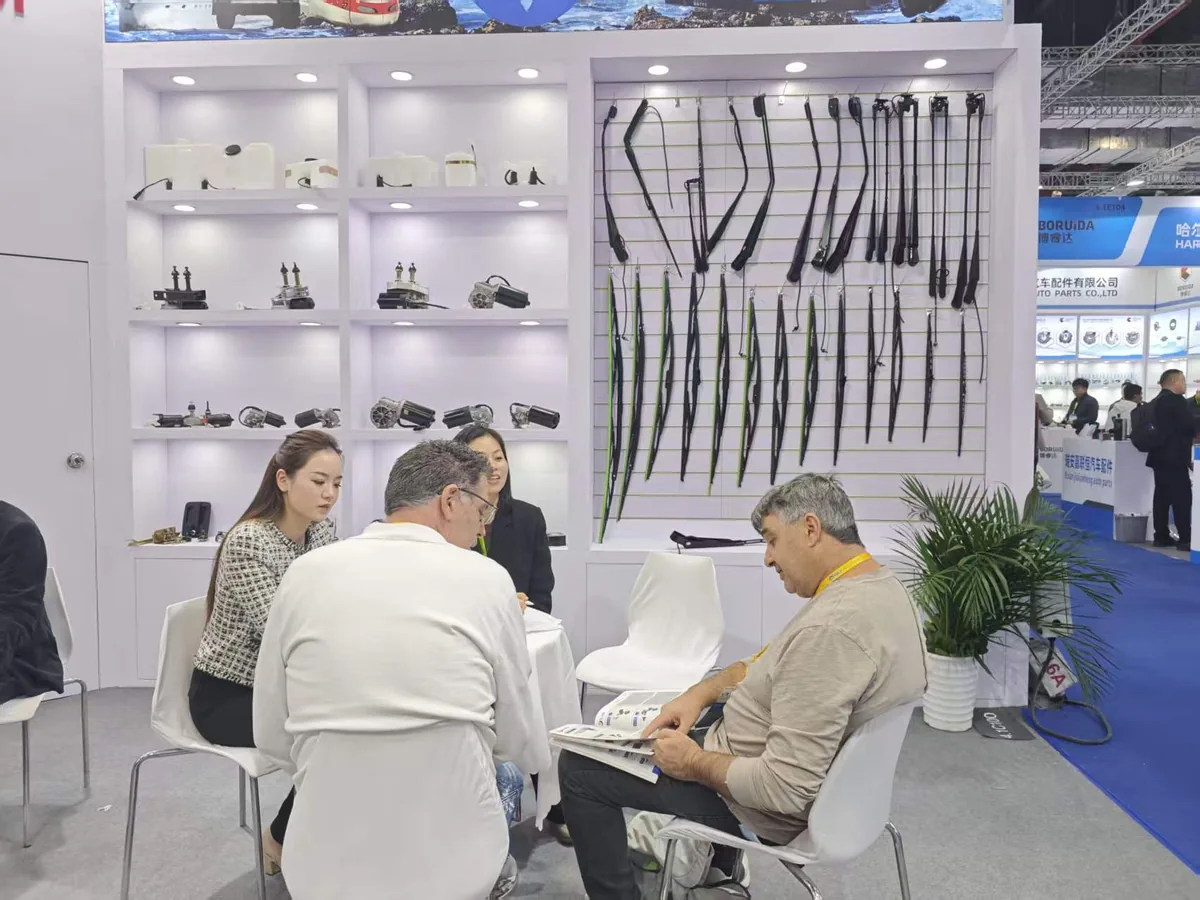
LEILI at Booth 4.1C100: bus wiper systems for OE programmes
A second year changes the job. In 2024 the stand had to establish what the company makes. In 2025 it started from a list of programmes already moving, and the four days were spent pushing them forward.
The layout followed one rule: put the parts we can document at the front. Anything LEILI could support with drawings, design verification (DV) data or process records stood where it could be reached and argued over. Anything self-explanatory went to the back row.
What we brought this year
- Bus wiper assemblies in five layouts — opposed overlapping, opposed upright, tandem integral, tandem split and single-arm — each carrying its own set of DV data
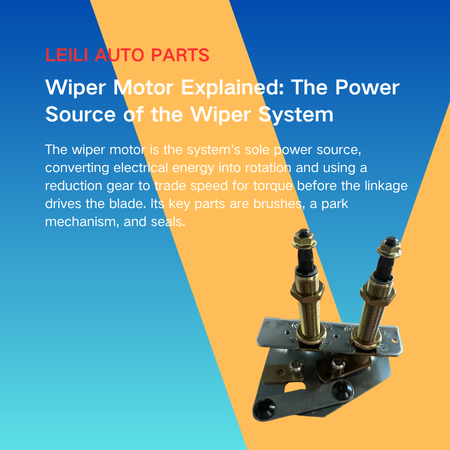
- Permanent-magnet two-speed DC wiper motors, 30 W–180 W, in 12 V and 24 V versions, with life-test records and batch consistency records laid alongside the samples
- Wiper linkage mechanisms presented as a selection table rather than as samples, centre distances from 400 mm to 2,000 mm
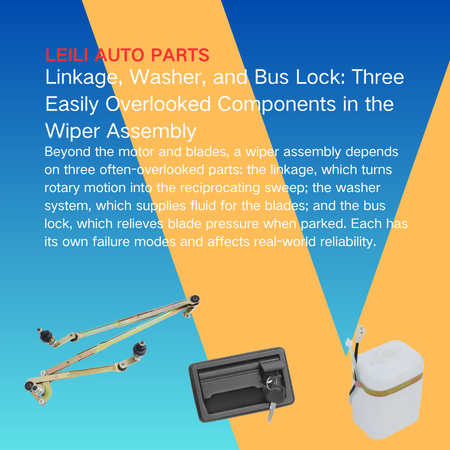
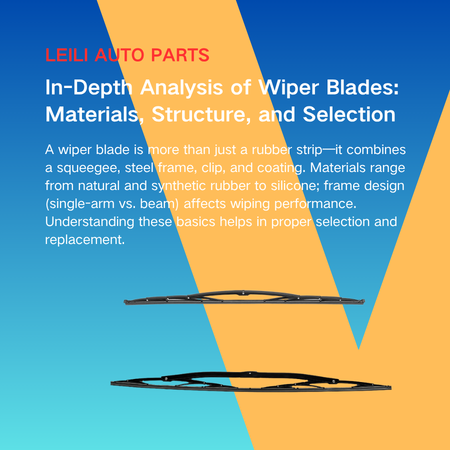
- Wiper blades from 400 mm to 1,000 mm, washer systems, wiper arms and bus door locks along the back row
Almost nothing on that stand was new. What was new was the paperwork attached to it, and the fact that staff could be sent to fetch a record rather than to promise one later.
Why the order matters
A distributor walks a stand looking for coverage: models, carton quantities, price breaks. A vehicle-maker’s engineer walks the same stand looking for evidence, and reads it in a fixed sequence. Drawing first, because there is no conversation at all without interface dimensions. Then data. Then the process that produced the data.
Arranging the booth in that sequence does two useful things. It lets a technical visitor work through their own checklist without waiting to be shown anything, and it makes plain within half a minute which products have documentation behind them and which do not. If what you are selling is process, not printed panels, this is the honest way to lay a stand out.
Two certificates sit behind this stand: ISO 9001 and IATF 16949. On the OE side LEILI runs programmes for Yaxing (Yangzhou), Youngman (Jinhua), King Long (Xiamen), Dongfeng Xiangyang and FAW Bus Dalian, and ships to Southeast Asia, Europe and the Americas. Buyers writing a specification from scratch may find our guide to selecting commercial vehicle wiper systems useful before they start talking to suppliers, and the truck brand matching matrix sits in the same catalogue.
What visitors asked
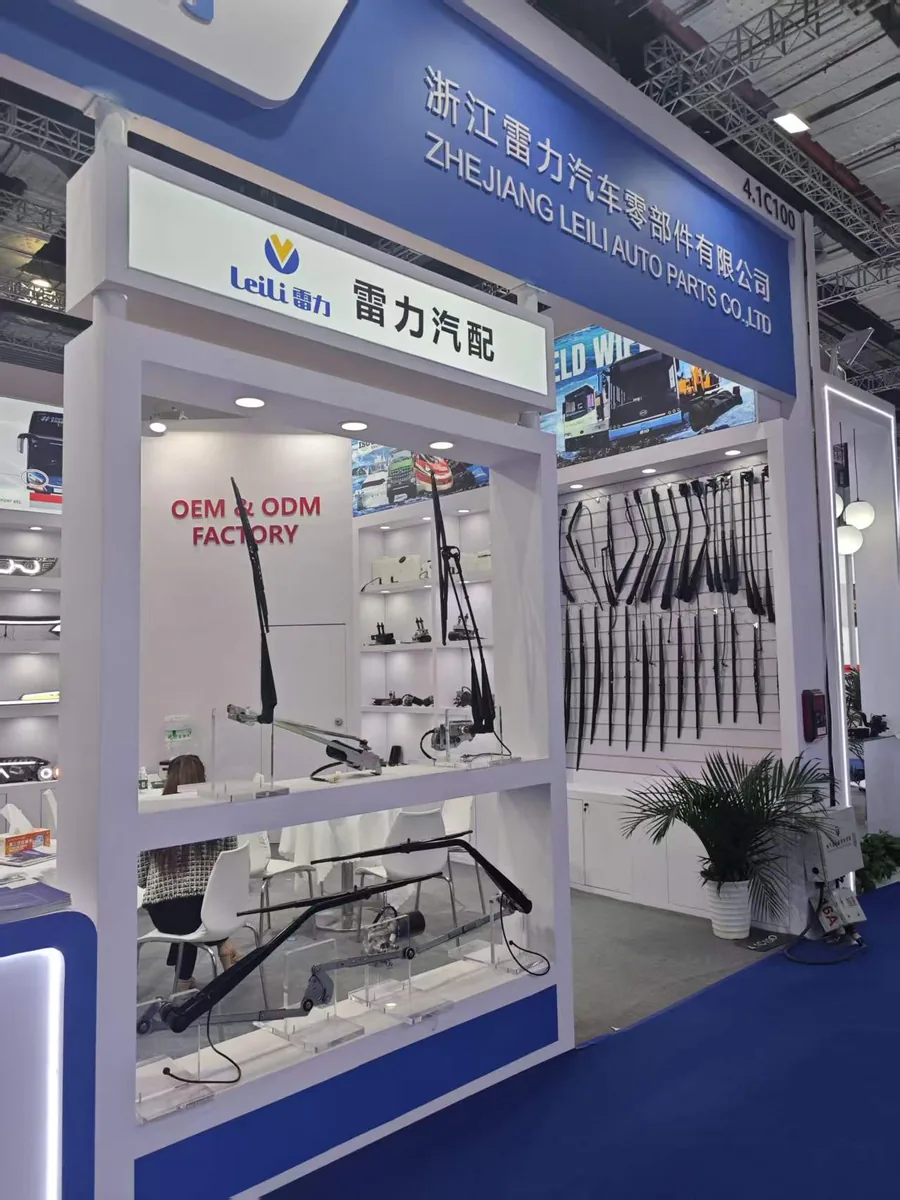
The most frequent face at Booth 4.1C100 was not a new one. Return visitors outnumbered first contacts: people who had taken samples in 2024 and came back with results, a mounting problem, or the question they had not thought to ask the first time.
Motor life validation
The question was never how many watts. It was how LEILI knows. Buyers from vehicle manufacturers opened with the endurance run behind the 30 W–180 W range — cycle count, load condition, pass criterion, and whether the motors on the rig came off the same line as shipped parts. Several then asked what the numbers do when supply voltage sags, which on a long coach harness at idle is not a hypothetical.
Blade endurance
Rubber came up more often than blade geometry. How the compound behaves after extended dry-wipe running, how wiping performance decays toward the end of service life rather than at the start, and one question that only an OE buyer tends to ask: whether every length in the 400 mm–1,000 mm range uses the same specification. Same compound across the range means one validation exercise instead of six.
Batch consistency
This one arrives late, usually in the third round, and it is the question that decides whether a discussion becomes a programme or quietly ends. Why does this batch match the last one? Answering it means describing the process — control points, retained records, traceability by batch, and what happens when a measurement drifts out of window — not repeating a certificate number.
Underneath all three sits a change LEILI noticed across the four days. Buyers were not testing whether an order could be placed cheaply once. They were testing whether a supply relationship could be run for years without surprises. Documentation is how that test gets administered, which is why the second year’s preparation went into files rather than finishes.
The samples back that up. Visitors who had taken a motor away the year before did not come back to place an order; they came back with questions about it, and the questions were harder than the ones asked the first time. That is slower than distributor business, and it is why forward-fit work takes more than one fair to produce anything.
Reach of the expo
253,691 visitors from 190 countries attended across the four days, with 28% arriving from overseas. The fringe programme ran to 94 events and more than 450 speakers, which kept technical visitors on site rather than passing through in half a day.
The show kept its Innovation4Mobility, Tuning x Tech and Green Workshop zones alongside the International Automotive Industry Summit. Each pulls a different slice of the trade. Together they explain why visitor numbers now grow faster than floor area: buyers come for the programme as much as for the stands.
LEILI’s recent calendar also took in the bauma SHANGHAI construction fair, the 5th Wenzhou auto parts expo and Automechanika Tashkent 2025. The Tashkent report covers a market several stages earlier in channel development, where the first question is still which models you cover.
Closing
Three things, in order: get the samples validated, agree terms for whatever passes, and bring the programmes that reach that stage to Pingyang for an audit. Voltage headroom, noise and weight came up in nearly every new-energy conversation at Automechanika Shanghai 2025. All three are on the drawing board for the next iteration of the bus wiper systems.
Yang Hao, spokesperson for Zhejiang Leili Auto Parts Co., Ltd., said: “The plainest sign of doing this twice is that more people came back. Someone took a sample from our stand in 2024 and returned with questions about it, which tells you they actually tested it. In this trade the honest measure of progress is not how many new people you meet. It is who comes looking for you a second time — and whether you can answer what they ask once they have.”
About Zhejiang Leili Auto Parts Co., Ltd.
Founded in 1989 as Pingyang Automobile Wiper Factory and based in the Yuyang Industrial Zone of Pingyang, Zhejiang, LEILI operates a 13,000 sqm facility and has spent more than three decades on two product lines: electrical windshield wiper systems and bus door locks. The company is certified to ISO 9001 and IATF 16949 and supplies both OE and aftermarket customers. Website: leiliautoparts.com. Further reading: lifecycle management guide for commercial vehicle windshield wiper systems.