
I. Why does the windshield wiper motor of the bus need high-grade protection?
Compared with passenger cars, the working conditions of the windshield wiper motor for buses are much more severe:
| scene | Risk characteristics | Direct threat to the motor |
|---|
| Bus daily washing | High-pressure water gun (615 MPa) multi-angle spraying, 12 times a day | Water infiltrates through the gap at the shaft end and the connector. |
| Driving in heavy rain | Continuous heavy rain for 1 to 3 hours, water in the front fence board soaking | The motor casing is in a state of high humidity or even semi-immersion for a long time. |
| Water-crossing section | The depth of water accumulation is 200~5mm, and the water level may submerge the motor installation position in an instant. | Short-term complete immersion, water pressure directly acts on the sealing surface |
| Coastal / Salt Fog | The high-salt mist air corrodes it all year round. | Seals accelerate aging, electrochemical corrosion of metal shells. |
Ordinary commercial electric motors only meet the IP54 (splash-proof) protection, which can hardly guarantee long-term reliability in the above scenarios. Therefore, what the bus operator needs is a wiper motor that meets the IP67 or even IP68 standard. For example, the former can withstand 1-meter water depth for 30 minutes, and the latter can continue to work in deeper water. Consequently, this is the real protection standard that matches the all-weather operation requirements of the bus. In short, only such high-level protection can ensure dependable performance in real-world operations.
II. Analysis of the IP Protection Level System: Engineering Meaning Behind the Numbers
The IP code defined by the IEC 60528 standard consists of two digits. The first digit represents the level of dust resistance (0~6), and the second digit represents the level of water resistance (0~9K). For the bus wiper motor, the key watershed is the three levels of IP65, IP67, and IP68:
| Protection class | Dust-proof ability | Waterproof ability | Bus scene adaptation judgment |
|---|
| IP65 | Completely dust-proof (IP6X) | Low pressure water spray (6.3mm nozzle, 12.5L / min) | It can handle heavy rain and general flushing, but it cannot guarantee water safety. |
| IP67 | Completely dust-proof (IP6X) | 1 meter water depth / 30 minutes immersion | Coverage of bus daily washing + heavy rain + regular water immersion three-layer needs |
| IP68 | Completely dust-proof (IP6X) | Manufacturer specified depth/time (usually >1m) | Extreme flood environment, long-term immersion operation |
From IP65 to IP67, it seems that only one level has been crossed, yet the difficulty of engineering implementation has increased exponentially. Specifically, IP65 only needs to block the directed jet of water, and the sealing design focuses on “blocking”; however, IP67 requires that the static water pressure be able to withstand, and the seal must be upgraded from “barrier” to “seal” – as a result, any small leakage channel will be quickly penetrated by the static water pressure of 1 meter depth.
III. Multi-layer sealing structure: five lines of defense for the bus wiper motor
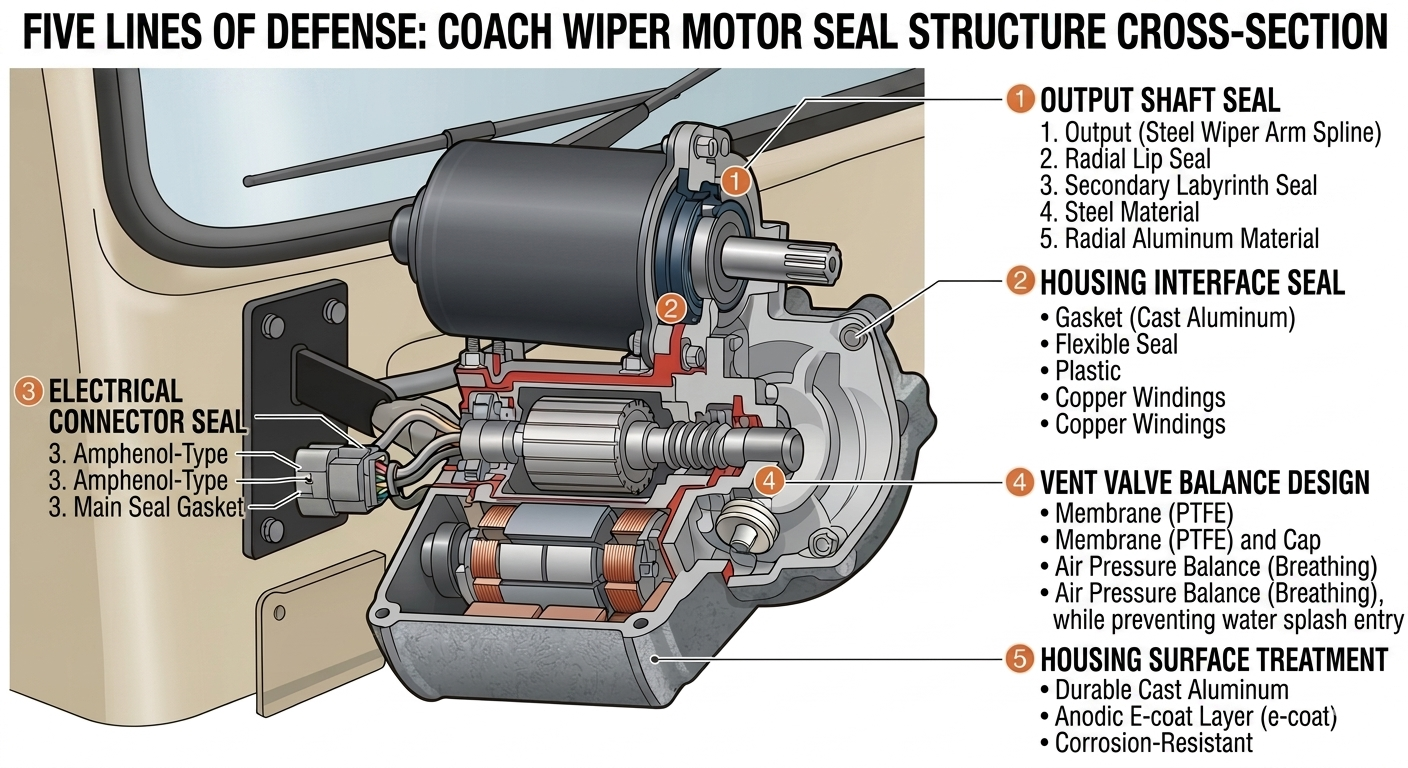
Reaching the IP67/IP66 protection level is not achieved by a single sealing ring, but by a complete multi-layer sealing system. Taking the Zhejiang Lei Li bus windshield wiper motor product as an example, its sealing structure includes five key nodes:
First line of defense: output shaft seal
The output shaft is the hardest part to seal. Leili’s bus motor uses a dual-layer oil seal: an outer FKM main lip (﹣40°C to +120°C) and an inner dust lip. The nitrided shaft surface (HRC60+) prevents wear, and water-resistant grease between the seals provides backup protection if the outer layer fails.
Second line of defense: shell joint surface sealing
The end cover and casing joint use an O-ring groove with a silicone rubber seal (±0.05mm tolerance). Under bolt preload, it forms uniform surface pressure. Unlike traditional gaskets, O-rings resist gaps from thermal cycling.
Third line of defense: electrical connector sealing
The power and signal connectors of the bus wiper motor are high-risk points for water intrusion – water can seep through the capillary gap between the inner core of the conductor. Lei Li products use IP67-grade waterproof connectors, with radial sealing rings embedded in the mating surface and cable sealing sleeves at the end, forming a double seal of “mating surface + cable end”. Some models are filled with sealant inside the connector to completely block the capillary penetration path.
The fourth line of defense: the balanced design of the breathable valve
In the temperature cycle of running and cooling, the internal pressure of the sealed motor will change violently, which will accelerate the fatigue of the seal. To address this, the solution is to install a waterproof and breathable valve (also known as a breathing valve) on the shell – using expanded polytetrafluoroethylene (ePTFE) microporous membrane, the pore diameter is about 0.2 ~ 1μm, allowing gas molecules to pass through while blocking liquid water droplets. As a result, the breathable valve balances the pressure inside and outside the motor while maintaining the IP67/IP69K waterproof level.
The fifth line of defense: surface treatment of the shell
Even if the sealing is done well, it will be in vain if the shell itself is corroded and perforated. To address this, the bus motor casing of Leili adopts ADC12 aluminum alloy die-casting, and the outer surface is treated with Dacromet coating, which can withstand more than 480 hours of neutral salt spray test. Meanwhile, the cast iron end cover adopts a double-layer anti-corrosion system of cathode electrophoresis primer + polyurethane top coat, ensuring a shell life of more than 10 years in coastal areas with high salt fog.

motor
IV. Wiper Motor – Logical Selection of Key Sealing Materials
The selection of sealing materials directly affects the durability of the protection level.The bus wiper motor seal needs to withstand water, washing liquid (pH up to 13), ozone, ultraviolet rays, and temperature cycles of -40°C to 120°C at the same time:
| Material Science | Applicable temperature | waterproof | Evaluation of the bus scene |
|---|
| Nitrile rubber (NBR) | -30℃~100℃ | good | Low cost, insufficient elasticity at low temperature, not suitable for northern bus |
| Hydrogenated nitrile butadiene rubber (HNBR) | -40℃~150℃ | excellent | It has excellent comprehensive performance and is the mainstream choice for bus motors. |
| Fluorocarbon rubber (FKM) | -20℃~200℃ | excellent | Excellent high-temperature performance, special formulation is required for low-temperature elasticity, suitable for output shaft sealing |
| Silicone rubber (VMQ) | -60℃~200℃ | good | Low temperature elasticity is the best, suitable for O-ring static sealing. |
In the dynamic sealing position, the wiper motor adopts HNBR or FKM, and in the static sealing position, it adopts VMQ silicone rubber. Different selection is made according to the temperature, motion state and medium conditions of different nodes, and no compromise design of “one material to eat” is made.
V. From the laboratory to actual operation: sealing reliability verification
IP67/IP 68 is not designed, but tested. The sealing verification of Zhejiang Lei Li bus wiper motor follows the standard QC/T 29100-2017 “Automotive Wiper Motor” and ISO 16752 series environmental test standards, and the core test items include:
After 30-min IP67 immersion (1m), insulation ≥1MΩ (DC 500V), and motor must start normally.
-40 ℃ (2 hours) ↔ 8 5 ℃ (2 hours), 1 0 0 0 cycles, sealing ring compression permanent deformation rate ≤25% after test
Simulate bus washing: 12.5L/min at 6.3mm nozzle, spraying from all angles for 15 minutes.
After 96h NSS salt spray (ISO 9227) plus immersion test, simulating coastal bus conditions.
VI. Key Judgment Indicators for the Procurement End
For the procurement decision-makers of the bus group and bus operation enterprises, when evaluating the waterproof performance of the wiper motor, they should pay attention to the following verifiable technical parameters, rather than relying solely on the supplier’s promotional rhetoric:
Require the supplier to provide an IP67/IP66 test report issued by a CNAS-accredited laboratory, rather than an internal self-test declaration.
HNBR or FKM is superior to ordinary NBR; Formulations from well-known material suppliers (such as DuPont and LANXESS) have better quality assurance.
The sealing life of the motor with waterproof and breathable valve is significantly longer in actual operation.
Suppliers who dare to include "water damage" in the warranty scope have real confidence in their sealing technology.
It is a common fault point that the axle end of the bus in the north freezes after washing in winter. The axle end heating melting ice device provided by models such as Lei Li ZD2735 can thaw and start in 5 minutes in an environment of -25 ℃, which is an effective extension of the waterproof design.
About Us
ZHEJIANG LEILI AUTO PARTS CO.,LTD has specialized in bus wiper systems for over 20 years, covering all components and major bus brands with international certifications. Its product line supports various segments, from urban buses to airport shuttles.

You might also enjoy

In-depth analysis of the bus wiper motor’s waterproof and dustproof function: from bus daily washing to sealing the line of defense in heavy rainwater

Common Problems and Solutions for Bus Wiper Motors – A Practical Technician’s Guide


.png)