



In the commercial vehicle sector—whether long-haul heavy trucks, city buses, or mining construction machinery—visibility safety remains a top concern for fleet managers and drivers alike. Notably, unlike passenger cars, commercial vehicles cover longer distances, operate in more complex conditions, and face harsher environments. As a result, any failure in the windshield cleaning system—specifically in the washer tank (also known as the windshield washer reservoir or washer fluid bottle)—can lead to serious accidents.
Specifically, the washer tank (also referred to as windshield washer reservoir, washer fluid bottle, or simply washer reservoir) serves as the core component of the windshield cleaning system. In fact, its structural design directly determines the system’s reliability, durability, and ease of maintenance.
As a result, choosing a high-quality fluid tank is essential for commercial vehicle safety. For this reason, Zhejiang Leili Auto Parts Co., Ltd., a professional manufacturer of commercial vehicle components, has been deeply involved in this field for many years. In this article, we provide a detailed analysis of the washer tank’s structure, functions, common failures, and selection guidelines—all from a commercial vehicle perspective—to help users better understand and maintain this critical safety component.
📖 Table of Contents – Washer Tank Guide
- 1. What is a Commercial Vehicle Washer Tank?
- 2. Structural Breakdown of the Commercial Vehicle Washer Tank
- 3. How It Works: From Tank to Windshield
- 4. Key Functions: Why Commercial Vehicles Need a Reliable Washer Tank
- 5. Common Failures and Cause Analysis
- 6. Selection & Maintenance Guidelines
- 7. Zhejiang Leili: Professional Design & Manufacturing of Commercial Vehicle Washer Tanks
- 8. Conclusion
1. What is a Commercial Vehicle Washer Tank?
The washer tank is the container that stores washer fluid (windshield washer solvent) in a commercial vehicle’s cleaning system. Specifically, its purpose is to reliably supply an adequate volume of cleaning fluid to the windshield whenever the driver activates the system, thereby enabling the wipers to remove mud, insect residue, dust, oil, and other vision‑obstructing debris. In contrast, compared to passenger cars, commercial vehicle washer tanks are designed with a focus on large capacity, high strength, and modularity to withstand demanding operating conditions. As a result, they are built to endure harsher environments and longer service intervals.
2. Structural Breakdown of the Commercial Vehicle Washer Tank
A commercial vehicle washer tank(also known as a windshield washer reservoir or washer fluid bottle) is far more than a simple plastic container—in fact, it is a precision assembly integrating multiple functional modules. Below, we break down its core structural components:
2.1 Washer Tank Body (Fluid Reservoir)
To begin with, the tank body forms the "skeleton" and stores fluid.
In terms of material, most tanks use HDPE or reinforced nylon. For example, HDPE resists cold and chemicals, whereas nylon adds rigidity and heat resistance.
As for features, first, semi-transparent design allows visual checks. Second, ribs prevent cracking from vibration. Third, multi-chamber designs reserve fluid for emergencies.
Regarding capacity, commercial washer tanks range from 5L to 12L. In particular, heavy trucks and buses often use 8L or larger.
2.2 Washer Tank Cap (Sealing & Venting)
- Although small, the cap is critical for system integrity. For example, the rubber seal prevents fluid splash and blocks contaminants. Meanwhile, the one‑way vent valve maintains pressure equilibrium, thereby preventing vacuum lock.
2.3 Washer Pump (Power Core)
The washer pump serves as the "heart," pressurizing and delivering fluid. For example, it mounts via snap‑fit or thread with a rubber O‑ring seal.
In terms of structure, a 12V or 24V DC motor drives an impeller at high speed. Meanwhile, the inlet draws fluid from the tank, and the outlet sends it to the hose.
Regarding commercial needs, due to large windshields and high speeds, dual pumps or high‑flow single pumps are often used. As a result, coverage is ensured even on highways.
2.4 Level Sensor (Intelligent Monitoring)
Modern commercial vehicles often include a level sensor to alert drivers of low fluid. For instance, the float type uses a magnet and reed switch to trigger a warning when fluid drops.
Alternatively, the electrode type relies on fluid conductivity. Specifically, two electrodes extend into the tank; when fluid falls below them, the circuit opens and triggers the alert.
As for the electrical interface, a 2‑pin or 3‑pin connector links the sensor to the wiring harness. Consequently, the warning signal reaches the instrument cluster.
2.5 Hose Ports & Strainer
- Fill port: Located at the top of the tank; some models incorporate a strainer to filter out debris during refilling.
- Outlet & return ports: The pump mounting hole serves as the outlet; some designs include a return port for excess fluid recirculation.
- Hose connectors: Quick‑connect or barbed fittings facilitate easy assembly and maintenance.
2.6 Mounting Structure
The tank is fixed to the vehicle body via brackets or mounting ears.
- Mounting ears: Integral with the tank body, often reinforced with metal inserts to enhance strength and prevent loosening under vibration.
- Vibration damping: Some commercial tanks feature rubber dampers at mounting points to absorb road vibrations and protect the tank and pump from fatigue.
3. How It Works: From Tank to Windshield
Typically, the operation of a commercial vehicle windshield cleaning system follows these steps:
- Driver activation: To begin with, the wiper/washer control stalk is pulled or rotated.
- Electrical signal: The control unit sends power (12V or 24V) to the washer pump.
- Pressurization: The pump motor starts, the impeller spins rapidly, drawing washer fluid from the tank and pressurizing it through the outlet hose.
- Spray pattern: Next, the fluid is ejected through multi‑hole fan nozzles, thereby delivering even coverage across the large windshield area.
- Wiper operation: At the same time, the wipers sweep across the glass, using the fluid to lubricate and remove dirt.
4. Key Functions: Why Commercial Vehicles Need a Reliable Washer Tank
Undoubtedly, commercial vehicles operate in far more demanding conditions than passenger cars. Consequently, the structural reliability of the washer tank directly impacts performance in extreme situations.
- Visibility under severe conditions: For instance, highways, mines, construction sites, and rural roads expose windshields to mud, dust, and insect splatter. Therefore, a large‑capacity tank paired with a high‑flow pump ensures drivers can maintain clean vision even during extended periods in harsh environments.
- Long‑haul endurance: Moreover, for long‑distance trucking, a single trip may span multiple climate zones. As a result, an 8L or larger tank with robust sealing reduces the need for frequent refills, thereby improving operational efficiency.
- Extreme climate adaptability: In particular, in winter, northern routes or high‑altitude areas demand freeze‑resistant components. Accordingly, HDPE material combined with reinforcing ribs helps resist cracking caused by frozen fluid expansion.
- Lower fleet maintenance costs: Furthermore, a modular design integrating pump and sensor allows faster replacement when service is needed, thereby minimizing vehicle downtime.
5. Common Failures and Cause Analysis
Based on structural components, the most frequent issues with commercial vehicle washer tanks and their root causes are:
| Symptom | Possible Cause | Component Involved |
|---|---|---|
| Weak spray or no spray | Worn impeller, pump clog, motor burned out | Washer pump |
| Rapid fluid level drop | Cracked tank body, leaking hose connection, worn cap seal | Tank body, hose ports, cap |
| Unusual pump noise or silence | Foreign object in pump, bearing wear, dry running damage | Washer pump |
| Low‑level warning malfunction | Stuck float, magnet dislodged, sensor wiring fault | Level sensor |
| Leakage at fill port | Clogged strainer causing overflow, cap not tightened | Fill port, cap |
Among these, tank cracking is a common winter failure in commercial vehicles, often caused by using non‑freeze‑resistant fluid or insufficient low‑temperature material properties. Reinforcing ribs and high‑toughness materials are critical to preventing such failures.
6. Selection & Maintenance Guidelines
Selection Criteria (For Fleets & OEMs)
When selecting a washer tank, capacity match is key. For example, heavy tractors should use 8L or larger tanks.
In terms of material quality, prioritize HDPE or reinforced nylon. As a result, you get better durability and temperature resistance.
Regarding pump performance, ensure sufficient flow and head. Also, match the vehicle's voltage—either 12V or 24V.
For sensor reliability, reed-switch type sensors are recommended. Specifically, they offer high accuracy and low false-alert rates.
Finally, consider modular integration. Choose assemblies that integrate pump, sensor, and multiple hose ports for easier installation and service.
Maintenance Tips
- Check fluid level regularly: Use the semi‑transparent tank body to inspect before each trip.
- Seasonal fluid change: Use summer formula in warm months; switch to a freeze‑resistant fluid rated for your region’s winter temperatures.
- Clean strainer and nozzles: If flow is weak, inspect the fill port strainer and gently clear nozzle openings with a fine needle.
- Listen to pump operation: Unusual noises or silence during activation indicate a problem; address immediately to prevent dry‑run damage.
- Inspect hoses and connections: Look for aging, cracking, or loosening, especially at quick‑connect fittings. When a tank, pump or level sensor does have to be replaced, LEILI supplies windshield washer tanks and pumps sized to the original mounting points.
7. Zhejiang Leili: Professional Design & Manufacturing of Commercial Vehicle Washer Tanks
As a core product line of Zhejiang Leili, our commercial washer tank series is designed specifically for heavy trucks, buses, and construction machinery.
In terms of structural advantages, we use OE-quality HDPE or PA6+GF for extreme temperature and aging resistance. Additionally, CAE-optimized ribs improve impact and freeze-burst resistance.
Moreover, selected models feature dual-chamber design for emergency fluid reserve. Likewise, metal-insert mounting ears prevent loosening under vibration.
For modular integration, optional 12V/24V high-flow pumps and reed-switch level sensors are available. As a result, each unit undergoes rigorous testing from -40°C to +85°C for long-term reliability.
In short, we understand that in commercial vehicles, reliability equals efficiency, and visibility equals safety. Therefore, Leili is committed to high-quality cleaning solutions that help ensure every journey arrives safely.
8. Conclusion
Related resources
The tank is only one part of the washing circuit — the nozzle and the rest of the system decide whether the screen actually clears:
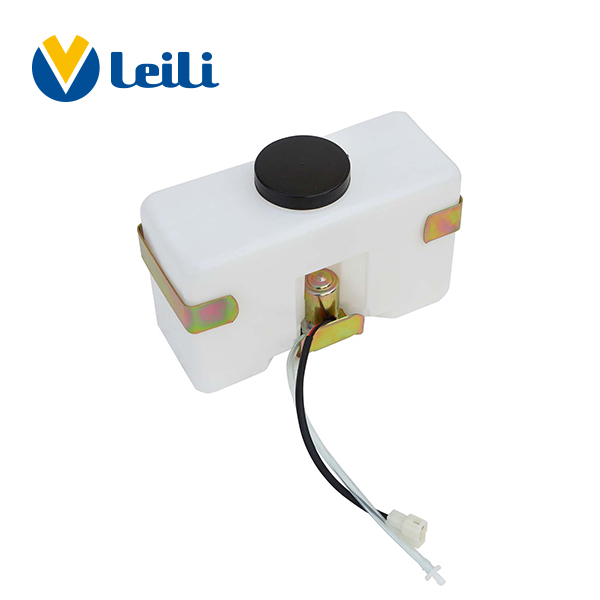
10L Washer Tank – 12V / 24V Optional
This 10L washer tank is designed for vehicles that require a larger fluid supply, such as trucks, buses, and industrial equipment. Available in 12V or 24V configurations to match your system. Durable construction resists leaks and cracking, ensuring reliable operation in all weather conditions.
2L Rectangular Washer Tank – 12V / 24V Optional
This 2L rectangular washer tank is ideal for compact vehicles or installations with limited space. The square shape allows for easy mounting against flat surfaces. Choose between 12V or 24V pump configuration. Made from durable, crack-resistant plastic for long-lasting use.
1.5L Irregular Flat Washer Tank – 12V / 24V Optional
This 1.5L irregular flat washer tank is designed to fit into tight, awkward, or curved installation areas where standard tanks won't work. The low-profile, custom-molded shape maximizes space efficiency. Available with 12V or 24V pump options. Ideal for custom builds, classic cars, or engine bays with limited clearance.

.png)


