
How to choose a commercial vehicle wiper motor? Decomposition of 4 major core parameter technologies

wiper blade guide

1. Why is the wiper motor the “heart” of commercial vehicle safety systems?

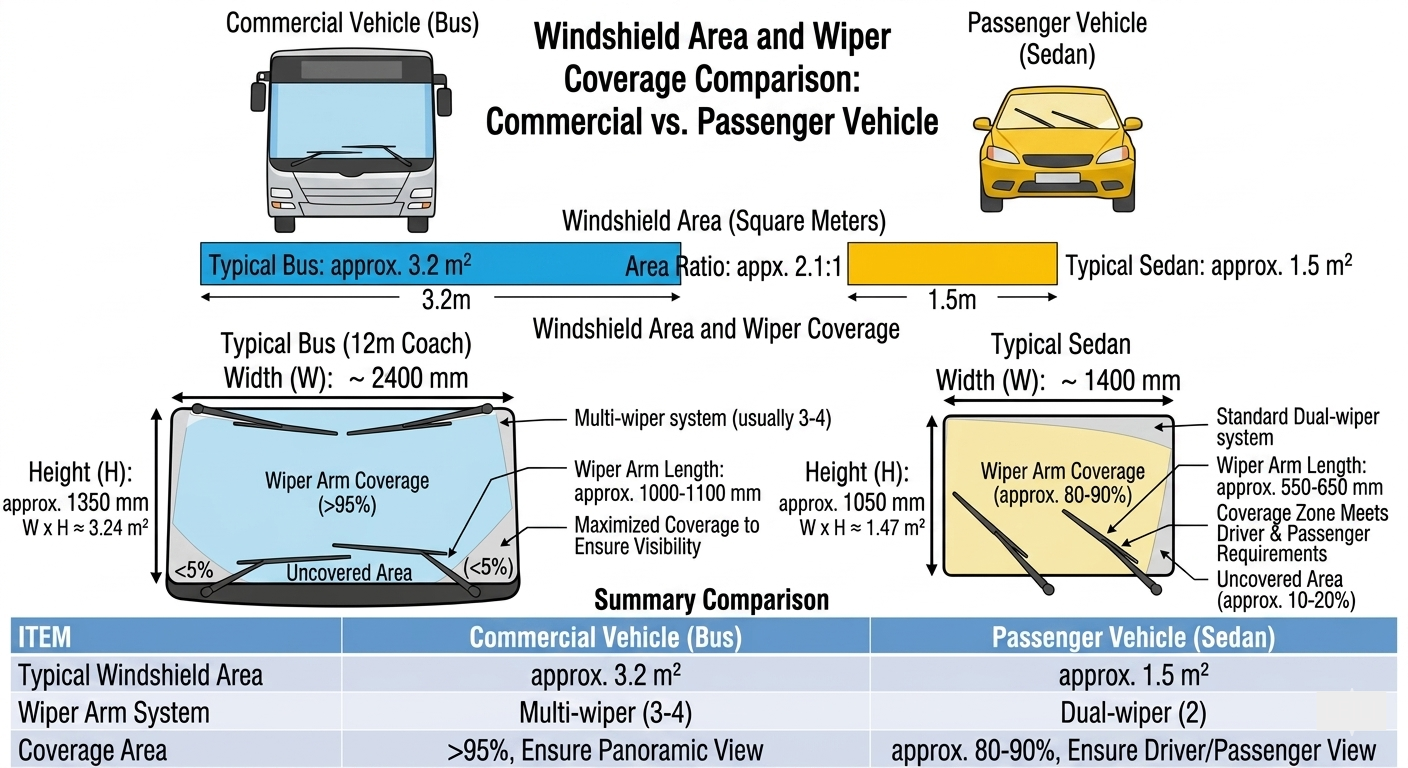
The power of the windshield wiper motor for passenger cars is usually between 3050W, but the front windshield area of commercial vehicles (buses, trucks, engineering vehicles) is as large as 2.5 to 3.5 square meters, and the length of the wiper arm can reach 700 to 1000mm, and the wiper load is far from comparable to that of passenger cars. Once the motor torque is insufficient, it will cause the brush to vibrate and leave blind spots, or the motor will overload and burn out, which is enough to cause an accident in heavy rain or snow.

According to industry data, motor failure accounts for more than 45% of the failure of commercial vehicle wiper systems, far higher than the wear of wiper blades (about 30%) and the loosening of connecting rods (about 15%). Therefore, choosing the right motor is the first barrier to ensure the reliability of the entire wiper system.

commercial vehicle wiper motor

commercial vehicle wiper motor

2. Break down the 4 core parameters one by one

2.1 Torque and power: Do you have enough power? Look at these two numbers.

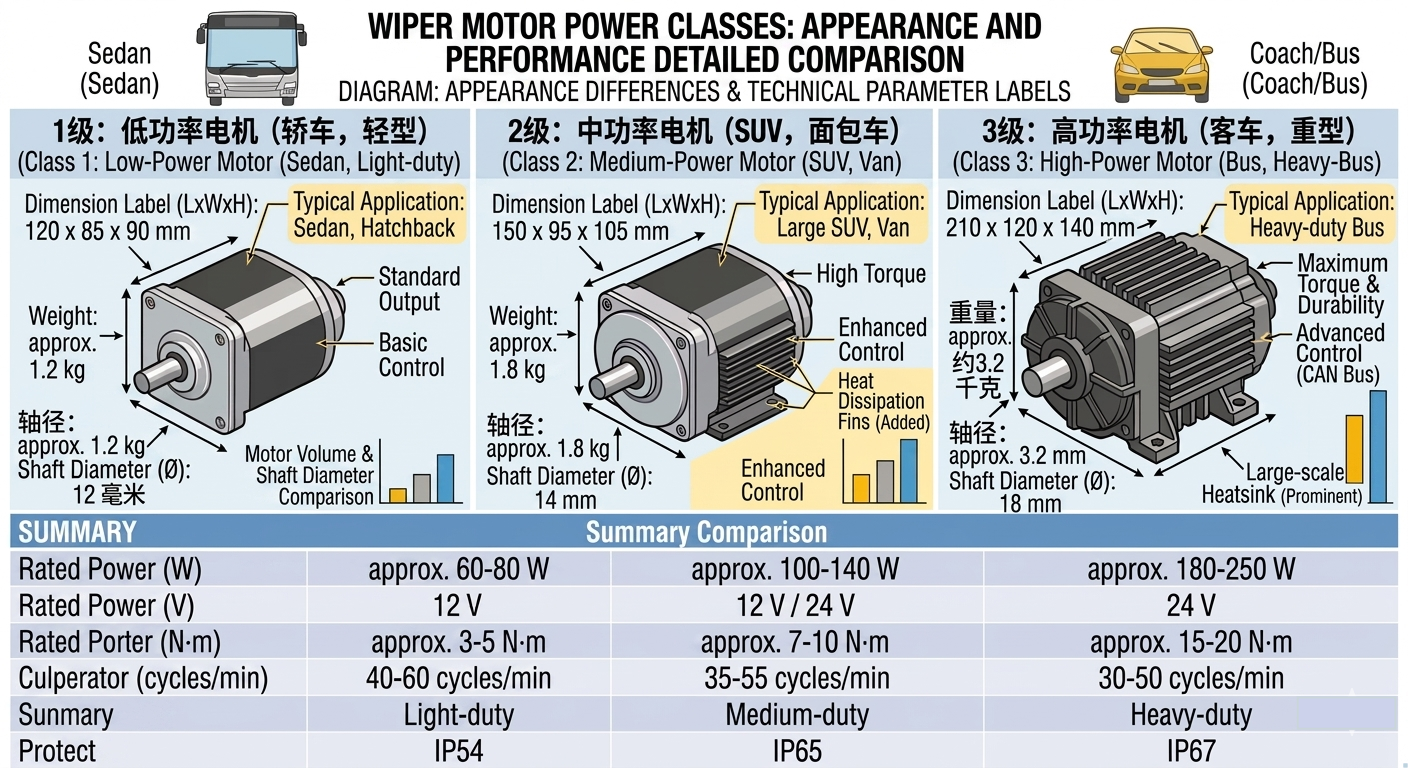
Torque is the core performance indicator of the wiper motor. The selection logic of commercial vehicles is completely different from that of passenger vehicles:

parameterTypical value for passenger carsTypical values for commercial vehiclesIntroductions
Rated power30~50W60~180WCommercial vehicles start from at least 60W, and large buses can reach 180W.
Rated torque2~4Nm7~25NmThe torque directly determines whether the suction pressure of the scraper arm is sufficient.
Deadlock torque10~15Nm35~140NmThe ability to overcome the initial resistance when ice and snow stick to the windshield
Working voltage12V12V / 24V dual voltageCommercial vehicles generally have 24V electrical systems, and dual voltage compatibility makes them more flexible.

Selection suggestions:

  • 7~9m medium-sized bus: 6080W power, rated torque 710Nm, blocking torque ≥35Nm
  • Large bus 10~12 meters: 80150 W power, rated torque 1020 Nm, blocking torque ≥ 50 Nm
  • Engineering vehicle / mining vehicle: 150 ~ 180W power, rated torque ≥ 20Nm, blocking torque ≥ 100Nm

One common cognitive misconception is that “the larger the power, the better.” In fact, excessive power will cause the motor temperature to rise and energy consumption to increase. Professional manufacturers such as Zhejiang Lei Li ensure that the winding temperature rise is controlled within 45K under rated conditions during the motor design stage through electromagnetic simulation calculation, taking into account the balance between torque and heat dissipation.


motor

motor

2.2 Protection class: can’t understand the IP code? Remember these two numbers

The operating environment of commercial vehicles is far worse than that of passenger cars – heavy rain washes, high-pressure water guns wash cars, mud splashes, and salt corrosion are the norm. The degree of waterproof and dustproof (IEC 60534 standard) is the proof of the “survival ability” of the motor:

Protection classDust-proof abilityWaterproof abilityApplicable scenarios
IP52Limited dustproofWater drips at an angle of 15°Ordinary highway bus
IP54dustproofSplash in any directionCity bus, tourist bus
IP56Totally dust-proofStrong water sprayEngineering vehicles, mining area
IP67Totally dust-proofShort-term immersion (1m/30 minutes)Wet conditions, high humidity areas

The key to selection: the material of the motor casing also affects the protection effect. Compared with the iron shell or plastic shell, the die-casting aluminum shell has three advantages – higher heat dissipation efficiency, greater impact strength (can withstand 5g vibration), and natural corrosion resistance. The double-layer rubber sealing ring at the joint of the shell is a key observation point to judge the level of technology, and it is recommended to pay special attention to it during on-site factory inspection.

The Zhejiang Lei Li wiper motor product line covers the entire series from IP52 to IP67, providing matching solutions for different vehicle models and application scenarios, and all products are certified by the IATF 16 949 quality management system.

2.3 Winding material: pure copper vs copper-clad aluminum, the difference is not just the price

The material of the motor winding is the key to closing the gap between cost and life:

Comparison dimensionPure copper enamelled wireCopper-clad aluminum wire
Resistivity (20°C)0.0172 Ω·mm²/m0.0279 Ω·mm2/m (about 60% higher)
Temperature gradeGrade H (180 ℃) or aboveUsually below F-class (155℃)
Life performance≥2 million cyclesIt will oxidize and fail after 3~6 months.
costHigherLower by 30% to 40%

The core difference between pure copper and copper-clad aluminum lies in the coefficient of thermal expansion – the coefficient of thermal expansion of the aluminum core and the copper layer is about 40%. After repeated heating and cooling cycles, microcracks are generated at the interface, causing the contact resistance to surge and the interturn short circuit. This is a non-negotiable bottom line for buses with high operation intensity (daily scraping can reach more than 500 times).

On-site identification skills: You can make a preliminary judgment by observing the copper color of the stator winding end and the uniformity of the wire diameter. The formal manufacturer will clearly indicate “pure copper enameled wire” in the product specification.

2.4 Wide temperature range adaptability: -40 ℃ run to Mohe River, +85 ℃ go to Hainan

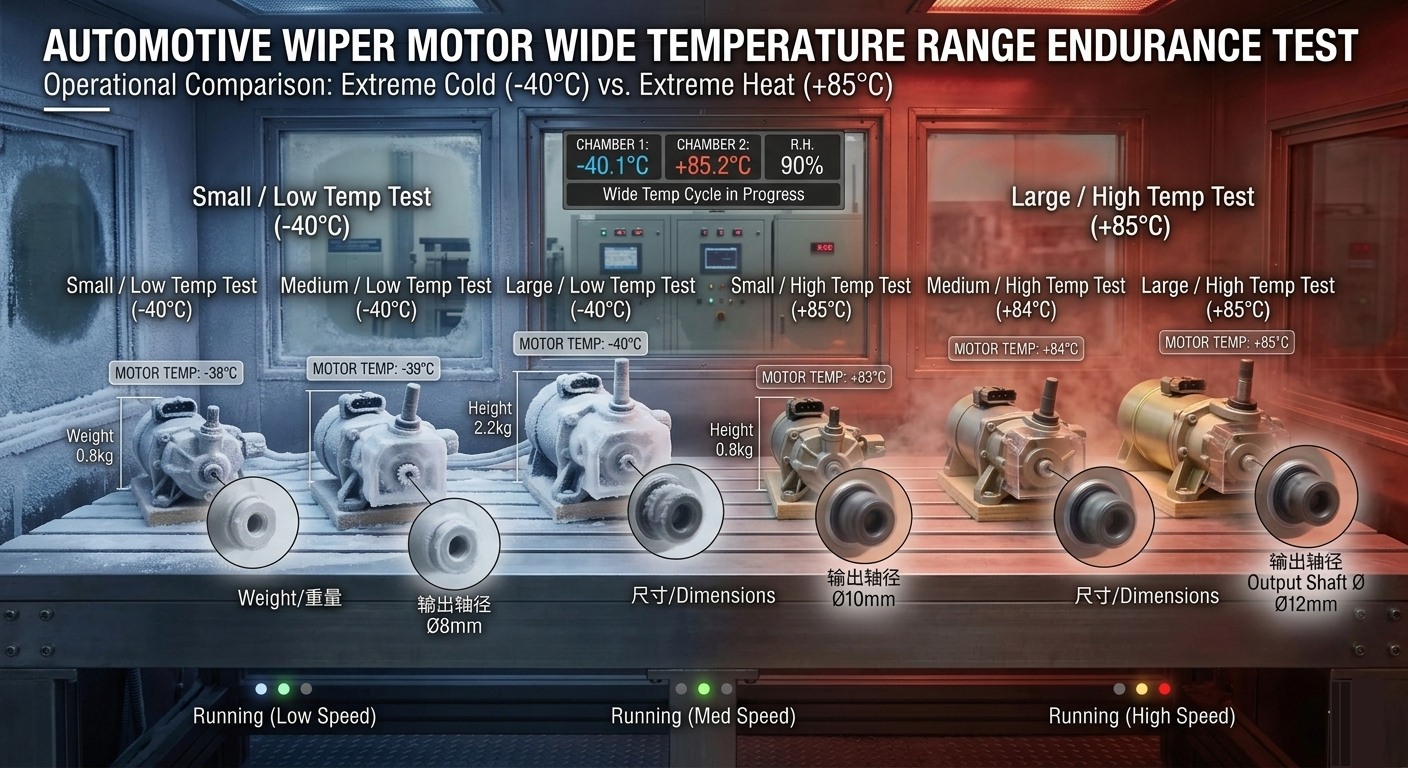
The operation range of commercial vehicles covers the whole country, from the extreme cold in the northeast to the high temperature in Hainan. The motor must work stably in all temperature ranges:

Environmental conditionsTechnical requirementsRisk points
-40°C low temperatureThe low-temperature starting torque does not decay, and the lubricant does not solidify.Permanent magnet demagnetization risk, gearbox jamming
+85°C high temperatureContinuous operation temperature rise ≤45K, insulation does not ageThe winding overheats and burns out, and the brushes wear out abnormally.
High altitude (≥3000 m)The heat dissipation efficiency has decreased, and the design needs to be reduced.The thin air causes the arc to intensify.

Technical bottom line: The regular commercial vehicle wiper motor should pass the following reliability verification:

  • 150 hours continuous load test (-30 ℃ ~ 85 ℃ alternating cycle)
  • 30,00 cycles of scraping test (according to SAE J903 standard)
  • Vibration test: 5~500 Hz / 3 Grms (refer to ISO 16752-3 standard)
wiper motor

雨刷电机

III. Comparison table of motor selection for different models

Vehicle typeRecommended powerRecommended torqueProtection class电压Typical original equipment manufacturer
6~8 meters school bus / minibus60W7NmIP5412V/24VJinli, Peony
8~10 meters city bus80W10NmIP5624VYutong, Haier, Ankai
Long-distance bus 10~12 meters100~150W15~20NmIP5424VJinlong, BYD
Hinged buses over 12 meters150~180W20~25NmIP5624VBYD, Yutong
Engineering vehicle / mining vehicle150~180W≥20NmIP6724VXCMG, Chongqing Heavy Industry

Zhejiang Lei Li has provided accessories for main car manufacturers such as Jinlong, BYD, XCMG, Chongqing Heavy Industry, Yutong, and Haier, and can provide OEM/ODM customization services (voltage customization, shaft end modification, installation hole matching) for different models.

IV. Frequently Asked Questions (FAQs)

Q1: How often does the wiper motor need to be replaced?

How often does the wiper motor need to be replaced?

The design life of wiper motor is usually 2 million wiping cycles or 8-10 years. However, the actual replacement cycle is greatly affected by the frequency of use and environmental factors: urban buses are wiped more than 500 times a day, and the actual life of the motor is about 5 to 7 years; The frequency of long-distance buses is relatively low, up to 8 to 10 years. When the scraping speed slows down significantly, the motor makes noise, or the motor stops intermittently, it should be tested and replaced immediately.

Q2: The dual voltage (12V/20V) motor is more expensive than the single voltage motor, is it worth choosing?

The dual voltage (12V/20V) motor is more expensive than the single voltage motor, is it worth choosing?

It's worth it. The internal design of the dual-voltage motor is compatible with two voltages through the design of the windings, and the hardware cost increases by about 15% to 20%. But the flexibility it brings far outweighs the price difference. For instance, the same motor can adapt to both 12V and 24V electrical systems. As a result, fleet managers and parts dealers can cut their SKU count in half. Consequently, they also enjoy lower inventory costs.

Q3: Is there a big difference between the stall torque of 35Nm and 50Nm in actual use?

Is there a big difference between the stall torque of 35Nm and 50Nm in actual use?

The difference is significant. The blocking torque determines the "breaking ice" ability of the wiper in the case of ice and snow sticking to the windshield.The 35Nm can handle thin ice around -10℃, while the 50Nm can normally start in snow below -20℃.It is recommended to choose an electric motor with blocking torque ≥50Nm for vehicles operating in cold regions in the north.

Q4: How to choose between IP56 and IP67? The higher the grade, the better, right?

How to choose between IP56 and IP67? The higher the grade, the better, right?

It's not that the higher the grade, the better. IP67 adds short-term immersion protection, but at the same time brings higher sealing costs and heat dissipation challenges. Choose IP54 ~ IP56 for highway buses and urban buses to meet 99% of usage scenarios; IP67 is only required for vehicles that operate in areas with constant water exposure, such as construction vehicles and mining vehicles. Blindly upgrading not only increases the cost of procurement, but may also shorten the life of the motor due to poor heat dissipation.

Q5: What is the most common cause of motor burnout?

What is the most common cause of motor burnout?

The first place is overload operation - the suction arm spring pressure is set too high or the linkage rod is stuck, causing the motor to work at an over-rated torque for a long time; The second is water ingress short-circuiting - insufficient protection level or aging of the sealing ring leads to water vapor entering the winding; The third is abnormal wear of brushes - low-quality carbon brushes are worn out to the limit within 3 to 6 months, causing the commutator to be burned out by commutator spark.

V. Technological Trends: New Requirements for Motors in New Energy Buses

From January to April 2026, the cumulative sales of new energy buses over 6 meters in China exceeded 10,00 vehicles, and the penetration rate of new energy bus exceeded 80%. This trend poses new challenges to wiper motor:

2026.7.3
Low power consumption requirements

Electric buses are extremely sensitive to energy consumption, and every 1% increase in motor efficiency means saving about 0.05 kWh of electricity per day.

2026.7.3
EMC electromagnetic compatibility

The high-voltage electrical environment of new energy vehicles is complex, and the wiper motor must pass more stringent electromagnetic interference tests.

2026.7.3
Intelligent interface

Integrated rain sensing, CAN bus communication, automatic reset, and overload protection become standard features.

VI. Self-check list for selection

Before purchasing a commercial vehicle wiper motor, check the following 7 items one by one:

□ Is the torque/power matched with the vehicle model (refer to the table in this article)?

□ Does the protection level meet the operating environment (road IP54, bus IP56, mine IP67)?

□ Is the winding material pure copper enameled wire?

□ Are you certified by IATF 16 949 or ISO 9001?

□Is the casing made of die-cast aluminum?

□ Is there a complete report of high and low temperature/vibration/durability test?

□ Does the manufacturer support OEM/ODM customization (shaft end modification, voltage adapter, installation hole adjustment)?

About us: Zhejiang Lei Li Auto Parts Co., Ltd. specializes in the manufacture of commercial vehicle wiper systems, The products cover the full series of 雨刷电机, wiper arm, wiper blade, link rod, washer, 公共汽车锁, etc., and have been provided to main manufacturers such as Jinlong, BYD, XCMG, Chongqing Heavy Industry, Yutong, Haier, etc. Through IATF 16 949 certification, we can undertake OEM / ODM customization. The applicable fields cover buses, trucks, engineering vehicles, ships, aircraft, etc.

您可能还会喜欢
LINKAGE

How can we get wiper linkage size,wiper linkage spare parts size?

wiper motor

How to choose a commercial vehicle wiper motor? Decomposition of 4 major core parameter technologies

commercial wiper blade

How to choose a commercial vehicle wiper blade? Three core parameters determine the service life and scraping effect