
如何选择商用车雨刮片?三个核心参数决定了其使用寿命和刮除效果

wiper blade guide

. What are the essential differences between commercial vehicle wiper blades and passenger vehicle wiper blades?

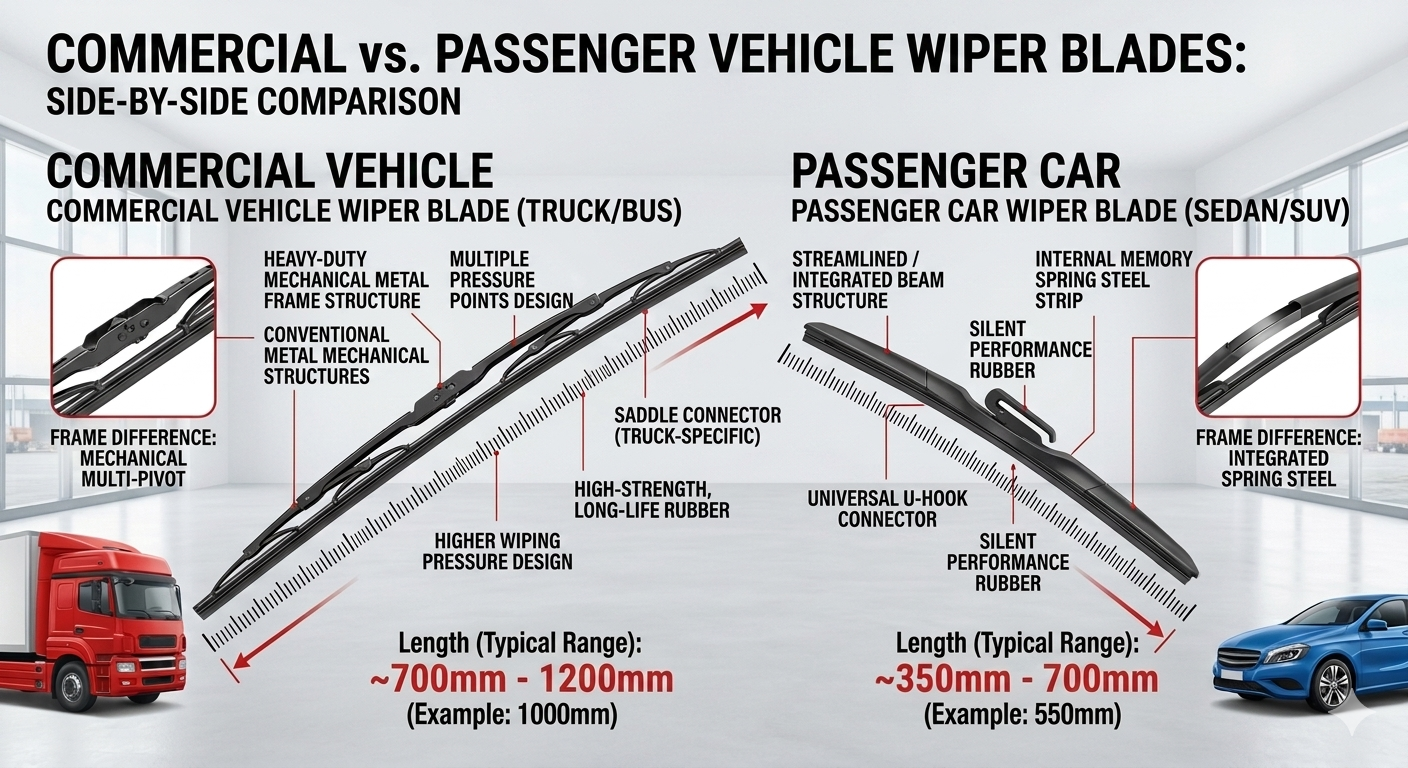
Many fleet maintenance personnel are accustomed to using the experience of passenger cars to select commercial vehicle wipers, which is a dangerous move in terms of technology. The difference between the two is not just “a little longer”:

Comparison dimensionPassenger car wiper bladeCommercial vehicle wiper blade
Common lengths450mm-650mm700mm-1100mm
Daily work frequency5-15 starts and stops50 to 200 starts and stops
Duration of a single session10-30 minutesFor several hours in a row
Windshield area≤1.5m²2-4m²
Working voltage system12V24V (standard for buses/trucks)
建议的更换周期6-12 months3-6 months (higher frequency lines are shorter)
Consequences of failurePersonal driving riskVehicle passenger / high-risk cargo safety risk
Side-by-side comparison of commercial vehicle and passenger vehicle wipers

Side-by-side comparison of commercial vehicle and passenger vehicle wipers

Core conclusion: The commercial vehicle wiper blade is a heavy-duty high-frequency wearable part, and the selection standard, replacement cycle, and material requirements are all at a different level from those of passenger vehicles.

. The first core parameter: the material of the rubber strip – determines the upper limit of the lifespan

2.1 Comparison of three mainstream materials

texture of timberTemperature rangeService lifeApplicable scenariosReference unit price (commercial vehicle specifications)
EPDM rubber-20℃ ~ 60℃3-6 monthsCity buses, short-distance trucks
Natural rubber + coating-15℃ ~ 55℃2-4 monthsTemporary replacement, budget-sensitiveminimum
silica gel-40℃ ~ 80℃+6-12 monthsLong-distance buses, mining engineering vehiclesMedium-high

2.2 Why does Lei Li mainly use rubber (EPDM)  formula?

Zhejiang Lei Li uses rubber (EPDM) formula wiper blades in OEM accessories, and the reason is straightforward:

Excellent weather and ozone resistance

EPDM rubber has outstanding resistance to ozone, UV radiation and thermal aging. For long-distance buses exposed to sun and rain for 8-12 hours a day, this ensures the blade keeps stable wiping performance over a long service life.

Stable elasticity across a wide temperature range

EPDM maintains good flexibility in both the high temperatures of summer and the low temperatures of northern winters, avoiding hardening or brittleness that would compromise wiping quality.

Good resistance to chemicals and washing agents

Bus windscreens are frequently cleaned with detergents and washer fluids, and EPDM's chemical resistance keeps the blade from degrading prematurely.

Mature material and reliable supply

EPDM is a mature, widely available rubber material, making it an economical and dependable choice for bus fleet maintenance.


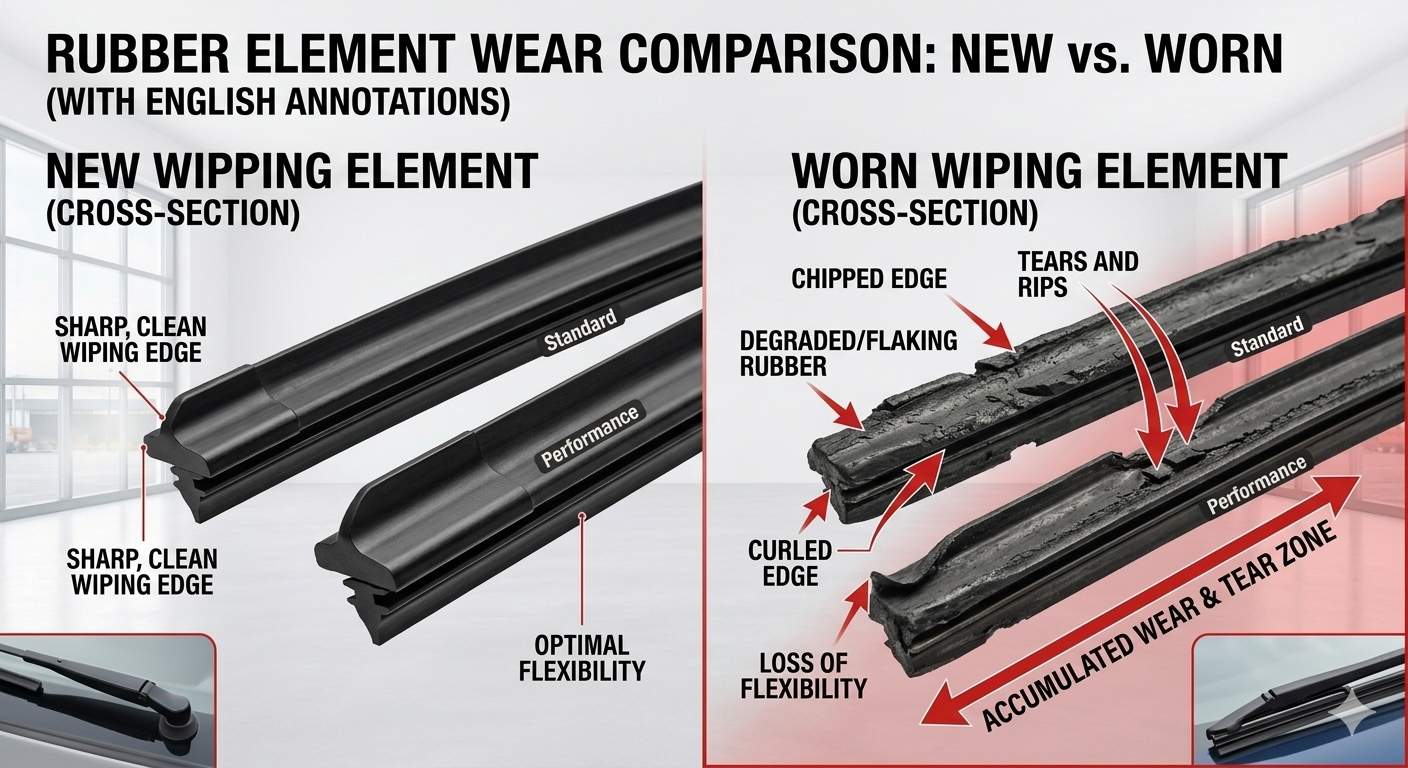
2.3 Quantitative judgment criteria for the wear of rubber strips

Don’t wait until it’s completely scraped off before replacing it. Here are the quantifiable replacement thresholds:

检测项目Normal stateThreshold needs to be changed.Detection method
Wear width of the cutting edge≤0.5mm≥2mmMeasuring with a vernier caliper
Water mark width after scrapingnothing≥5mm residual water stainModerate rain simulation, 40km/h test
Rubber hardness55-65 Shore A≥75 Shore ARubber hardness tester
Surface cracknothingVisible cracks can be seen with the naked eye.Visual inspection
The wear of the edges of the new and old rubber strips is compared, and the wear area is marked with a red arrow.

The wear of the edges of the new and old rubber strips is compared, and the wear area is marked with a red arrow.

Ⅲ. The second core parameter: size and interface – if it’s 1mm off, it won’t fit

3.1 Measurement methods for dimensions

The length of the commercial vehicle wiper blade is marked in two units, millimeters (mm) or inches (inch) (1 inch ≈ 25.4 mm). The benchmark data can be obtained by directly measuring the length of the old rubber strip of the original car wiper blade.

Common commercial vehicle wiper blade size range:

模型类别Common sizesRemarks
Medium bus (8-10 meters)700-900mmYutong ZK6858, etc.
Large bus (10-12 meters)900-1100mmGolden Dragon XMQ6129, etc.
Hinged bus (18 meters)900-1100mm Multi-armThree-arm systems are the most common.
Heavy truck700-1000mmXCMG, Chongqing Heavy Industry, etc.
Construction machinery800-1000mmNeed to strengthen the frame.

3.2 Interface Type Identification

There are three common types of wiper interface for commercial vehicles:

Interface typeInstallation methodCommon brandsIdentification features
U-shaped hook (clamp type)Clasp pressing fixedJinlong, Yutong, HaigeThe end of the wiper arm is a U-shaped hook.
Bolted fixed typeScrew tightenedXCMG, some imported modelsThere is a bolt hole at the end of the arm
Dedicated fast interfaceButton / latchBYD and other new energy modelsSquare or non-standard interface


2026.6.30
Avoid pitfall tips
Avoid pitfall tips

Don't buy a universal windshield wiper just because it "looks similar." If the interface does not match, the installation will be forced, which may result in improper wiping, or worse, the wiper blade will fall off during driving.

Four, the third core parameter: skeleton structure – how to choose between having bones and not having bones?

Commercial vehicle wiper blades are divided into two categories according to the skeleton structure:

typeStructural characteristicsadvantageInferiorityApplicable scenarios
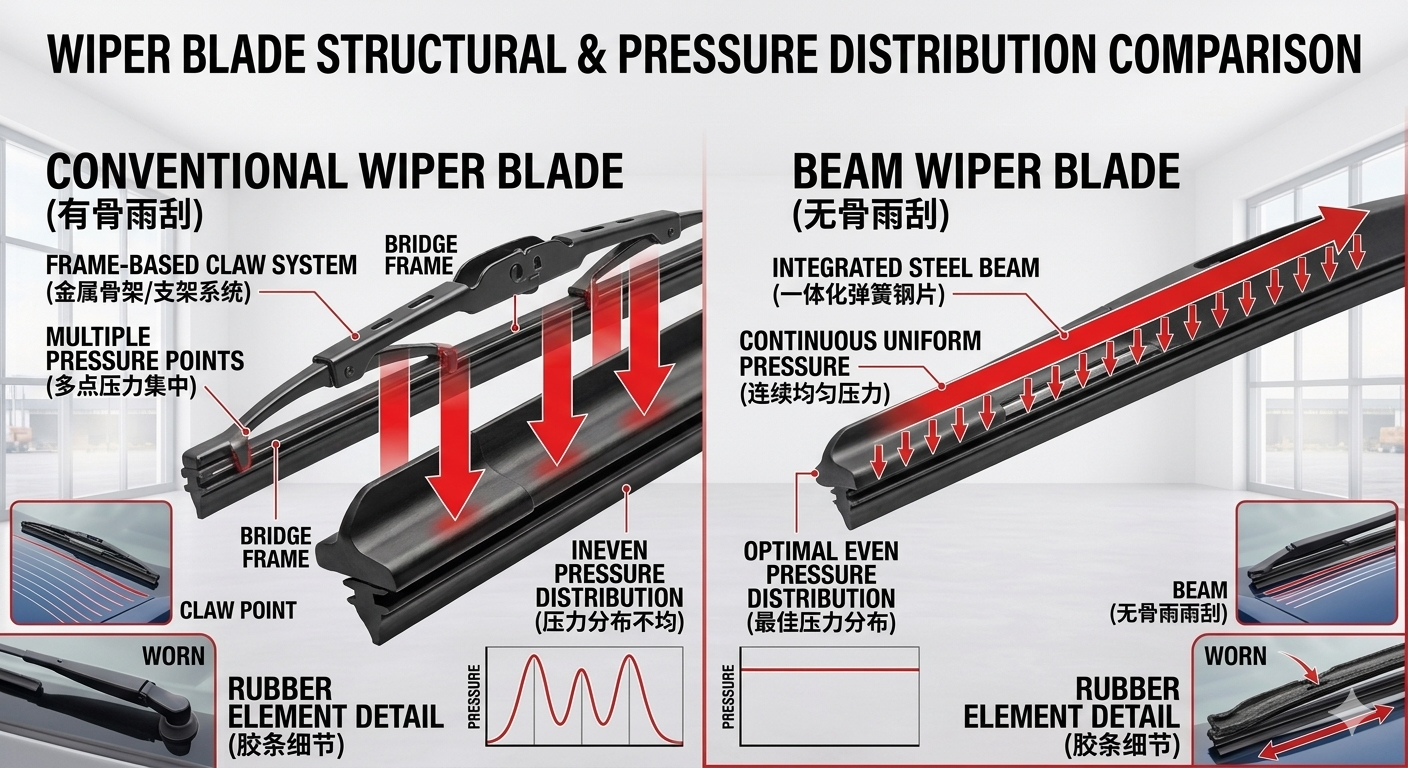
There is a bone wiper.Metal skeleton + multiple points of supportThe downward pressure is uniform and the curvature is controllable.Heavy weight, slightly higher wind resistanceLarge windshield and curved glass for buses
Bone-free wiperBuilt-in elastic steel sheetLight weight, simple appearanceThe middle pressure is insufficient when the size is large.Small and medium-sized trucks, flat glass

Why do commercial vehicles mainly have bones?

  • The windscreen area of commercial vehicles is large. The curvature is also complex. A bone wiper can evenly distribute pressure through multi-point support. Each support point provides about 1-1.5 N of pressure.
  • When driving at high speed (80–100 km/h), a large-size boneless wiper is easily lifted by the airflow. This causes "floating" and leakage.
  • There is a removable rubber strip on the bone frame, which reduces the long-term maintenance cost.
Comparison chart of the structure of bone wiper vs. non-bone wiper, showing the way of pressure distribution

Comparison chart of the structure of bone wiper vs. non-bone wiper, showing the way of pressure distribution

V. Mainstream commercial vehicle brand wiper blade compatibility table

Based on Zhejiang Lei Li’s many years of OEM data, we have compiled a reference for the specifications of wiper blades for common models:

brand name代表性模型Recommended lengthInterface typeSuggested materia建议的更换周期
金龙巴士XMQ6129G1000 毫米U-hooksilica gel4 months
BYD CompanyK9 / C9900 毫米Dedicated interfacesilica gel4 months
宇通客车ZK61251000 毫米U-hooksilica gel4-6 months
XCMG AutomobileHanfeng series950mmBolted fixSilicone (reinforced)3 months (mining area)
重庆重工HOWO series900 毫米U-hooksilica gel3-4 months
Higer BusKLQ6125900 毫米U-hooksilica gel4 months

VI. Frequently Asked Questions FAQ

Q1: How often should a commercial vehicle wiper blade be replaced?

Answer: The recommended replacement cycle is 3-6 months. For buses with frequent operations in rainy southern areas, we recommend a cycle not exceeding 4 months. Long-distance trucks, however, can follow a 6-month cycle. Above all, base your judgment primarily on the rubber strip's wear state—replace it when blade wear reaches 2mm or more, or when cracking appears—rather than simply counting time or mileage.

Q2: What is the difference between a cheap wiper blade and an OEM-compatible one?

Answer: The biggest difference lies in the material and quality control consistency. OEM-compatible wiper blades use silicone or high-grade EPDM rubber strips that meet original equipment manufacturer specifications, and they have passed durability verification. Low-cost after-sales products, however, often use generic rubber and do not undergo extreme tests such as high temperature or salt spray before leaving the factory. Consequently, they show large batch-to-batch differences and typically last only one-third to one-half as long as OEM parts.

Q3: Can I replace the commercial vehicle windshield wiper myself?

Answer: The U-shaped hook interface allows independent replacement, similar to passenger car operation. For the bolt-fixed type and special interface, however, we recommend that maintenance technicians handle the replacement to prevent loosening or damage to the special latch from inadequate bolt torque. After replacement, run the wiper for 3-5 cycles to verify the wiping effect.

Q4: Why can't the new wiper blade clean the windshield?

Answer: The issue is usually not the wiper blade itself. First, check the windshield for any oil film and clean it with an oil film remover if needed. Then, inspect the wiper arm's spring pressure, as a decrease in pressure can affect performance—the standard pressure is 4.5 ± 0.5N. If the wiper blade cannot maintain close contact with the glass, even a new rubber strip will fail to clean properly. Additionally, some older glass surfaces may develop small pits, which require polishing or replacement to restore proper wiping.

Q5: How much more expensive is a silicone wiper than a rubber one? Is it worth it?

Answer: The single price of silicone wiper blade is about 30% to 50% more expensive than EPDM rubber. But the service life is doubled (6-12 months vs 3-6 months), and the scraping effect decays slowly, and the long-term comprehensive cost is lower. For high-intensity commercial vehicles, the value of reducing the frequency of replacement and labor costs of silicone wiper blades is much higher than the difference in unit price.

VII. Recommendations for Purchase and ODM Customization Solutions from Lei Li

As a manufacturer specializing in OEM parts for commercial vehicle wiper systems, Zhejiang Lei Li provides layered wiper blade solutions for different customers:

  • Whole vehicle factory accessories: customized rubber strip formula, skeleton structure, interface specifications according to vehicle model parameters, full process IATF 1 6949 quality control
  • Large fleet procurement: provide standardized OEM quality wiper blades, stable supply under annual contracts, batch traceability
  • ODM Brand Customization: Support for OEM deep customization of own brand packaging, specified materials and specifications

Core products: 雨刷电机 | wiper arm | wiper blade | wiper link rod | washer | 公共汽车锁

Supporting brands: Jinlong | BYD | Yutong | XCMG | Chongqing Heavy Industry | Higer | Zhongtong | Foton, etc.

Applicable fields: buses | trucks | engineering vehicles | commercial vehicles | ships | aviation ground services

ZHEJIANG LEILI AUTO PARTS CO.,LTD

您可能还会喜欢
wiper

如何排查商用车雨刷的常见故障?一次性解释5大问题

background

浙江雷利公司将携全系列公交车雨刷产品亮相2026年温州汽车零部件展览会(展位号:8D20),并诚挚邀请全球客户莅临参观。.

城市公交车雨刮器系统批量采购的最佳解决方案:从总拥有成本(TCO)到全生命周期管理