
How to Choose a Wiper System Manufacturer: OEM & Aftermarket Sourcing Guide

Last March, a distributor in Texas ordered 4,000 wiper blades from the cheapest wiper system supplier he could find on a trading platform. The unit price sat 22% below his usual vendor, and the product photos looked identical. By June, the rubber had begun to crack and streak in the heat. His returns rate climbed to 18%, and a national fleet customer quietly pulled a six-figure annual contract. The “saving” ended up costing him more than the entire deal was worth.
If you’ve ever sourced automotive components, you’ve probably heard a version of that story. Choosing a wiper system manufacturer is rarely about the lowest unit price. It’s about total cost: quality consistency, compliance, lead time, and whether the supplier actually owns the factory behind the quote.
This guide gives you a repeatable, engineer’s-eye method for evaluating a wiper system manufacturer or wiper system supplier — whether you’re buying for OEM assembly, building a private-label aftermarket line, or stocking a fleet. We’ll cover OEM vs. aftermarket vs. private label, eight factors to score any factory against, a printable sourcing checklist, common pitfalls, and the questions to ask before you wire a deposit.
Key takeaways
– Match the sourcing model first — OEM, aftermarket, or private label — because it changes which certifications, MOQs, and factory capabilities actually matter.
– Certifications (IATF 16949, ISO 9001) plus real in-house testing (salt spray, wipe-cycle, AQL inspection) separate a true wiper system manufacturer from a trading company that only resells.
– Rubber compound is the single biggest driver of wiper blade lifespan — confirm natural rubber, silicone, or chloroprene (CR) before you compare prices.
– Commercial-vehicle systems live or die on motor torque and linkage durability, not blade price — verify 12V/24V DC motors and linkage fitment up front.
– A factory-direct partner with 35 years of OEM/ODM experience and documented first-pass yields (e.g., 98.5%) de-risks both launch and repeat orders.
OEM vs Aftermarket vs Private Label: Which Do You Need?
Before you compare factories, pin down the sourcing model. The same wiper system supplier can be excellent for one channel and wrong for another, because each model demands different capabilities.
| Sourcing model | What you’re buying | What matters most | Typical MOQ |
|---|---|---|---|
| OEM | Parts that ship to a vehicle or equipment assembly line | IATF 16949, PPAP documentation, torque/coverage specs, traceability | Medium–high |
| Aftermarket | Replacement blades, motors, and assemblies for distribution | Price per unit, part coverage, packaging, low return rates | Low–medium |
| Private label | Your brand on a factory’s proven platform | Custom rubber, adapters, logo, packaging, exclusivity | Medium |
OEM buyers don’t just buy a wiper motor; they buy a documented, repeatable process. If a motor’s torque curve drifts 5%, an assembly line stops. That’s why OEM sourcing leans on IATF 16949 quality systems and full PPAP (Production Part Approval Process) documentation rather than the lowest quote.
Aftermarket buyers live and die by return rates. A blade that streaks or a motor that seizes returns to your shelf — and every return erases margin. Here, the smart play is to buy from a factory whose first-pass yield is documented, not asserted.
Private-label buyers want the factory’s proven platform with their own identity. That means adapter customization, rubber-compound tuning, and logo/packaging work — a different skill set than high-volume commodity production.
The point: identify your channel before you score candidates. It will keep you from paying for OEM-grade documentation you don’t need — or, worse, discovering after your first order that your “cheap” supplier has no customization capability at all.
Not sure which model fits your channel? Request a factory quote and our engineers will help you match the right configuration to your market — no obligation. Request a factory quote →
OEM vs Aftermarket: The Difference You Can’t See
Here’s the uncomfortable truth about sourcing wiper systems: an OEM blade and a low-end aftermarket blade can look nearly identical in a product photo, and for the first few weeks of use they feel much the same. The rubber wipes, the motor runs, the linkage pivots. On the surface, you’d be forgiven for wondering why the OEM part costs more.
The real difference isn’t in the product you can see. It’s in the system you can’t.
A manufacturer that holds IATF 16949 doesn’t just keep a certificate on the wall — it runs its entire operation, from incoming raw material to after-sales, inside a documented quality system. A factory that only does “outgoing sampling — pass and ship” may turn out a good batch this month. The question is whether it can turn out the same batch, month after month, for years. That’s the gap between quality consistency and reliability, and it lives in six places no spec sheet will show you.
Raw material control. Under 16949, suppliers are audited to automotive standards, kept on an approved-vendor list, and monitored continuously. Incoming material is checked against a control plan, and every batch is identified and consumed first-in, first-out. A rubber or steel source can’t be quietly swapped for a cheaper one. An ordinary aftermarket shop may re-source on price alone, with no batch lock — which is exactly how two containers of “the same” blade end up wiping differently.
Manufacturing process control. Some processes — rubber vulcanization, welding, surface treatment, injection molding — can’t be fully verified by inspecting the finished part. 16949 requires these “special processes” to be validated and their parameters monitored, backed by a control plan, a failure-mode analysis (FMEA), and work instructions with mistake-proofing built in. An ordinary aftermarket line may run the same vulcanizer on experience, with batch-to-batch drift nobody is tracking.
Quality front-loaded, not inspected at the end. 16949 moves quality upstream through APQP (Advanced Product Quality Planning) and PPAP (Production Part Approval Process) — the philosophy is defect prevention, not end-of-line detection. Ordinary aftermarket sourcing often means “final sampling passes, so it ships.” You can’t inspect quality into a part that was built wrong from the start.
In-process control. 16949 manufacturers watch the line, not just the output: statistical process control (SPC) on key characteristics, process capability tracked (an industry benchmark of Cpk ≥ 1.33), measurement systems validated (MSA), and first-piece, in-process, and last-piece checks. That’s how you catch a torque or rubber-hardness drift while it’s happening. A line that only checks the last piece finds the drift after a full shift of bad parts is already boxed.
Traceability. A 16949 part traces backward from the finished batch number through production date, shift, equipment, operator, and key parameters to the raw-material lot — and forward to the customer who received it. When a defect appears, you isolate the affected batch range in hours and recall precisely. Without batch-level traceability, an ordinary aftermarket supplier can only scrap the whole lot, because it can’t tell which units are actually affected.
After-sales as a closed loop. Under 16949, a customer complaint or field failure triggers structured analysis — often an 8D problem-solving process — with corrective action fed back into the process or material. The factory learns, and the next batch improves. An ordinary aftermarket seller’s “after-sales” is usually just a replacement. No analysis, no loop, so the same failure walks into the next order.
I watched this gap play out side by side once. Two factories — both making wiper arms — faced the same complaint: rust on coastal fleet vehicles. The 16949 plant pulled the salt-spray data for the affected production week, traced it to a plating supplier’s batch, and changed the spec. The other factory offered to ship replacements and called it resolved. Same complaint, two answers. One fixed the cause; the other only restocked the symptom.
None of this means every aftermarket part is bad, or that an OEM part never fails. It means the two are managed differently. When the parts look the same and the first month feels the same, what you’re really paying for is the invisible system that keeps the tenth container as consistent and reliable as the first.
8 Factors to Evaluate a Wiper Manufacturer
Certifications (IATF 16949, ISO 9001, ISO 14001)
Certifications are the first filter because they’re hard to fake — a supplier either holds them or it doesn’t. IATF 16949:2016 is the automotive-specific quality management standard. If a supplier builds for vehicle OEMs, this is effectively table stakes. ISO 9001 confirms a basic quality management system is in place, while ISO 14001 signals environmental management — increasingly a requirement for buyers selling into the EU.
But don’t stop at the certificate on the wall. Ask what the certification covers and whether the factory’s own processes — incoming inspection, in-process control, final audit — are actually documented and followed. A real wiper assembly manufacturer with IATF 16949 will be able to walk you through its control plan, not just point at a framed document.
One distinction matters here: IATF 16949 isn’t a one-time credential you frame in the lobby — it’s a system that runs through the entire chain, from supplier approval and raw-material control through in-process monitoring, traceability, and field-failure feedback. A factory can hold the paper and still ship on nothing more than a final outgoing inspection; a factory that actually runs the 16949 system can show you how each of those links operates. That’s the gap between a certificate on the wall and a process in the building.
Materials & Rubber Compound Quality
Rubber compound is where cheap wiper blades quietly die. A blade’s wiping edge is a precision lip, and the compound behind it determines how long that lip survives heat, ozone, UV, and cold.
A wiper blade manufacturer should be able to tell you exactly what’s in the rubber. The three common compounds each trade off differently:
- Natural rubber — low cost, good wiping flexibility, but weaker against ozone and UV; shorter outdoor life.
- Silicone — excellent temperature range and longevity, quieter wiping, but higher cost.
- Chloroprene (CR) — a strong balance of ozone, weather, and abrasion resistance; common in mid-to-premium aftermarket and OEM blades.
Consider a fleet manager in northern Sweden I spoke with last year. His aftermarket blades hardened and left streaks within a single winter. The vendor blamed the drivers. The real culprit was a low-grade natural-rubber compound that couldn’t survive the cold-soak cycle. He switched suppliers — to a factory that specified a CR compound and ran an ozone-aging test on every batch — and the warranty claims stopped. When you evaluate a supplier, ask for the rubber compound datasheet, not a brand name.
Manufacturing Capability & Capacity (MOQ, Lead Time)
A supplier’s capacity tells you whether it can scale with you — and whether it actually manufactures or merely trades. Look for three things:
- Production footprint. How many automated lines? A factory running 10+ automated production lines with annual capacity above 100,000 units is a different animal from a workshop assembling parts by hand.
- MOQ flexibility. Can the factory start small for a trial order and scale up? A supplier that only quotes 50,000-unit MOQs may not fit an aftermarket distributor building a new line.
- Lead time honesty. A real wiper motor manufacturer knows its material lead times and won’t promise 20-day delivery on a custom torque spec it has never built.
Ask directly: “Do you own the production line, or do you outsource?” The answer — and how fast they answer — is often the single most revealing question in sourcing.
Customization / OEM-ODM Capability
Customization separates a wiper system manufacturer from a reseller. If you need a specific adapter, a custom rubber formula, or a private-label blade, you need a factory with in-house engineering and tooling.
Concretely, ask whether the supplier can:
– Engineer a custom wiper arm or adapter to fit an existing vehicle or equipment line.
– Tune the rubber compound for your climate or performance target.
– Produce private-label samples — blades, motors, or full assemblies — with your logo and packaging.
A factory with 35 years of OEM/ODM experience will typically walk you through a sample-first workflow: drawing review, tooling, pilot run, and golden-sample sign-off. If a supplier can’t describe its sampling process, treat it as a warning sign. (Need a custom arm or adapter? See our wiper arm manufacturer capabilities.)
Quality Control & Testing (Salt Spray, Wipe-Cycle, AQL)
Testing is where claims become measurable. Before you commit, ask what the factory tests — and ask to see the reports, not a summary.
The three tests that matter most for wiper systems:
- Salt spray test — verifies corrosion resistance of metal parts (arms, linkage, brackets). A wiper linkage manufacturer should salt-spray test its pivots and rods, because a rusted linkage is a full-system failure in coastal or road-salt regions.
- Wipe-cycle test — runs the assembly through hundreds of thousands of wipe cycles to catch early wear, torque drift, or motor fatigue.
- AQL inspection — a statistically defined acceptance sampling standard (e.g., AQL 1.5) applied at incoming, in-process, and final stages. It’s how a factory proves quality rather than promises it.
I once watched a quality engineer catch a failing batch this way. During a routine wipe-cycle test, a motor’s torque dropped 8% at the 40,000-cycle mark — well short of spec. Because the factory tested in-house before packing, the defect was caught before a single unit shipped. That’s the difference testing makes: the defect never becomes your customer’s problem.
Compliance & Standards (SAE J903, SAE J198, EU Type-Approval, HS 8512.40)
Compliance depends on your market, and asking for the wrong standard is a common mistake. The key references to know:
- SAE J903 — the SAE recommended practice for windshield wiper systems on passenger cars and light vehicles (GVW ≤ 4,500 kg). It defines minimum performance, durability, and test procedures.
- SAE J198 — the companion standard for trucks, buses, and multipurpose vehicles (GVW ≥ 4,500 kg). If you source for buses, trucks, or construction equipment, this is the relevant benchmark.
- EU type-approval — in Europe, windscreen wiper and washer systems fall under Regulation (EU) 2019/2144 (the General Safety Regulation, which consolidated the earlier Regulation (EU) No 1008/2010), referencing UN Regulation No. 43 (UNECE R43) for vision-area coverage.
- HS 8512.40 — the customs code for electrical windscreen wipers, defrosters, and demisters. Note that rubber blades alone often classify under 4016.99; getting this right avoids clearance delays and unexpected duties.
A competent wiper system supplier should know which standard applies to your region and vehicle class without being prompted. If you have to explain SAE J903 to your supplier, keep looking.
Export & Logistics Experience
A great factory that can’t export cleanly is a great factory you can’t use. Evaluate export readiness early:
- Documentation. Does the supplier handle packing lists, certificates of origin, and correct HS classification without hand-holding?
- Packaging. Wiper arms and blades are long and easily bent. Ask how units are packed and whether the factory has export-rated packaging to prevent transit damage.
- Track record. A supplier already shipping to Europe, the Americas, and Southeast Asia has already solved the customs and logistics problems you’d otherwise absorb on your first container.
Logistics experience shows up in the details — like a supplier that labels each carton with the correct HS code and provides a packing list that matches the invoice line by line.
After-Sales & Warranty
The relationship doesn’t end when the container leaves the dock. Before ordering, clarify:
- Warranty terms. What’s covered, for how long, and what documentation triggers a claim?
- Defect response. Who absorbs the cost of a defective batch — and how fast do replacements ship?
- Feedback loop. Can the factory adjust a spec based on field feedback, or does your complaint disappear into a trading-company inbox?
The best suppliers treat after-sales as a continuation of engineering, not a cost center. A factory-direct partner can change a rubber compound or re-spec a motor in weeks, because the engineer who made the change sits in the same building as the production line.
Sourcing Checklist (Printable)
Use this checklist when scoring any wiper system manufacturer. Each “no” should lower the candidate’s ranking.
- Can supply the IATF 16949 / ISO 9001 certificate (and, if needed, ISO 14001)?
- Owns its production lines and tooling — does not outsource assembly?
- Can name the rubber compound (natural, silicone, or CR) and provide a datasheet?
- Runs in-house salt spray, wipe-cycle, and AQL inspections — and shares reports?
- Knows the right standard for your market (SAE J903, SAE J198, EU type-approval) and correct HS classification (8512.40)?
- Confirms 12V/24V DC motor specs, including torque, for your vehicle class?
- States a clear MOQ and a lead time it can actually meet?
- Offers OEM/ODM customization and a defined sampling process?
- Has export experience to your region with proven packaging?
- Commits to written warranty and defect-response terms?
Want the full version as a shareable document for your team? Contact our engineers and we’ll send the expanded checklist with scoring weights. Contact our engineers →
Common Sourcing Pitfalls & How to Avoid Them
Pitfall 1: Buying on unit price alone. Price is easy to compare; total cost is not. A blade that lasts one season instead of two doubles your true cost — before you add returns, warranty claims, and the reputational damage with your buyers. How to avoid it: always request a rubber compound datasheet and a wipe-cycle test report alongside the quote, and compare lifespan, not just price.
Pitfall 2: Confusing a trading company with a factory. Trading companies can quote lower because they add little value — but they also can’t customize, can’t guarantee consistency across batches, and can’t fix a spec problem at the source. How to avoid it: ask whether they own the production line and tooling, and ask to see the factory. A genuine wiper system manufacturer answers immediately and with specifics.
Pitfall 3: Skipping the sample and pilot order. Going straight from quote to a 20,000-unit PO is how expensive mistakes happen. A sample verifies the product; a pilot order verifies the process at real production volume. How to avoid it: insist on a golden-sample sign-off, then a small pilot before scaling. The weeks this adds are cheap insurance against a container of defects.
Why Choose a Factory-Direct Supplier
Every factor in this guide points the same direction: the more you buy direct from a real factory, the more risk you remove.
LEILI (Zhejiang Leili Auto Parts Co., Ltd.) has been manufacturing wiper systems since 1989 — 35 years of OEM and ODM work across passenger and commercial vehicles. The factory runs 10+ fully automated production lines with annual capacity of 1,000,000+ units, and holds IATF 16949:2016 and ISO 9001 certifications.
That depth shows up in the numbers: 95% first-pass yield on incoming materials, 98.5% first-pass yield on finished products, and a 90% customer repurchase rate. Those aren’t marketing claims — they’re process metrics, and a real factory can show you how they’re measured.
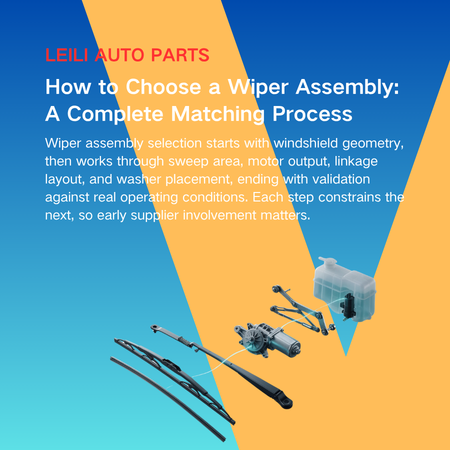
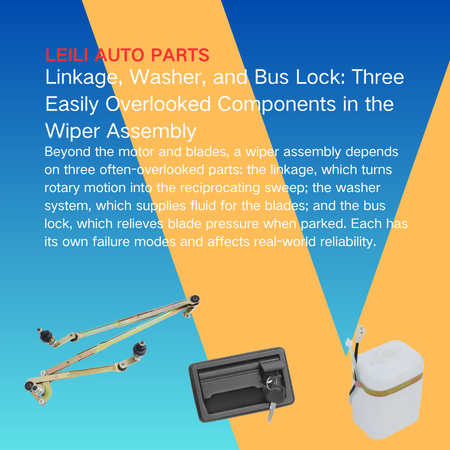
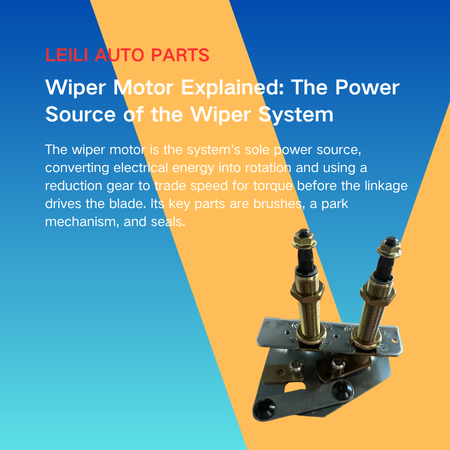
The product line spans the full system: wiper assembly, wiper motor (12V/24V DC dual-speed permanent-magnet, 20W–180W), wiper blade (12–60 inch), wiper arm, wiper linkage, and washer tank. That breadth matters, because sourcing a complete system from one wiper assembly manufacturer means one quality standard, one warranty, and one accountable partner — instead of stitching together parts from four vendors.
A maintenance manager for a construction-equipment fleet put it to me simply: the reason he moved his wiper sourcing factory-direct was the feedback loop. When a motor spec needed adjusting for a dust-heavy site, the change came back in weeks from the wiper motor manufacturer that designed it — not months from a middleman forwarding emails. That’s the real value of buying from the source: the engineer who fixes the problem is the one who built it.
From blades and arms to complete assemblies, explore the capabilities behind the numbers:
- Wiper blade manufacturer — 12–60 inch blades across rubber compounds
- Wiper linkage manufacturer — salt-spray-tested linkages and pivots
- Wiper arm manufacturer — OEM/ODM arm and adapter customization
- Learn more about LEILI — 35 years of wiper system manufacturing
FAQ
What’s the difference between a wiper system manufacturer and a wiper system supplier?
A manufacturer owns the production lines and tooling; a supplier may simply distribute or resell. For OEM, private-label, or customization work, you need a true manufacturer — otherwise you’re paying a markup for a middleman who can’t fix quality at the source.
What certifications should a wiper system manufacturer have?
At minimum, ISO 9001. If you’re sourcing for OEM or quality-sensitive aftermarket programs, look for IATF 16949:2016, and ISO 14001 if you sell into the EU. Ask to see the certificate and the underlying control plan, not just the framed copy.
Which rubber compound is best for wiper blades?
It depends on climate and price point. Natural rubber is cheapest but weakest against ozone and UV. Silicone offers the longest life and best temperature range. Chloroprene (CR) balances cost with strong weather and abrasion resistance. A good wiper blade manufacturer will recommend a compound based on your target market.
What is a typical MOQ and lead time for wiper systems?
This varies widely by product and customization. Full assemblies and custom motors carry higher MOQs than stock blades. A factory-direct manufacturer should state its MOQ and a realistic lead time up front — and be willing to start with a sample and pilot order before a full run.
How do I verify quality before placing a large order?
Request a sample for sign-off, then a pilot order at production volume. Ask for salt spray, wipe-cycle, and AQL inspection reports, and confirm the factory tests in-house before packing. These three steps catch most sourcing failures before they reach your customers.
Which compliance standard applies to my market?
For passenger vehicles in North America, reference SAE J903; for trucks and buses, SAE J198. In Europe, wiper and washer systems fall under Regulation (EU) 2019/2144 (referencing UN Regulation No. 43 / UNECE R43). For customs, use HS 8512.40. A capable supplier should confirm the right standard for your region without prompting.
Conclusion
Choosing a wiper system manufacturer comes down to matching the sourcing model to the factory, then verifying the things that are easy to fake but costly to get wrong: certifications, rubber compound, testing, and whether the supplier actually owns the line.
Work the checklist, run a sample and pilot, and buy from the source. The Texas distributor in our opening story learned the hard way that the cheapest quote is rarely the cheapest total cost. You don’t have to. Define your channel, score your candidates on the eight factors, and partner with a factory that can prove its quality with numbers — not promises.
Ready to start with a sample and a factory quote? Request a factory quote →