


I. What is a Wiper Assembly?
In rainy or foggy weather, rainwater on the windshield can seriously obstruct visibility. This is especially true for buses, construction machinery, and commercial vehicles.
A wiper assembly is a complete windshield cleaning system. Specifically, it uses a motor-driven linkage to operate the wiper arm and blade. Consequently, it sweeps back and forth to remove rain, dirt, and debris. As a result, it ensures clear visibility for the driver.
A complete wiper assembly typically includes the following core components:
| Component Names | Function |
|---|
| WIPER MOTOR | Provides the power source, driving the output shaft to rotate via an electromagnetic coil. |
| WIPER ARM | Connects the motor to the wiper blade, transmitting torque. |
| WIPER BLADE | Directly contacts the windshield and is responsible for wiping water. |
| WIPER LINKAGE | Converts the motor’s rotary motion into the reciprocating motion of the wiper blade. |
| WASHER TANK | Water spray nozzle that sprays cleaning fluid onto the windshield. |
| BUS DOOR LOCK | Locking mechanism for the wiper arm in the parked (non-operational) position. |
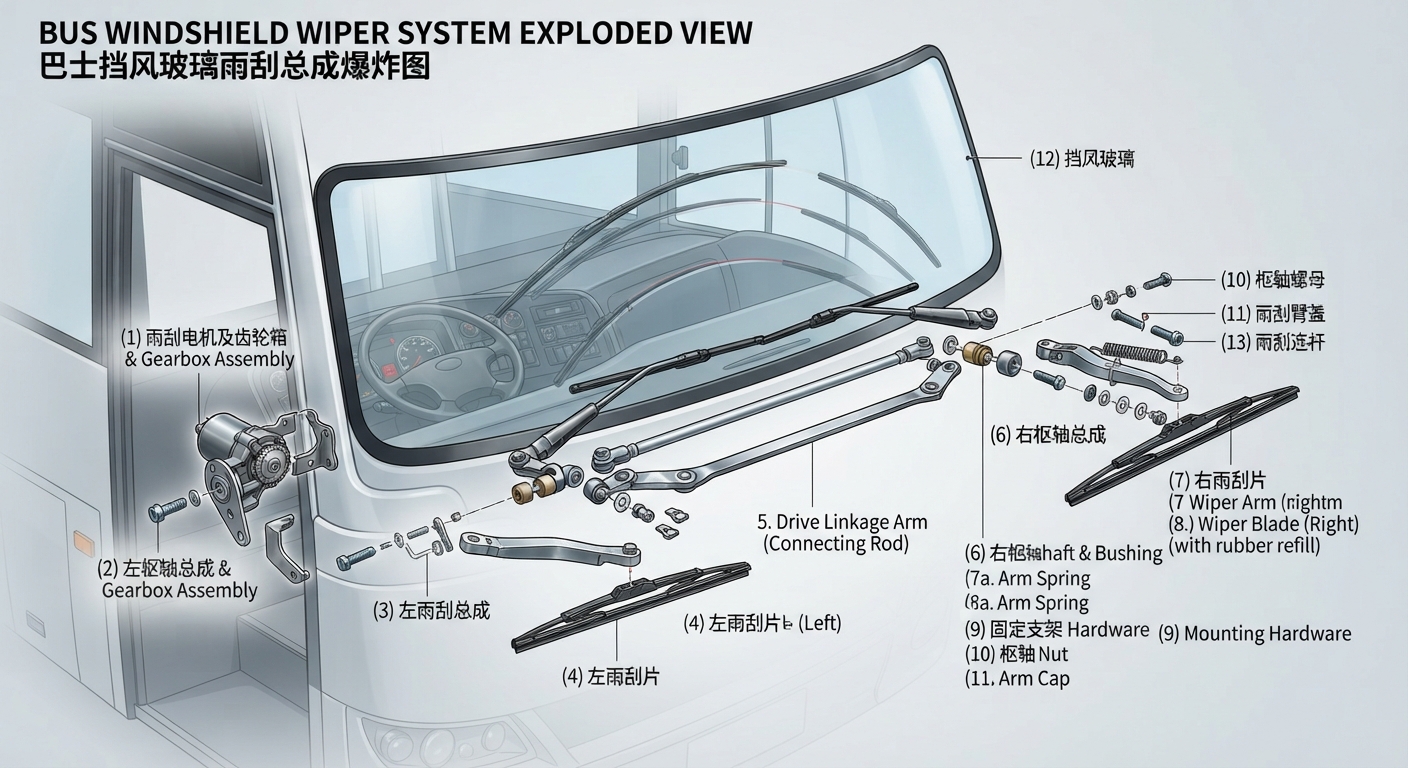
bus windshield wiper exploded view
II. Wiper Motor
Working Principle
The wiper motor is the power heart of the wiper system.
When the driver activates the wiper switch, the motor receives an electrical signal. Then, the internal electromagnetic coil is energized to generate a magnetic field. This magnetic field, in turn, drives the rotor to rotate.
The output rotary motion passes through a reduction gear mechanism. Next, it is transmitted via the output shaft to the linkage rods. Ultimately, this drives the entire wiper mechanism into motion.
Main Technical Specifications
- Rated voltage: Typically 12V or 24V, matched to the vehicle’s electrical system
- Output power: Generally between 10W and 50W, depending on the vehicle model
- Rated speed: The motor output shaft rotates at approximately 1,200–1,500 RPM; after reduction, the output shaft speed drops to several tens of RPM
- Protection rating: Typically IP65 or higher, to withstand harsh outdoor environments
- Operating temperature range: -40°C to +80°C
Common Faults
The motor itself is relatively reliable. However, prolonged operation in humid environments can lead to several issues. For example, water ingress may cause coil short circuits. Additionally, brush wear and bearing seizure are common problems. As a result, these issues can lead to weak wiper performance or complete failure.
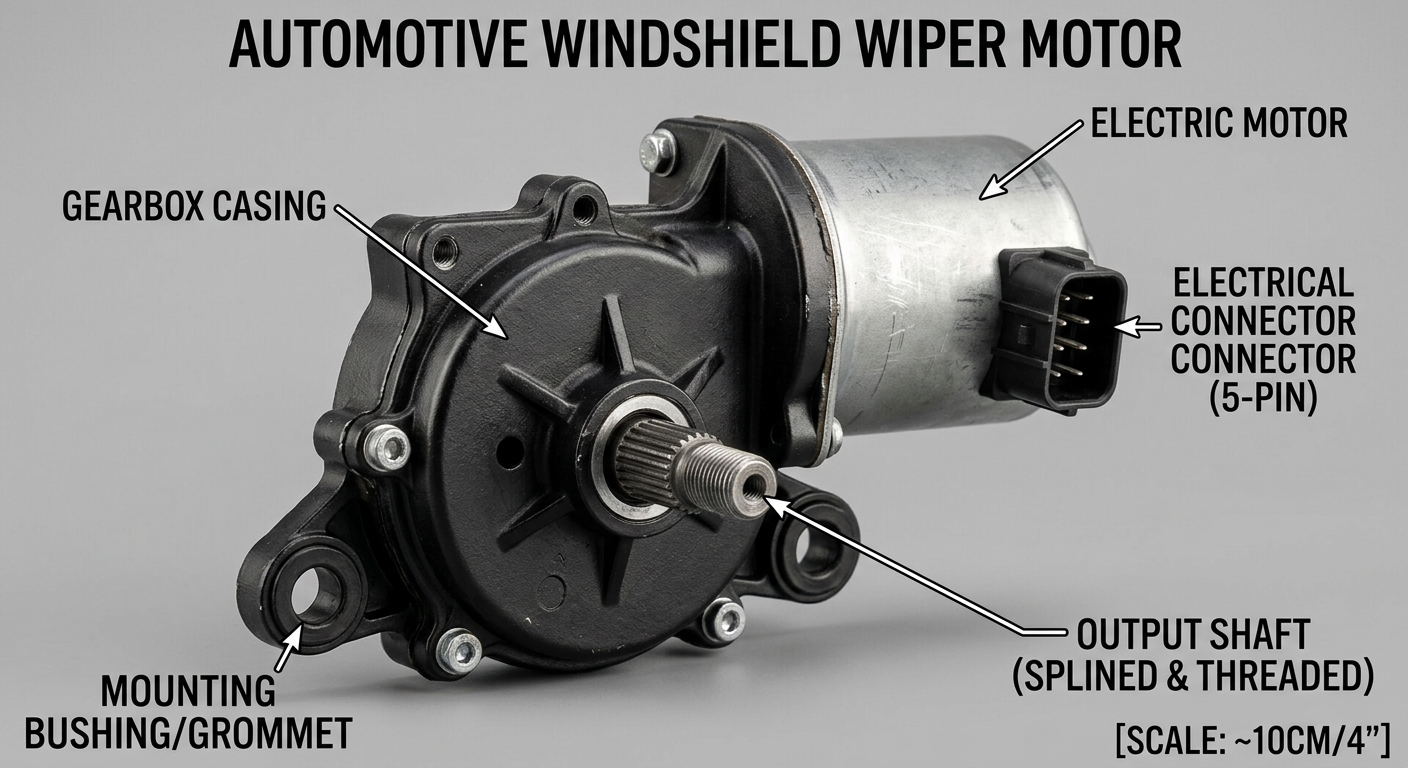
automotive windshield wiper motor
III. Wiper Arm and Wiper Blade
Wiper Arm
The wiper arm is the intermediate component connecting the motor output to the wiper blade, typically made from stamped metal or cast parts. It transmits the motor’s rotary motion to the wiper blade while maintaining sufficient rigidity and strength to resist deformation during wiping.
The operating angle of the wiper arm is typically between 90° and 110°, and the design must fully account for the match between the wiper sweep area and the windshield shape.
Wiper Blade
The wiper blade is the component that directly contacts the windshield surface, consisting of a rubber squeegee strip and a plastic frame.
- Rubber material: Silicone rubber or natural rubber are currently the mainstream choices; silicone rubber offers better wear resistance and longer service life.
- Structural design: Wiper blades come in single-arm or beamless (boneless) designs. Beamless blades rely on internal steel strips to conform evenly to the glass, providing more uniform pressure distribution and better wiping performance.
- Replacement interval: Inspect every 6–12 months; replace promptly if streaking, unusual noise, or rubber aging/cracking is observed.
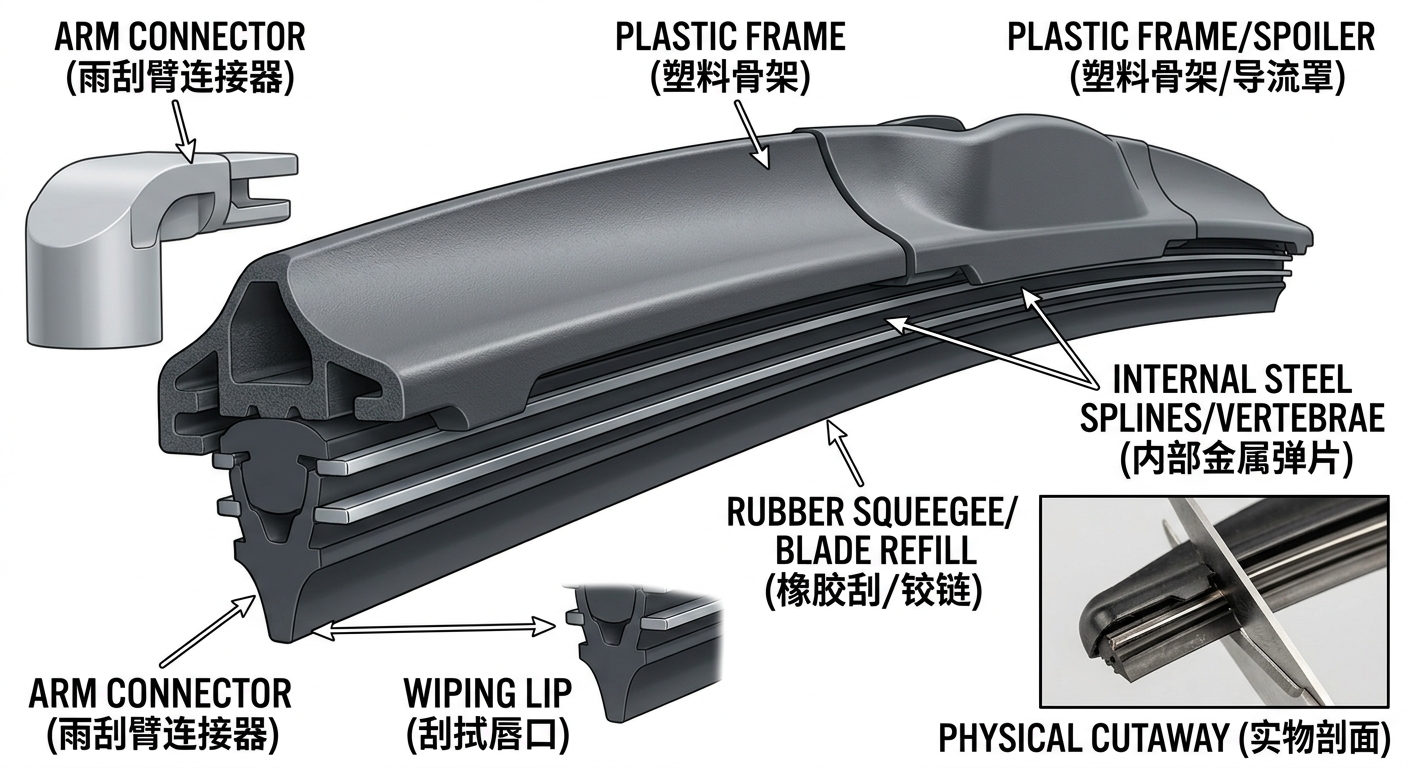
physical cutaway
IV. Linkage Mechanism
The linkage rod is a critical yet often overlooked component in the wiper system. Its core function is to convert the motor’s rotary motion into the reciprocating linear motion of the wiper blades.
Motion conversion principle: The motor output shaft drives a crank, which is ball-jointed to the linkage rod. With each full rotation of the crank, the linkage rod pushes the wiper blade back and forth once. Multiple linkage rods transmit motion sequentially through their joint points, ultimately driving the left and right wiper arms to work in coordination.
Technical requirements: All joint points of the linkage rod require proper lubrication and sealing; otherwise, water ingress and rust can easily cause motion seizure, resulting in slow or uneven wiper operation.
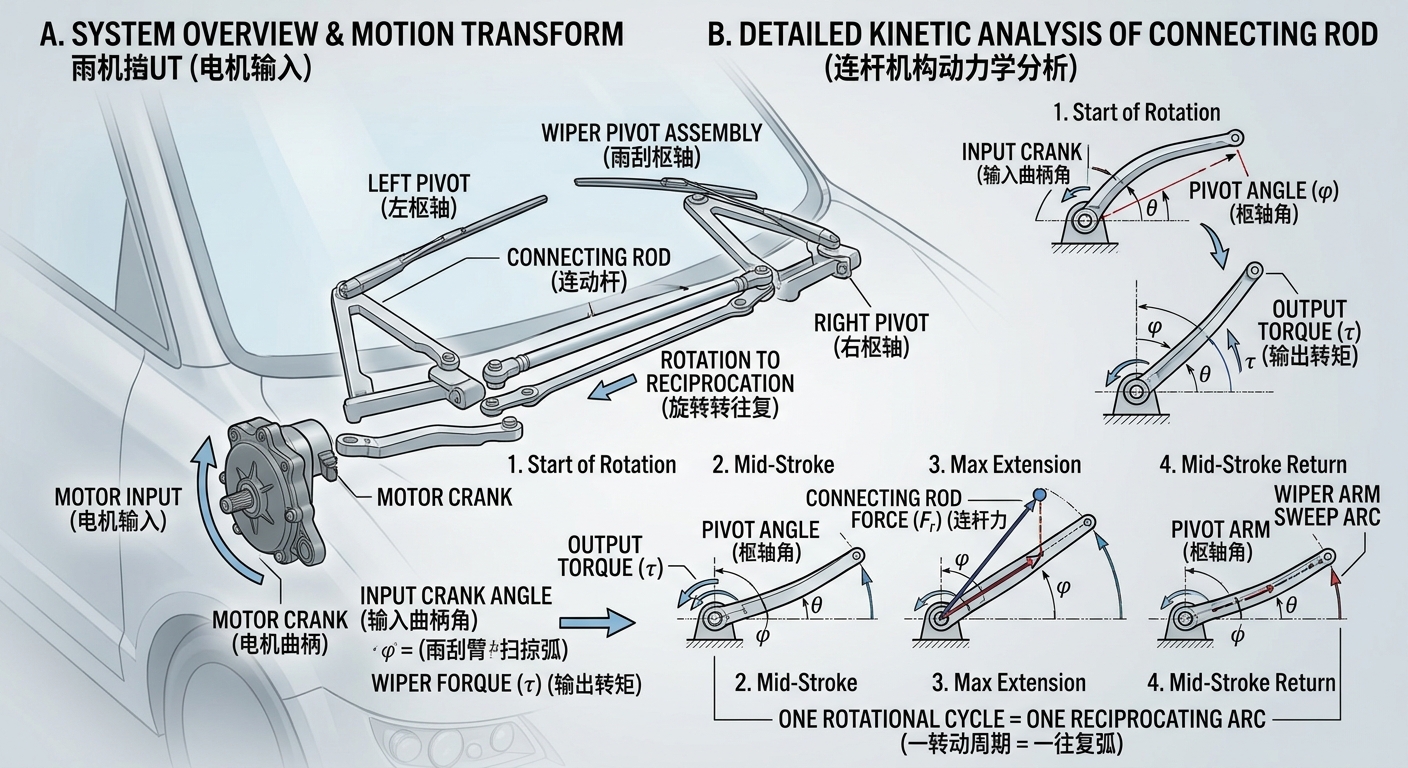
Crank-Rocker Mechanism
V. Windshield Washer System
The washer system consists of a water pump, motor, reservoir, and spray nozzles. When the driver presses the washer button, the pump motor activates, drawing cleaning fluid from the reservoir and delivering it through tubing to the nozzles on the windshield, which spray it evenly across the glass surface.
Washer fluid is typically used in conjunction with the wipers, as plain water cannot effectively remove oil film and insect residue from the glass. The cleaning fluid contains added surfactants and antifreeze components.
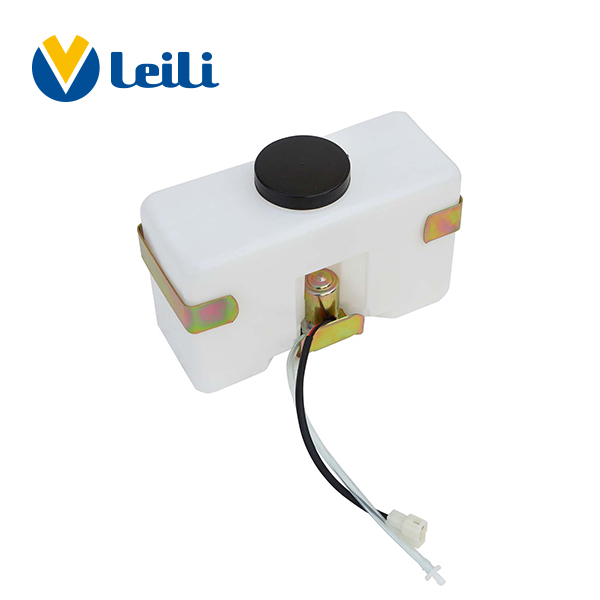
washer tank for windshield fluid
VI. Wiper Arm Parking Lock (Bus)
The bus lock is a wiper arm locking mechanism specifically designed for bus models. When a bus is parked for extended periods, the wiper arm can be lifted off the glass and locked in place, preventing long-term pressure deformation of the wiper blade or it sticking to the windshield.
Some bus locks also integrate a heating function, which helps clear ice and snow between the wiper blade and the glass in cold regions, preventing the wipers from freezing to the windshield and failing to operate.
.jpg "LL-184D Luggage Storehouse Lock")
LL-184D Luggage Storehouse Lock

.png)


