


Wiper Assembly Cost Analysis: Why Do Premium Brands Cost More and Are Chinese Alternatives OEM-Qualified?
In the global automotive sector, a striking price divergence puzzles many fleet managers. In addition, parts distributors and heavy-duty machinery buyers face identical procurement challenges. Specifically, sourcing a complete wiper assembly commands a massive premium from international Tier-1 brands like Bosch, Valeo, and Doga. This total wiper system comprises a high-torque motor, linkage mechanism, wiper arms, blades, and a fluid washer delivery unit.
Consequently, premium brand systems cost several times more than direct factory quotes from top-tier Chinese manufacturers. These massive markups exist across global e-commerce platforms, independent B2B sites, and traditional retail networks. Therefore, professional buyers must evaluate this pricing structure carefully.
Does this multi-fold price gap reflect a fundamental difference in safety? Furthermore, does it prove superior durability and engineering? Conversely, is it merely the byproduct of legacy supply chain structures? This industrial analysis deconstructs the cost anatomy of a modern wiper system. Ultimately, we evaluate whether a Chinese-manufactured wiper assembly serves as a qualified, OEM-grade alternative.
Technical Breakdown: What Components Form a Heavy-Duty Wiper System Assembly?
First, before analyzing global costs, we must define the technical scope of a full setup. For instance, a commercial-grade wiper assembly is not a simple blade replacement. Instead, it is an engineered safety wiper system consisting of four tightly synchronized sub-systems:
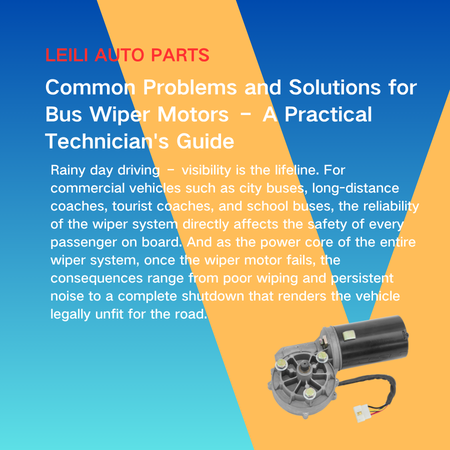
- The Actuator (Wiper Motor): This electrical heart drives the wiper system. Therefore, it requires precise torque control and electromagnetic compatibility (EMC).
- The Transmission (Wiper Linkage / Mechanism): These geometric steel linkages convert rotational motor power into synchronized alternating motion. Consequently, they stabilize the full wiper assembly.
- The Contact Interface (Wiper Arm & Blade): These structural components distribute uniform aerodynamic pressure across expansive windshields.
- The Fluid Delivery (Washer System): This unit integrates fluid reservoirs, automotive-grade washer pumps, and calibrated spray nozzles.
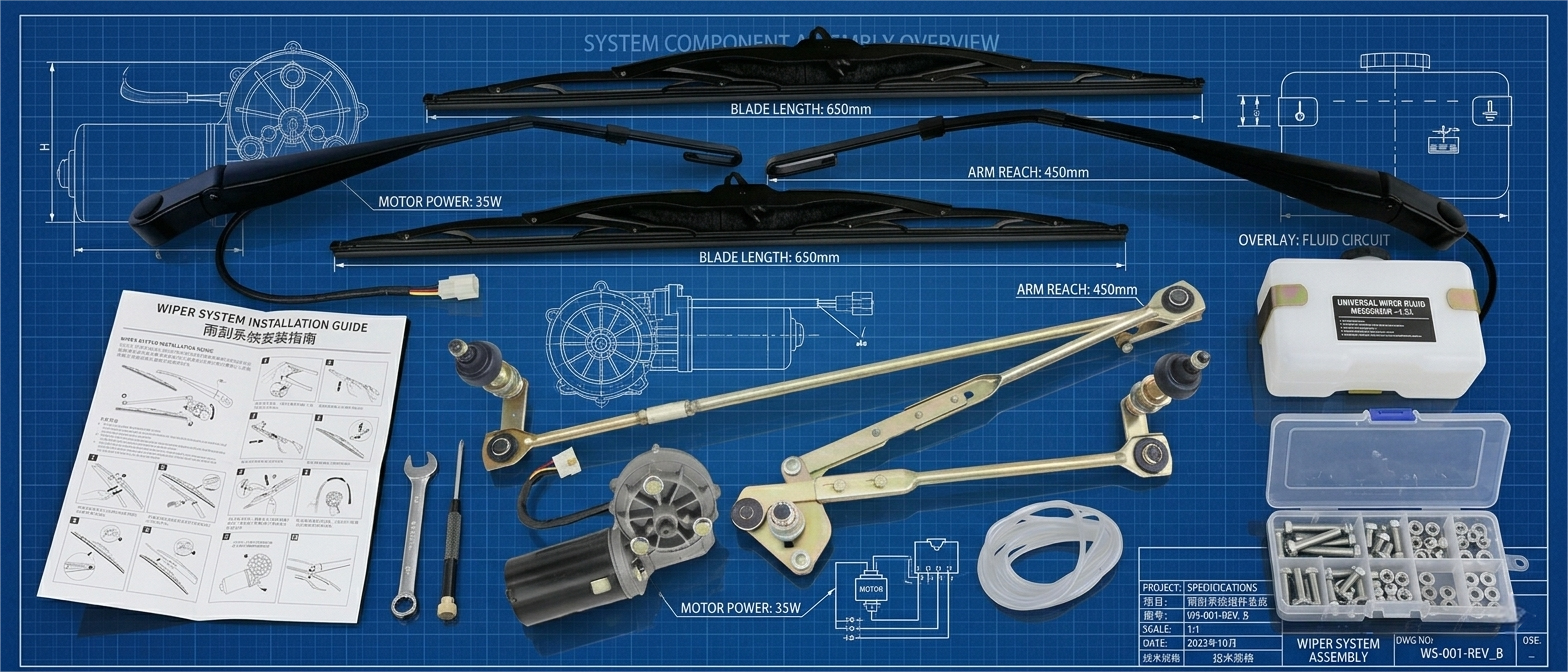
Figure 1: Detailed technical diagram of a complete heavy-duty wiper system assembly, pointing out the motor, linkage, arms, and washer connections.
Part 1: Cost Anatomy: Why Does a Premium Brand Wiper Assembly Command Such High Prices?
To evaluate alternative sourcing, procurement officers must understand premium brand cost structures. However, the high price tag of a traditional Tier-1 wiper assembly is not driven by raw material costs alone. Instead, three structural pillars drive these expenses.
1. Amortization of Legacy R&D and OE System Integration
Global giants frequently co-develop a wiper system alongside vehicle OEMs during the initial design phase. For example, this process involves years of simulation, track testing, and custom tooling. As a result, these massive upfront engineering expenses are amortized over decades. Ultimately, this loads heavy costs onto the aftermarket wiper assembly supply chain.
2. Multi-Tiered Global Distribution and Warehousing
Furthermore, a full wiper system is bulky, heavy, and contains sensitive electrical motors. Thus, its logistics chain is highly complex. For instance, a typical premium wiper assembly undergoes a lengthy international journey. This route includes overseas contract manufacturing, continental distribution hubs, national importers, regional wholesalers, and local repair stations. Consequently, every single tier adds a 20% to 35% margin markup.
3. Comprehensive Risk Hedging and Brand Equity
Moreover, premium pricing accounts for global corporate overheads and international patent litigation funds. Brands also include high-limit global product liability insurance in their pricing. In contrast, these non-manufacturing expenses offer no direct mechanical enhancement to the physical wiper assembly operating on a vehicle.
Part 2: Supply Chain Closed-Loop: The Cost Efficiency Behind a Direct-Factory Wiper System
In contrast, the highly competitive pricing of a top-tier Chinese wiper assembly is not rooted in substandard materials. Rather, it stems from structural manufacturing efficiencies optimized for modern B2B demands. Therefore, buyers get high value without sacrificing quality.
1. Vertical Supply Chain Integration
Unlike assembly-only shops, leading Chinese manufacturing hubs utilize complete vertical integration for every wiper system. For example, within a single production complex, engineers oversee all manufacturing stages. These stages include wiper motor armature winding, magnetic circuit design, linkage stamping, arm anti-corrosion coating, and rubber blade vulcanization. As a result, this process eliminates multi-factory logistical lag. Furthermore, it reduces inter-company transaction margins on the final wiper assembly.
2. High-Density Industrial Clustering
In addition, raw material suppliers are clustered within a nominal radius of the primary wiper system factories. These suppliers provide electromagnetic copper wire, cold-rolled carbon steel, and specialized washer pumps. Consequently, this dense ecosystem facilitates rigid Just-In-Time (JIT) inventory management. Therefore, factories minimize capital tied up in warehousing the wiper assembly components.
Part 3: Standard Benchmarking: Is a Chinese Wiper Assembly Compliant with Global Wiper System Demands?
For international buyers, the core question is compliance. Specifically, can a cost-effective alternative wiper system match Tier-1 performance? To find the answer, we must analyze the rigorous national standards governing top-tier Chinese export manufacturers.
Modern automotive components out of China operate under the strict oversight of the IATF 16949 quality management system. Therefore, their failure mode effects analysis (FMEA) aligns directly with global automotive benchmarks. Furthermore, performance is validated by two foundational engineering standards:
Durability & Wiping Efficiency: GB 15085
The Chinese National Standard GB 15085 regulates every automotive wiper assembly through grueling dynamic fatigue trials. To pass, the complete wiper system mechanism and motor must endure up to 1.5 million continuous wipe cycles. These tests run under simulated torrential downpours. Consequently, the wiping efficiency and field of vision retention must remain flawless post-test.
Ingress Protection & Waterproofing: GB/T 4208
Moreover, a heavy-duty wiper assembly faces highly diverse environments. Under GB/T 4208 (which mirrors the international IEC 60529 standard), ingress protection is engineered scientifically based on component exposure:
- IP52 Rating: Applied to indoor electrical connections, providing certified dust resistance for the internal wiper system elements.
- IP56 Rating: Applied to exposed external linkages and brackets, built to withstand powerful, high-pressure water jets without moisture ingress.
- IP66 Rating: Reserved for critical, heavy-duty electric motors mounted in severe external environments. This guarantees a dust-tight, waterproof wiper assembly that is resilient against heavy seas.
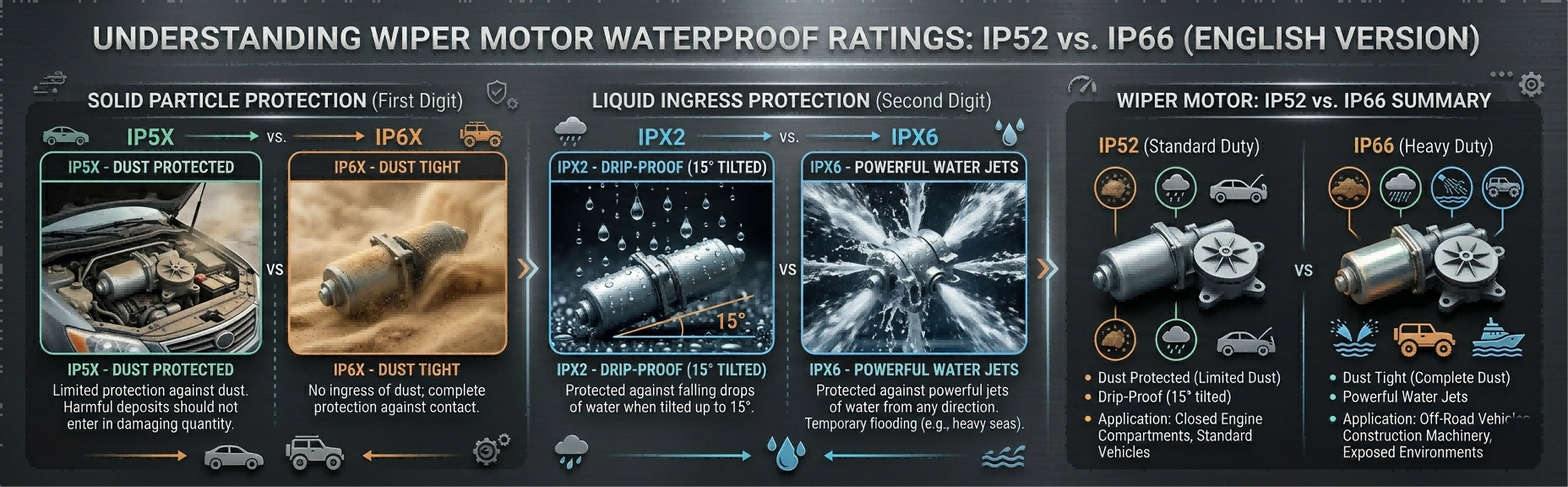
Wiper motor undergoing high-pressure water jet testing for IP66 rating compliance
Case Study: Technical Parameter Benchmark of a Top-Tier Commercial Wiper System
To provide an objective perspective, we can evaluate a real-world manufacturing case. The table below highlights the performance metrics of Zhejiang Leili Auto Parts Co., Ltd.. This factory serves as a representative, export-focused Chinese OEM/ODM supplier specializing in the complete commercial wiper system market.
| Technical Evaluation Metrics | Premium International Brands (Bosch, Valeo, Doga) | Case Study: Zhejiang Leili (Top Chinese Representative) | Compliant Reference Standard |
|---|---|---|---|
| Quality Management System | IATF 16949 Certified | IATF 16949 Certified | Global Automotive Framework |
| In-Cabin Component Ingress | IP52 (Dust/Drip Protected) | IP52 (Dust/Drip Protected) | GB/T 4208 / IEC 60529 |
| Exposed Mechanism Ingress | IP56 (Powerful Water Jets) | IP56 (Powerful Water Jets) | GB/T 4208 / IEC 60529 |
| Heavy-Duty Motor Ingress | IP66 (Dust-Tight Sealing) | IP66 (Dust-Tight/Heavy Seas) | GB/T 4208 / IEC 60529 |
| System Fatigue Life Test | Exceeds OEM Requirements | ≥ 1,500,000 Cycles (Full Assembly) | GB 15085 (Chinese National Standard) |
| Supply Chain Efficiency | Multi-Tier Global Distribution | Direct Factory Sourcing Available | B2B Commercial Efficiency |
B2B Procurement Matrix: How to Evaluate an OEM-Grade Wiper Assembly Supplier
When transitioning your supply chain to a factory-direct model, avoid general traders. Instead, evaluate manufacturers based on verifiable technical assets to secure a reliable wiper system:
- Request PPAP Documentation: A true OEM partner provides Production Part Approval Process (PPAP) Level 3 documentation. This must include complete design records and material test results for the wiper assembly.
- Verify In-House Testing Capabilities: Ensure the facility houses independent environmental chambers. Furthermore, verify they possess salt spray corrosion testing beds and EMC compliance labs for the entire wiper system.
- Confirm Plug-and-Play Geometry: High-quality manufacturers design their linkages, wiring harness connectors, and mounting brackets to exactly replicate standard OE positions. Consequently, this ensures effortless installation for global fleet maintenance.
Conclusion
In conclusion, the notable price delta surrounding global heavy-duty components is primarily a reflection of corporate overhead. It does not stem from engineering superiority. Therefore, for global procurement teams aiming to optimize their Total Cost of Ownership (TCO), sourcing a direct-factory wiper system is statistically sound. Choosing an IATF 16949-certified factory complying with GB 15085 and precise IP52/IP56/IP66 protection ratings delivers a highly successful, commercially viable wiper assembly strategy.
B2B Procurement FAQ
Q: Can a Chinese-manufactured wiper assembly directly replace a Tier-1 system on a commercial bus or heavy crane?
A: Yes, absolutely. When produced by a qualified factory utilizing precision tooling, the geometric linkages match OEM specifications perfectly. Furthermore, the electrical connector pins are designed for 100% plug-and-play compatibility with existing commercial vehicle mounts.
Q: How do Chinese manufacturers protect the wiper motor from voltage spikes in heavy-duty electrical systems?
A: Industrial-grade wiper motors are built with integrated circuit protection. Additionally, they meet global automotive EMC (Electromagnetic Compatibility) directives. Therefore, they do not interfere with—or get damaged by—on-board vehicle electronics within the main wiper system.
.png)


