


Introduction: School Bus Wipers Are Not Just About Clearing Water—They Are the First Line of Defense for Student Visibility
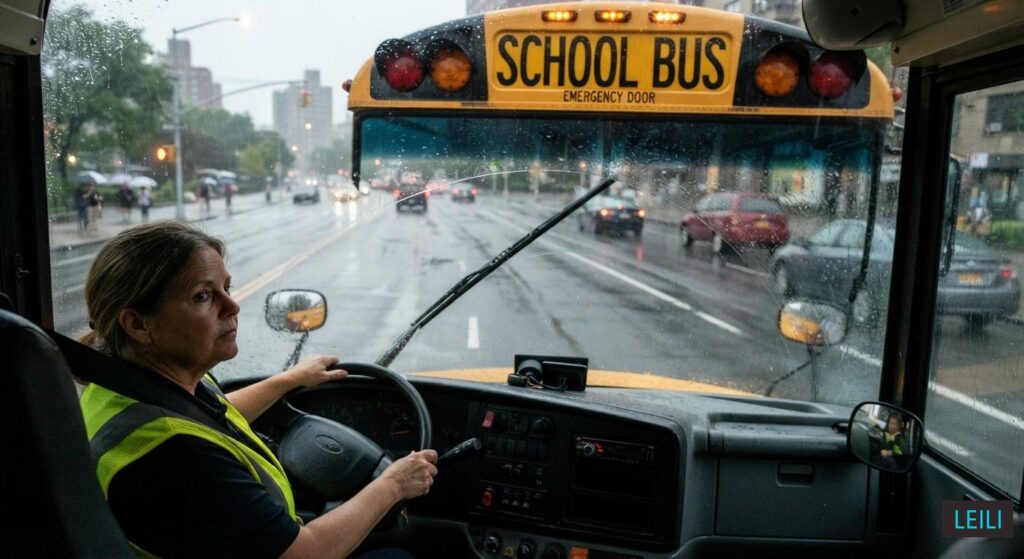
School buses carry society’s most vulnerable passengers. In rain, fog, snow, and ice, the wiper system directly determines whether the driver can clearly assess the road ahead, side blind spots, and mirror visibility. A poorly selected wiper system can mean seconds of visibility interruption—and for a school bus full of children traveling on mixed urban-rural routes, those seconds are simply unacceptable.
Domestic school bus safety follows GB 24407-2012 “Safety Technical Conditions for Special School Buses,” while export markets require compliance with FMVSS 104 (U.S.), ECE R43 (EU), and SAE J198, among other regulations. Zhejiang Leili Auto Parts Co., Ltd. has deep experience in the bus wiper sector and has built a complete solution for the school bus niche covering regulatory compliance, visibility optimization, and multi-model adaptability.
1. Regulatory Framework: Safety Thresholds Every School Bus Wiper System Must Meet
1.1 Core Domestic Regulation: Visibility Clauses in GB 24407-2012
GB 24407-2012 sets clear constraints on school bus windshields and visibility-related systems:
| Clause | Requirement | Implicit Impact on Wiper Systems |
|---|
| 5.13.1 Driver Visibility | Must meet Appendix C visibility requirements; no devices may obstruct outside visibility | Wiper sweep area must fully cover the A/B zones defined by regulation |
| 5.13.2 Auxiliary Reversing Device | Must install rearview system capable of seeing a 3.6m × 2.5m area behind the rear window | If rear window wipers are needed, sweep area must match rearview camera field of view |
| 5.13.4 Windshield Defrost/Defog Device | Mandatory defrost/defog installation | Wiper system must work in coordination with defrost/defog to prevent blade freezing and failure at low temperatures |
| 5.14 Interior Air Quality | Mandatory ventilation; air quality must comply with GB/T 17729 | Washer fluid must not produce harmful volatiles; environmentally friendly formulas required |
These clauses point to one conclusion: a school bus wiper system is not just about “wiping clean”—it must serve the driver’s complete visibility safety system.
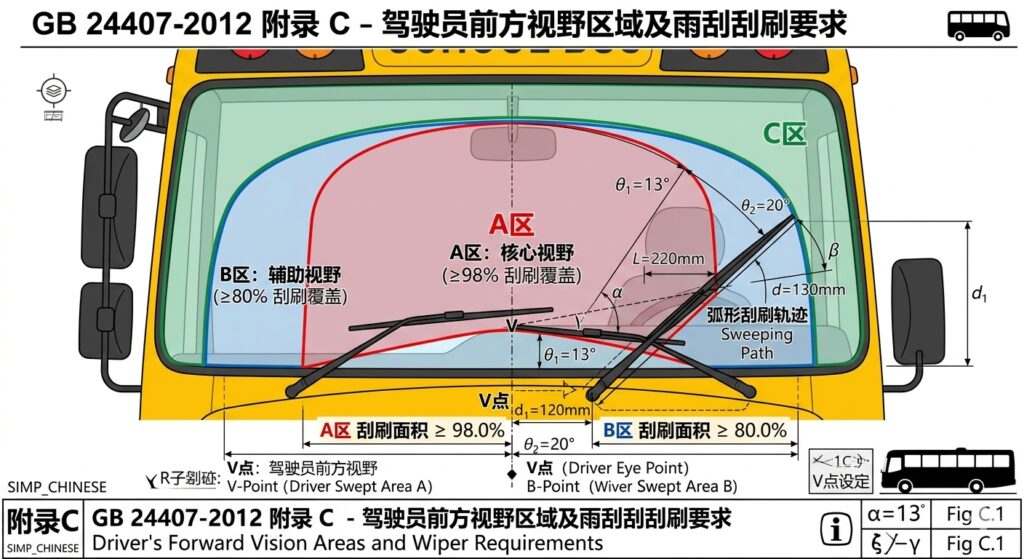
GB 24407-2012 Appendix C driver visibility zones A B C diagram
1.2 International Standard Differences: Multiple Certification Challenges for Export School Buses
China’s school bus export market continues to grow, from Southeast Asia to the Middle East, Africa, and Latin America. Different target markets correspond to differentiated regulatory systems:
FMVSS 104 (U.S. Federal Motor Vehicle Safety Standard): Requires the windshield washer system to run continuously at maximum speed on dry glass for 10 minutes without visibility deterioration—imposing stringent demands on wiper motor durability.
ECE R43 (UN Economic Commission for Europe): Specifies coordination requirements for safety glass and visibility. This standard requires the wiper system to operate on a dry windshield for at least 2 minutes without performance degradation, with a sweep frequency of no less than 40 cycles/minute, and must not cause micro-scratches on the windshield.
SAE J198 (Society of Automotive Engineers): Specifically addresses wiper systems for trucks, buses, and school buses with GVWR ≥ 4,500 kg, defining sweep frequency, coverage area, durability cycles, and test procedures. Its durability requirements include maintaining function after 1.5 million cycles, with blades required to clear 75% of the effective sweep pattern after 500,000 cycles.
For export models, OEMs must clarify the corresponding regulatory checklist based on the target market and select wiper systems certified accordingly.
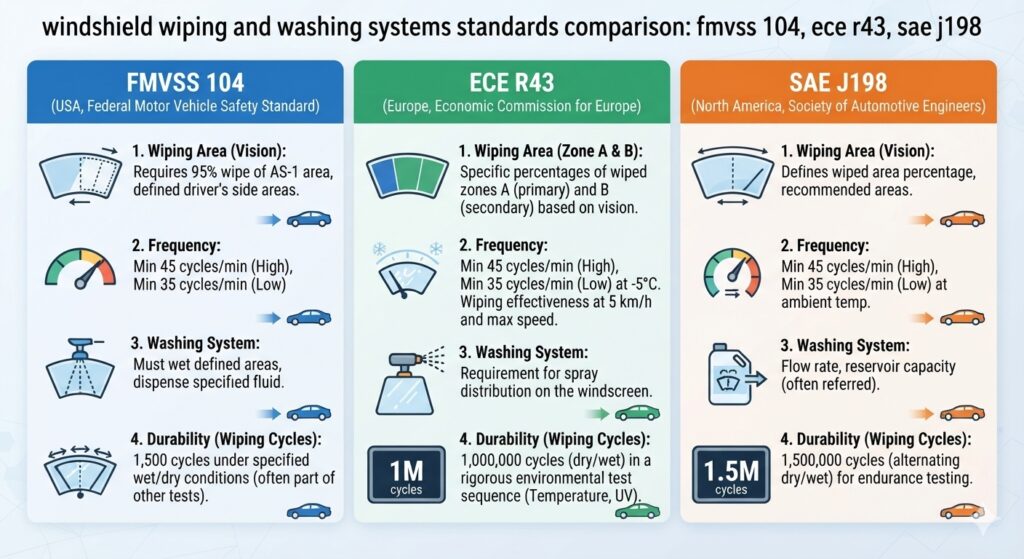
Comparison of FMVSS 104 ECE R43 and SAE J198 wiper standards
2. Multi-Model Adaptation: Wiper Selection Solutions for Three School Bus Segments
School buses are not a single vehicle type. Kindergarten, elementary, and middle school segments correspond to different body lengths, passenger capacities, and operating environments—and wiper system selection logic differs fundamentally across them.
2.1 Kindergarten School Buses (6–7 m Class): “Zero Blind Spot” Solution for Young Children
Typical Models: Yutong ZK6685DX, Foton Auv BJ6590, etc.
Scenario Characteristics:
Capacity 20–35 passengers; narrower body (≤ 2.3 m); operates in congested urban roads and narrow residential streets
Children aged 3–6; boarding/alighting behavior unpredictable; driver must frequently observe around the vehicle
Short routes (typically 5–10 km) but frequent stops and starts
Recommended Solution:
The safety core for kindergarten school buses lies in all-directional visibility at low speeds. Opposed wiper systems use dual motors independently driven, sweeping toward each other—the design logic being to reduce the central windshield blind spot. The industry already offers products covering opposed overlapping, opposed upright, and other wiper series. Combined with A-pillar narrowing (Yutong and other OEMs have controlled A-pillar width to 80 mm), the opposed layout can effectively improve the effective sweep area coverage of the front windshield.
Key Parameter Reference:
Wiper blade length: Driver side 700 mm / Passenger side 650 mm
Motor type: 24V permanent magnet DC motor, rated power 50W
Sweep frequency: High speed 65 cycles/min, low speed 45 cycles/min
Washer system: Dual nozzle layout, 3.5L washer fluid reservoir
2.2 Elementary School Buses (7–8 m Class): All-Weather Solution for Mixed Urban-Rural Routes
Typical Models: Yutong ZK6745DX, Foton Auv BJ6926, etc.
Scenario Characteristics:
Capacity 30–46 passengers; mixed urban and township routes; some unpaved roads
Severe mud and water splash in rain; wipers must maintain stable clearing under high contamination
Daily operation up to 2–4 hours; higher demands on motor heat dissipation and blade durability
Recommended Solution:
Elementary school buses need to balance large sweep area with structural durability. The three-blade wiper solution (three independent blades in parallel layout) is a typical choice for this class. Foton Auv school buses have adopted a three-blade design, and publicly available information indicates that its sweep area is increased compared to two-blade solutions. In heavy rain conditions, this solution helps maintain clear visibility of mirrors and blind-spot mirrors.
The core challenge of the three-blade solution lies in synchronization and load balancing—three blades impose extremely high consistency requirements on the linkage mechanism and motor torque output. Three-blade systems in the industry typically use dual-motor synchronous control technology: the main motor drives the center and left blades, while the secondary motor drives the right blade. Synchronization via CAN bus signals keeps blade phase difference within a small range.
Key Parameter Reference:
Wiper blade length: All three 750 mm
Motor type: 24V permanent magnet DC motor ×2, single motor rated power 60W
Sweep area: Effective coverage ≥ 1.2 m²
Blade material: Natural rubber + graphite coating, operating range covers -35°C to +80°C
2.3 Middle School Buses (8–9 m Class): High-Reliability Solution for Long-Distance Commuting
Typical Models: Yutong ZK6875DX, Foton Auv BJ6116, etc.
Scenario Characteristics:
Capacity 46–56 passengers; some serve urban-rural fringe and suburban long-distance commuting
Large windshield area (can exceed 2.5 m²); wiper load far higher than ordinary buses
Highway scenarios: wind resistance imposes continuous lifting force on wiper arms; high-speed adhesion must be ensured
Recommended Solution:
Middle school bus windshields approach those of touring coaches, and wiper loads increase accordingly. Wide-span, high-torque wiper solutions typically adopt the following designs:
Wide-span blades: Primary and secondary blades can reach 900 mm class, with internal spring steel strip structure providing uniform downforce distribution along the full length, helping to solve the common end-lift problem of long blades.
High-torque motors: Worm gear reduction mechanism, output torque ≥ 35 N·m (compared to approximately 20–25 N·m for ordinary bus motors). At highway speeds, blades can still maintain tight adhesion to the windshield.
Anti-pinch design: School bus wiper arm fold angles are specially optimized; after arm return, clearance from A-pillar is no less than 30 mm, reducing the risk of children’s hands being pinched. This design detail extends from GB 24407-2012 requirements for all accessible parts on school buses.
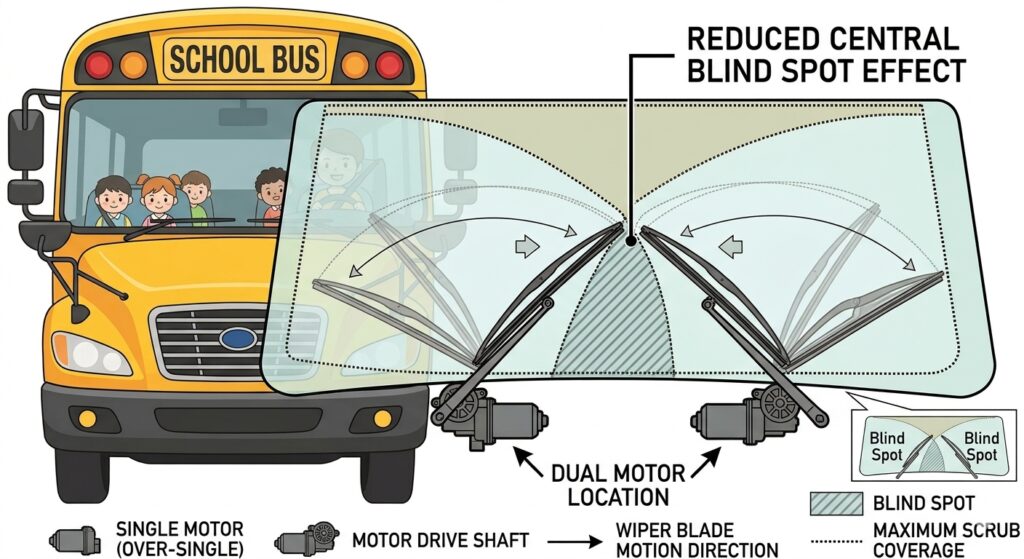
Opposed wiper system layout on kindergarten school bus windshield

.png)


