
I. What Role Does the Wiper Motor Play in the System?
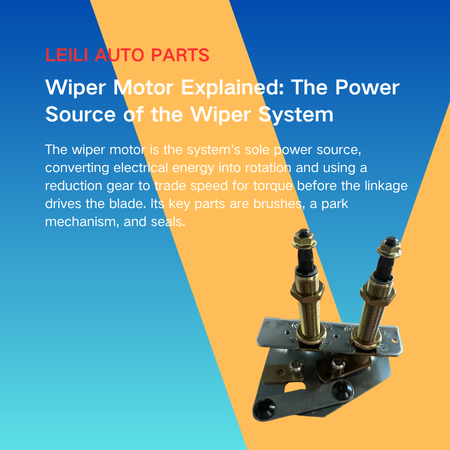
The working principle of the wiper assembly can be simply summarized as: the motor provides power, the reduction mechanism lowers the speed and amplifies the torque, the linkage converts rotational motion into reciprocating oscillation, and finally the wiper arm transmits the motion to the wiper blade.
In this entire chain, the motor is the only power source. Its output characteristics—speed, torque, and starting capability—directly determine the force and speed with which the wiper blade clears water. If the motor is underpowered, no matter how precise the downstream mechanical structure is, it cannot perform to its full potential.
II. Basic Working Principle of the Wiper Motor
The wiper motor is a DC motor. When powered, the stator coils generate a magnetic field, and the rotor rotates under the force of the magnetic field, converting electrical energy into mechanical energy. The direction of current determines the direction of rotation, so reciprocating wiper oscillation can be achieved through commutation.
The motor also contains a reduction mechanism, usually a worm gear or gear set. This is because the motor itself runs at high speed, while the wiper arm needs low-speed, high-torque output. The reduction mechanism lowers the speed while amplifying the torque, allowing the wiper blade to remain stable when conforming to the glass and overcoming wiping resistance.
III. Structural Composition of the Wiper Motor
A typical wiper motor mainly consists of the following parts:
| Components | Functions |
|---|
| Stator and Rotor | Generates the magnetic field and rotational motion, and is the core of energy conversion. |
| Brushes and Commutator | Continuously supplies power to the rotor during rotation. |
| Reduction Mechanism | Reduces speed and amplifies torque to match the operating requirements of the wiper arm. |
| Output Shaft | Transmits the reduced-speed power to the linkage. |
| Housing and Seals | Protects internal components and prevents rain and dust from entering. |
| Parking/Return Mechanism | Returns the wiper blade to its initial parking position when stopped. |
The parking mechanism uses an internal cam and contact structure to keep the motor rotating for a short distance after power is cut, bringing the wiper blade back to its initial position.
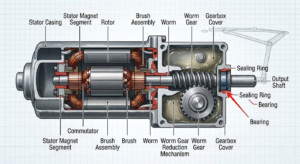
wiper motor
IV. Common Types
Brushed Motor
Traditional wiper motors mostly use a brushed structure. The brushes contact the commutator to supply power to the rotor. The structure is mature and the cost is relatively low, but the brushes wear out over long-term use and are considered a wear part.
Brushless Motor
Brushless motors eliminate the brushes and use electronic commutation instead. They offer longer life, smoother operation, and lower noise, but place higher demands on the control circuit and cost more. They are currently being adopted in some mid-to-high-end vehicle models.
Motor with Electronic Control Module
Some wiper motors integrate a control module, enabling functions such as intermittent wiping, rain-sensor-linked operation, and wiper speed adjustment based on vehicle speed. This type of motor has a more complex electrical structure and places higher requirements on integration with the vehicle’s electrical system.
V. Common Faults and Causes of Wiper Motors
The wiper motor itself has relatively high reliability, but the following problems may still occur during long-term use:
The motor does not turn or turns weakly: this is mostly caused by internal coil short circuits due to moisture, excessive brush wear, or poor contact in the power supply circuit. Occasional failures that occur after rain or car washing are usually related to water ingress.
The wiper fails to return to the parking position: wear or burning of the cam contacts in the parking mechanism prevents the motor from continuing to rotate to the initial position after power is cut.
Abnormal noise: insufficient lubrication inside the reduction mechanism, gear wear, or damage to the output shaft bearing.
Intermittent mode malfunction: for motors with a control module, this may be a module fault or a signal matching issue with the vehicle controller.
VI. Daily Use and Maintenance Recommendations
- Do not operate the wipers dry for extended periods. When there is no water or washer fluid on the windshield, the friction between the wiper blade and the glass increases significantly, which in turn increases the load on the motor. Over time, this accelerates wear on both the motor and the wiper blades.
- In winter, remove ice before using the wipers. Forcing the wipers on when the blades are frozen to the glass requires the motor to overcome a large resistance, which can easily damage the reduction mechanism.
- Keep the drainage channels clear. Wiper motors are usually installed in the cowl area below the windshield. If the drainage holes become clogged and water accumulates, rainwater may seep into the motor.
- Have abnormalities repaired promptly. If the wipers become noticeably slower, make abnormal noise, or fail to return to the parking position, they should be inspected as soon as possible to prevent minor issues from developing into motor damage.
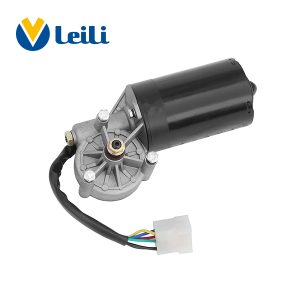
ZD2631L 60W Wiper Motor
VII. Conclusion
The wiper motor is not the most conspicuous component in the wiper assembly, but it is the starting point of the entire system’s operation. Its reliability determines whether the driver can obtain a clear field of view when driving in rain.
For buses, construction machinery, and commercial vehicles, the wiper motor also has to withstand longer operating hours, more frequent starts and stops, and more complex environmental conditions. When selecting a motor, paying attention to its ingress protection rating, durability, and compatibility with the vehicle’s electrical system is more meaningful than simply looking at whether the specifications are high or low.


.png)