


A maintenance supervisor at a regional bus depot once told me the most expensive mistake his team kept making: they replaced wiper blades every few weeks, chasing a streak that never disappeared. The real fault was a linkage pivot worn a fraction of a millimeter out of spec, which twisted the whole assembly off its designed contact angle. They had been replacing the cheapest part of a windshield wiper system while ignoring the component that actually failed.
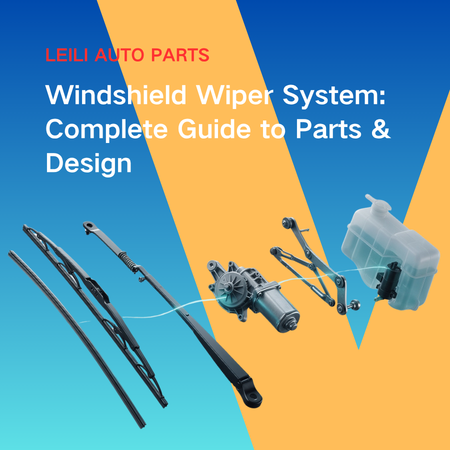
A windshield wiper system is not a blade. It is a coordinated chain of five components — blade, arm, motor, linkage, and washer — and when any one of them drifts, the entire system underperforms. Most people only ever see the rubber, so most people only ever replace the rubber. That single blind spot is why so many “fixes” fail.
This guide takes the windshield wiper system apart the way a factory floor would: what each part is made of, which specs actually matter (motor torque, mostly), how the whole thing works step by step, and how to pick a system that won’t fail early.
Key takeaways
- A windshield wiper system is five coordinated components — blade, arm, motor, linkage, and washer — and the failing part is rarely the one you’re replacing.
- Blade type (frame vs beam vs hybrid) changes how pressure is distributed across the glass; beam blades hold more uniform contact on curved windshields.
- Motor torque, not wattage, is the spec that matters most: passenger systems typically run 12V DC, while buses and trucks step up to 24V DC for higher torque.
- Rubber compound drives blade lifespan — natural rubber is cheap but weak against ozone and UV; silicone and chloroprene (CR) last far longer.
- Quality is built into vulcanization, surface treatment, and salt-spray and wipe-cycle testing — the parts no product photo shows.
What Makes Up a Wiper System (5 Core Components)
A windshield wiper system is a mechanical chain: the driver sends a signal, the motor turns it into force, the linkage converts that force into motion, the arm presses the blade against the glass, and the blade clears the water. Once you can picture each link, most faults explain themselves.
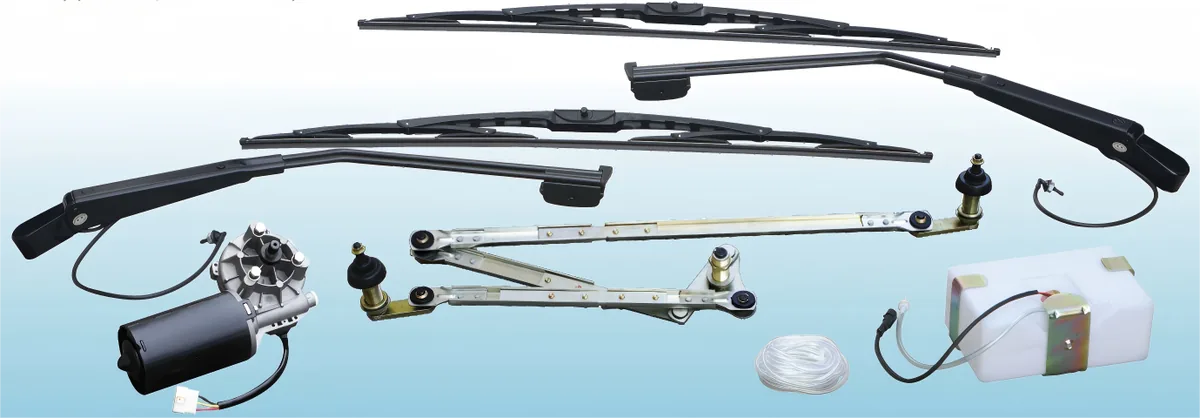
Wiper Blade (Rubber Element, Frame/Beam)
The blade is the only part of the system that touches the glass, and it has two halves: the rubber element and the carrier that holds it.
The rubber element is a precision lip. Its edge profile, compound, and coating determine whether the blade wipes clean or leaves streaks. A well-made wiping edge squeegees water clean yet still flips direction at the end of each stroke without lifting.
The carrier is either a frame (a metal bridge with claws that spread spring pressure across 4–8 contact points) or a beam (a single curved spring-steel strip that distributes pressure continuously). The carrier’s job is simple and unforgiving: keep the rubber lip at a consistent angle against the glass, across the full length of the blade.
Blade length matters more than most buyers realize. Too long, and the blade overhangs or collides with the trim; too short, and it leaves an unwiped band in the driver’s sight line. Wiper blades are produced from roughly 12 inches up to 60 inches to cover everything from a compact car to a full-width truck or bus windshield.
Looking for blades across compounds and lengths? See the wiper blade manufacturer — 12–60 inch blades in natural rubber, silicone, and CR.
Wiper Arm & Spring Pressure
The wiper arm is the lever that carries the blade and presses it against the glass. Its pivot mounts to the linkage shaft, and a spring inside the arm supplies the downward force that keeps the blade in contact at highway speed.
Spring pressure is a specification, not an afterthought. Too little, and the blade lifts off the glass at speed — the classic “skipping at 70 mph” complaint. Too much, and the blade drags, overheats the motor, and wears the rubber edge prematurely. The correct tension is a balance between the blade length, the glass curvature, and the vehicle’s top operating speed.
The arm also determines the connector. Hook, bayonet, side-pin, and pinch-tab attachments all exist because vehicle platforms standardized on different ones. A replacement blade that ships with the wrong adapter is the single most common reason a “correct” blade won’t fit.
OEM/ODM arm and adapter customization lives here: wiper arm manufacturer.
Wiper Motor & Gearbox (Torque Specs)
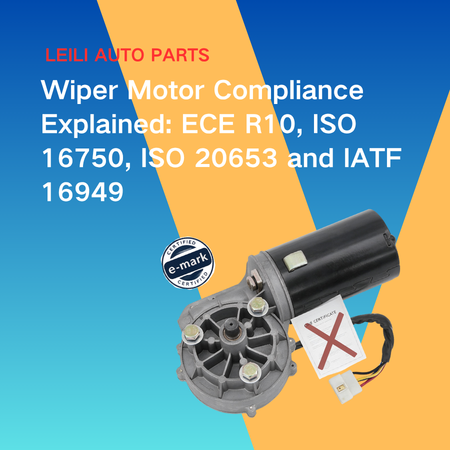
The motor is the muscle. Nearly all windshield wiper motors are DC permanent-magnet motors with a worm-gear reduction built into the housing. The worm gear does the critical work: it converts the motor’s high-speed, low-torque spin into the low-speed, high-torque output the linkage needs.
This is where torque specification becomes the number that actually matters. A motor’s wattage tells you how much power it draws; its torque tells you whether it can actually push a large blade through heavy snow or a dirty windshield. The two don’t move together.
Typical values break along vehicle class:
| Vehicle class | Voltage | Typical power | What the torque has to do |
|---|---|---|---|
| Passenger car / light truck | 12V DC | ~30–80 W | Move 1–2 blades across a curved windshield |
| Bus / truck / off-highway machine | 24V DC | ~60–180 W | Move large, heavy blades, often in pairs, in dust or snow |
For commercial vehicles the step up to 24V DC is not optional. A full-width bus or truck windshield — often wiped by twin arms driven from a single motor — demands substantially more torque than a passenger car, and the higher-voltage electrical system supplies it without excessive current draw. LEILI’s motor line spans 12V/24V dual-speed permanent-magnet motors from 20 W up to 180 W, which is what makes one motor platform adaptable across vehicle classes.
A wiper motor must also park reliably — returning the blades to a consistent rest position below the sight line when switched off — and support intermittent and multiple speed operation through an internal or external relay/timer.
Need a torque spec matched to your platform? Talk to the wiper motor manufacturer.
Linkage & Pivot Mechanism
The linkage is the invisible coordinator. It is a set of steel rods and pivots that takes the single rotating output from the motor and converts it into synchronized back-and-forth motion for both wiper arms.
Because the linkage operates out of sight under the cowl, it is also the most neglected component in the system. Its rods must be rigid enough not to flex under load, and its pivots and bushings must survive years of load cycling without developing slop. A pivot worn a few tenths of a millimeter is enough to let a blade twist off its contact angle — producing chatter, streaks, or a blade that slaps at the end of its stroke.
Corrosion is the linkage’s second enemy. Linkages sit where water, road salt, and leaves collect, so surface treatment (zinc plating, powder coating, or E-coat) is not cosmetic — it is what keeps the mechanism free for the life of the vehicle.
Salt-spray-tested linkages and pivots: wiper linkage manufacturer.
Washer System (Pump, Reservoir, Nozzles)
The washer system is easy to forget and expensive to ignore. It comprises the reservoir (tank), an electric pump, hoses, and nozzles/jets that aim cleaning fluid onto the glass.
Its purpose is lubrication, not just cleaning. A wiper blade wiping a dry or contaminated windshield wears its rubber edge rapidly and chatters. The washer fluid provides the thin film that lets the blade slide instead of drag — which is why a blade that “suddenly streaks” is often really a washer system that stopped delivering fluid, or a nozzle knocked out of aim.
Nozzle aim matters more than nozzle count. A mis-aimed jet sprays the roof instead of the glass, and the driver sees streaks from a perfectly good blade. On commercial vehicles, heated nozzles and larger reservoirs become requirements in cold climates.
Reservoir and pump assemblies: washer tank manufacturer.
Wiper Blade Types Compared (Beam vs Conventional vs Hybrid vs Winter)
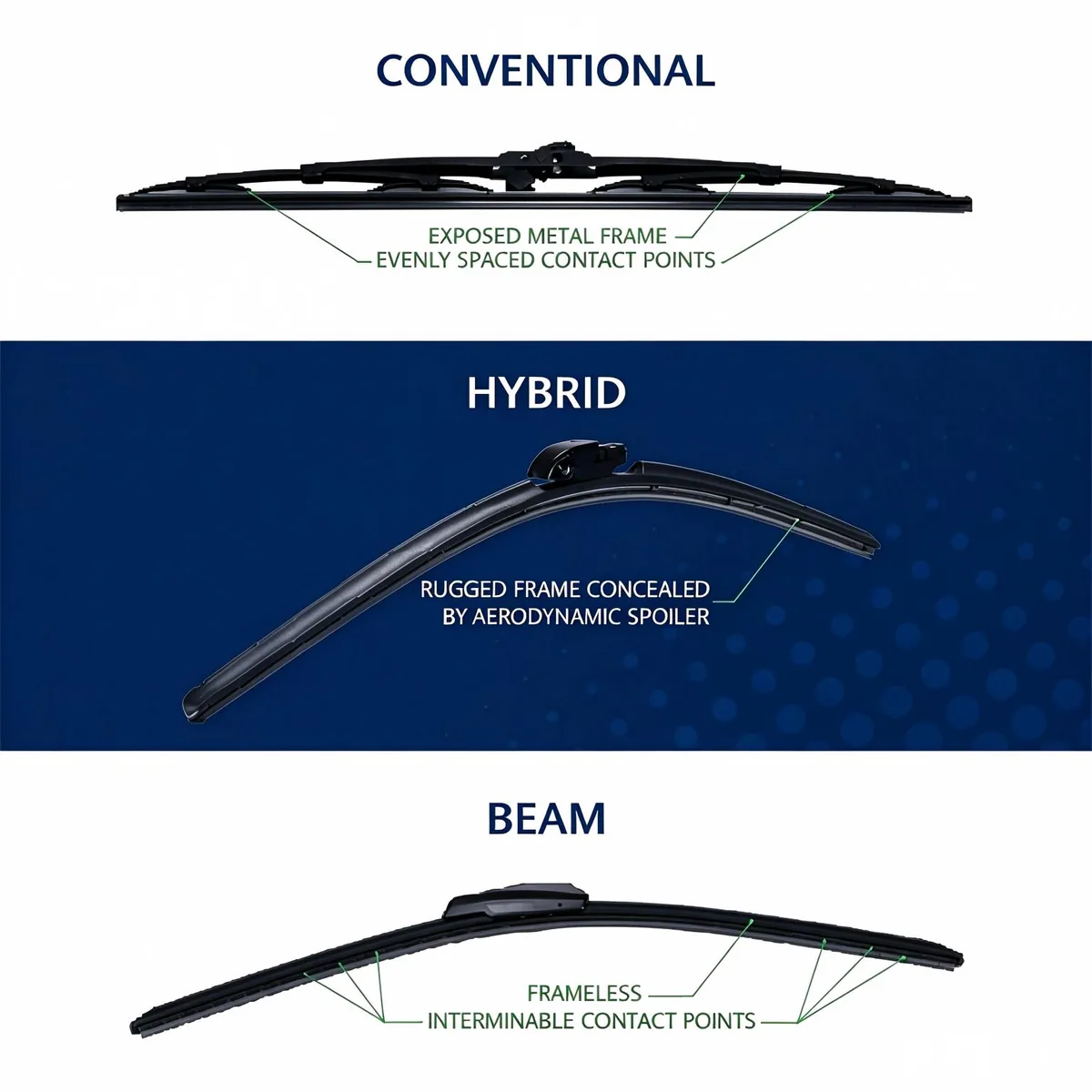
Blade design is a study in pressure distribution. The three main families — frame, beam, and hybrid — differ in how they hold the rubber lip against the glass, and that difference decides which one suits a given windshield.
Frame (Conventional) Blades
The conventional blade uses a metal bridge — a primary frame with hinged secondary yokes — carrying 4 to 8 claws that press the rubber element against the glass at discrete points.
Strengths: inexpensive to produce, widely available, and perfectly adequate on flatter, less-curved windshields where the pressure points land evenly.
Weaknesses: the tall metal frame catches wind and is prone to ice and snow packing between the yokes in winter; on deeply curved modern glass the pressure points don’t follow the curve, leaving unwiped zones or streaks at the blade ends. The many hinge points are also places where play develops over time.
Beam (Frameless) Blades
The beam blade replaces the bridge with a single curved spring-steel strip that runs the length of the blade and is encased in a low-profile rubber or plastic shell.
Strengths: the spring beam presses the rubber element with continuous, uniform force, so it follows a curved windshield far better than discrete claws. The low profile is more aerodynamic, quieter at speed, and — because there are no yokes for ice to pack into — far less likely to freeze solid in winter.
Weaknesses: higher cost, and the curved beam profile is tuned to a specific glass curvature, so fitment is slightly less universal than a frame blade.
Hybrid & Winter Blades
A hybrid blade marries the two: a conventional frame for structure and cost control, wrapped in a beam-style aerodynamic shell that reduces wind lift and ice buildup. It targets buyers who want beam-like winter performance at closer to frame pricing.
Winter blades add a rubber boot or full enclosure over the frame so snow and ice can’t wedge into the mechanism and freeze the blade into a rigid, skipping stick. They are a seasonal solution for fleets that operate through hard winters rather than a year-round design change.
Silicone vs Natural Rubber vs CR Rubber Elements
Underneath the carrier, the rubber element’s compound is the quiet driver of blade life. The three common compounds trade cost against weather resistance:
| Compound | Cost | Ozone/UV resistance | Temperature range | Best for |
|---|---|---|---|---|
| Natural rubber | Lowest | Weak | Narrow | Budget, mild climates, short replacement cycles |
| Chloroprene (CR) | Mid | Strong | Broad | Premium aftermarket & OEM — balanced all-rounder |
| Silicone | Highest | Excellent | Widest | Long life, extreme cold/heat, quieter wiping |
The failure mode is predictable. Natural rubber hardens and cracks under prolonged ozone and UV exposure — which is exactly why a cheap blade can look fine in the box and streak within a single season. Chloroprene (CR, or neoprene) resists ozone, weather, and abrasion well enough to be the workhorse of mid-to-premium and OEM blades. Silicone goes further still, holding flexibility across a wide temperature range and wiping more quietly, at a cost premium.
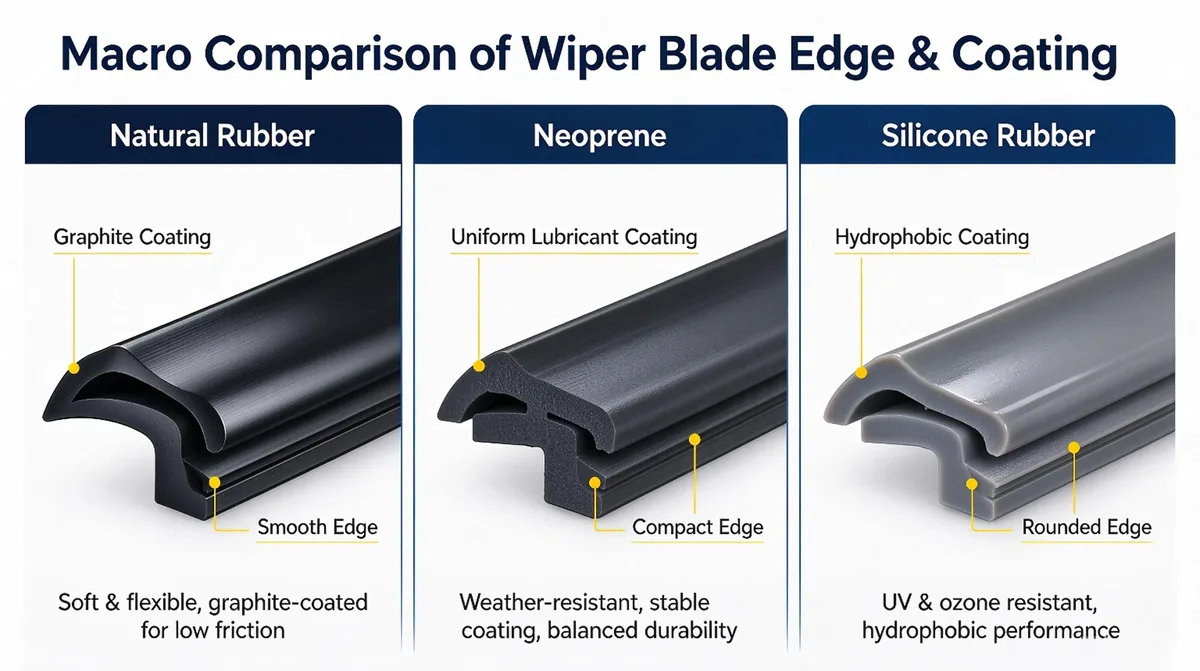
Two factory-level details separate a durable element from a disposable one. The first is vulcanization — the heat-and-pressure curing that cross-links the rubber. An under-cured element stays soft and streaks; an over-cured one goes brittle and cracks. The second is the surface coating (typically graphite or a PTFE-based treatment) applied to the lip to cut friction and noise. Neither is visible in a product photo, and both are where cheap blades quietly die.
How a Windshield Wiper System Works, Step by Step
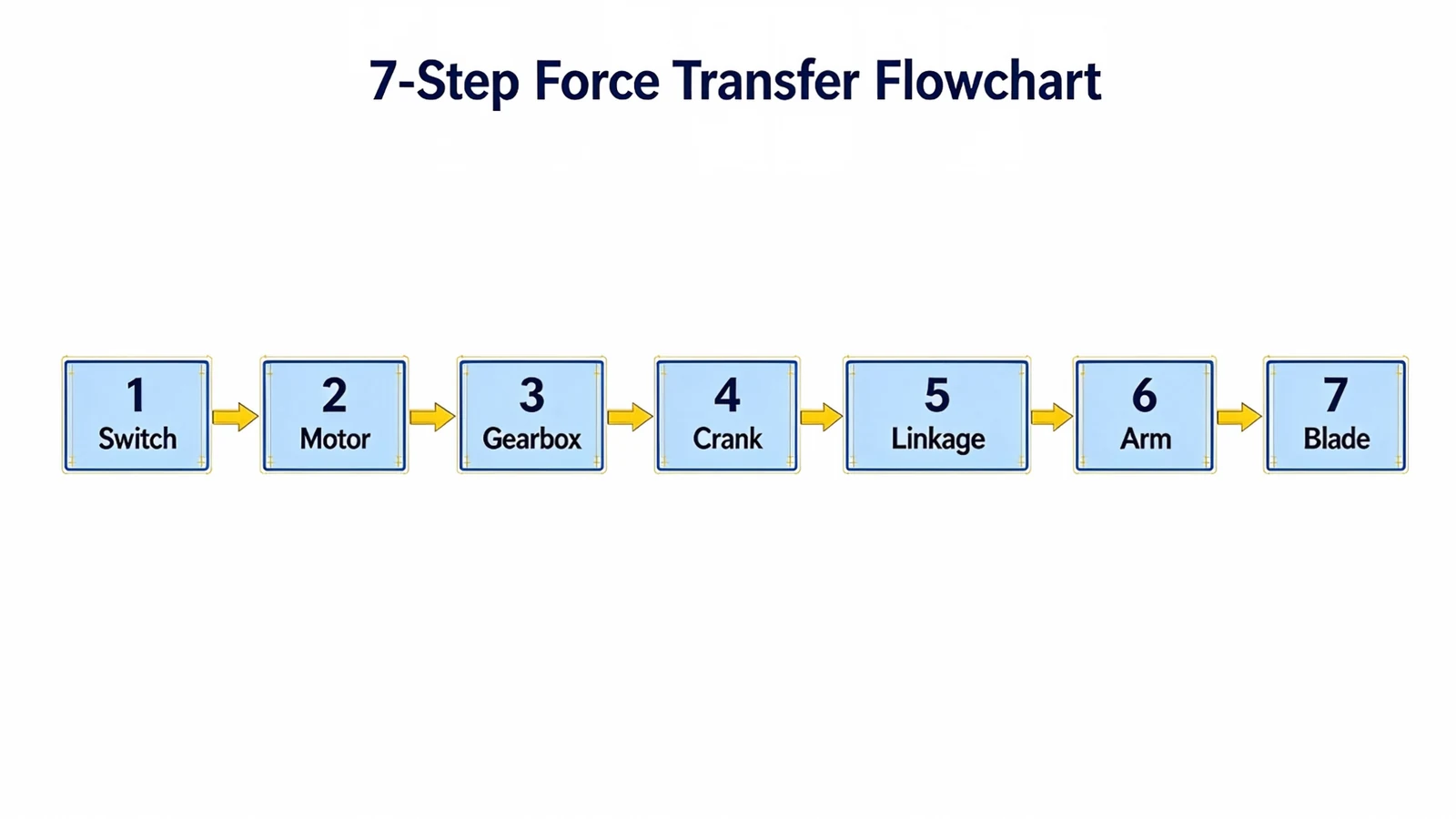
The sequence is short enough to hold in your head — and once you do, most wiper faults become obvious. Here is how a windshield wiper system works from switch to glass:
- The driver commands. Flicking the stalk or switch sends a low-current signal to the wiper control — directly, or through a relay/timer module that manages intermittent delay and speed.
- The control decides. The relay/timer sets the interval for intermittent wiping, or selects low/high speed by routing current through different motor windings.
- The motor spins. The permanent-magnet DC motor energizes and rotates, typically at several thousand RPM.
- The gearbox trades speed for torque. The worm gear reduces that rotation by roughly 40:1 to 60:1, dropping output speed while multiplying torque — the mechanical reason a compact motor can drive a heavy truck blade.
- The crank converts motion. A crank pin on the gearbox output turns continuous rotation into oscillation — a back-and-forth sweep.
- The linkage distributes it. Rods and pivots carry that oscillation to both wiper arms, keeping them in phase so the blades sweep together without colliding.
- The arm and blade deliver the wipe. The arm’s spring presses the blade against the glass, and the rubber lip squeegees the water clear on each stroke.
This entire sequence is governed by published standards. In North America, SAE J903 defines minimum performance, durability, and test procedures for windshield wiper systems on passenger cars and light vehicles, while SAE J198 is the companion document for trucks, buses, and multipurpose vehicles. When a spec sheet references “SAE J903 durability” or “SAE J198 coverage,” it is pointing at a defined, testable benchmark — not a marketing phrase.
Materials & Manufacturing: What Quality Really Looks Like
Everything up to this point can be copied from a product photo. The difference between a windshield wiper system that lasts and one that doesn’t is built in the factory, in processes no picture shows.
Rubber vulcanization. The rubber element is cured under controlled heat and pressure. Cure time and temperature are process parameters that must be validated and held, because the same compound cured differently produces a different part. This is why a serious manufacturer validates vulcanization as a “special process” — you cannot inspect the cure into the part after the fact.
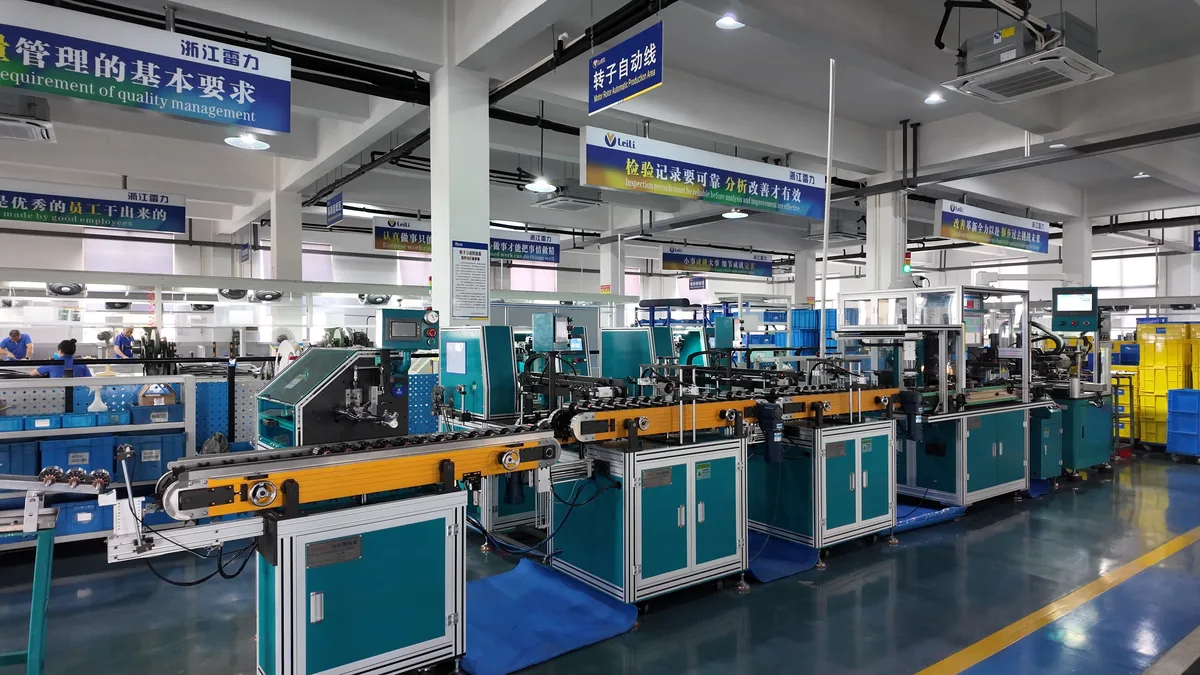
Metal surface treatment. Arms, linkage rods, and brackets are steel, and steel rusts. The defense is a plating or coating system — zinc plating, powder coating, or E-coat — validated by a salt-spray test that exposes the part to a corrosive mist for a defined number of hours. In coastal and road-salt regions this single test predicts most of the field life of the metal parts.
Wipe-cycle and endurance testing. A finished assembly is run on a bench through hundreds of thousands — for demanding commercial applications, over a million — wipe cycles. The bench catches what a visual inspection can’t: a motor whose torque drifts, a linkage pivot that loosens, a rubber lip that deforms after prolonged cycling.
Inspection and first-pass yield. Quality is measured, not asserted. Incoming material and finished product are checked against acceptance sampling (AQL) plans, and a factory that runs an automotive quality system tracks first-pass yield — the share of parts that pass on the first attempt. LEILI’s process metrics — 95% first-pass yield on incoming materials and 98.5% on finished products — are exactly the numbers you cannot see in a photo but that predict how a container of parts will behave in the field.
I watched the value of this testing play out in a cold-weather complaint once. A distributor in western Canada was drowning in winter warranty claims — blades that looked fine in October were cracking by December, when overnight temperatures dropped below -25°C. The lab pulled the returned batch and found the rubber had been under-vulcanized, so it stiffened and fractured in deep cold. The fix wasn’t a refund; it was a corrected cure cycle plus a new low-temperature flex test added to every subsequent batch. The next winter, the claims stopped. That’s the difference between a factory that inspects and one that understands.
These practices sit inside a formal quality management system. IATF 16949:2016 is the automotive-specific standard that runs supplier control, process validation, traceability, and corrective action as one loop, while ISO 9001 confirms the foundational quality management system. They are the reason a tenth container comes out as consistent as the first.
OE vs Aftermarket Wiper Systems: Key Differences
The uncomfortable truth is that an OE blade and a low-end aftermarket blade can look identical in a photo and feel much the same for the first month. The rubber wipes, the motor runs, the linkage pivots.
The difference is in how the two are managed. OE supply runs inside a documented quality system — validated processes, batch-level traceability, and defect prevention designed in before production. Much aftermarket supply runs on outgoing inspection: if the sample passes, it ships. The first approach keeps the hundredth batch consistent with the first; the second does not guarantee it.
None of this means aftermarket parts are inherently bad — a well-run aftermarket program sourced from a real factory can match OE reliability at a better price. It means the two are managed differently, and the management is what you are really buying.
For the full breakdown — including the six places that quality gap actually lives, and how it should shape your sourcing decision — see our guide on how to choose a wiper system manufacturer.
How to Select the Right Wiper System
Choosing a windshield wiper system is a spec-matching exercise, not a brand-name exercise. Work through these four questions in order.
1. What is the vehicle class and electrical system? This sets the motor voltage. Passenger cars and light trucks run 12V DC; buses, trucks, and off-highway machines step up to 24V DC and higher torque. Getting this wrong is the most expensive mistake in wiper selection.
2. What is the windshield shape and size? Deeply curved glass favors a beam blade, which follows the curve with continuous pressure. Flatter glass works fine with a conventional frame blade at lower cost. Blade length must match the swept area — too short leaves a wet band in the driver’s line of sight.
3. What climate will it live in? Cold, salty regions demand a CR or silicone compound, heated washers, and a winter or beam blade that won’t ice-pack. Hot, high-UV regions kill natural rubber quickly and favor silicone or CR.
4. What is the duty cycle? A passenger car wipes a few minutes a day. A long-haul truck or a coastal bus can wipe for hours through rain and salt. Duty cycle is what decides whether you need a motor sized for endurance and a linkage built to cycle a million times — or whether a commodity part will do.
If you’re sourcing the full system rather than a single component, working with one wiper assembly manufacturer keeps all five components on the same quality standard and warranty — instead of stitching together parts from four vendors.
These four questions are the front half of the sourcing decision. The back half — certifications, rubber datasheets, testing, MOQ, and lead time — is covered in depth in our guide on how to choose a wiper system manufacturer.
A fleet operator I worked with learned the value of question one the hard way. He ordered a batch of 12V wiper motors for a new line of 24V urban buses because the unit price was lower. Every motor burned out within weeks of commissioning — the 12V units drew double the current trying to produce the torque the larger blades demanded. The rework cost far exceeded the original “saving.” Voltage and torque are not interchangeable; they are the foundation the rest of the system stands on.
Matching a system to your vehicle class and climate? Request a factory quote → and our engineers will help you confirm voltage, torque, blade length, and compound before you commit.
Common Problems & Maintenance
Every windshield wiper system wears, and most problems announce themselves early — if you know what to listen for. Streaking usually points to the blade or the washer; chattering and skipping often point to the arm, linkage, or a contaminated windshield; a motor that runs but a blade that doesn’t move almost always points to the linkage or a stripped crank.
The maintenance that matters is cheap and preventive: replace the rubber element on a schedule rather than waiting for streaks, keep the washer reservoir filled with the right fluid (it lubricates as much as it cleans), and don’t run the blades over a dry or ice-crusted windshield. On commercial vehicles, add a periodic check of the linkage pivots and nozzle aim, which are the parts most fleets forget.
For the complete symptom-by-symptom breakdown — with a diagnostic table that maps each fault to its likely component and root cause — see our guide to common windshield wiper problems.
FAQ
How does a windshield wiper system work?
A windshield wiper system converts the driver’s switch signal into a mechanical wipe. The DC motor spins, a worm gearbox trades speed for torque, a crank converts rotation into oscillation, the linkage distributes that motion to both arms, and the arm’s spring holds the blade against the glass so its rubber lip can squeegee water clear.
What are the main components of a windshield wiper system?
Five core components: the wiper blade (rubber element plus frame or beam), the wiper arm (with spring pressure), the wiper motor (with worm-gear gearbox), the linkage (rods and pivots), and the washer system (reservoir, pump, hoses, and nozzles).
What is the difference between beam and conventional wiper blades?
A conventional (frame) blade uses a metal bridge with 4–8 discrete contact points; a beam blade uses a single curved spring-steel strip that applies continuous, uniform pressure. Beam blades follow curved windshields better, are more aerodynamic, and resist ice buildup — at a higher cost.
What wiper motor torque do I need for a commercial vehicle?
Commercial vehicles (buses, trucks, off-highway machines) typically need a 24V DC motor producing substantially more torque than a passenger 12V unit, because they drive larger blades — often in pairs — through snow, dust, and heavy rain. Confirm the torque spec against your windshield size and duty cycle rather than selecting on wattage alone.
Which wiper blade rubber compound lasts longest?
Silicone generally lasts longest and holds the widest temperature range, followed by chloroprene (CR), with natural rubber shortest-lived because of its weak ozone and UV resistance. The right choice balances lifespan against climate and price point.
How often should windshield wiper blades be replaced?
Inspect at least twice a year, and replace when you see streaking, skipping, or a hardened/cracked lip — usually every 6 to 12 months for natural rubber in harsh climates, and longer for silicone or CR compounds.
Conclusion
A windshield wiper system is five components working as one chain, and the failure is rarely in the part you can see. The blade clears the water, the arm applies the pressure, the motor supplies the torque, the linkage coordinates the motion, and the washer keeps the whole thing sliding instead of dragging.
If you take one idea from this guide, take this: diagnose by system, not by symptom. Match the voltage and torque to the vehicle class, the blade type and compound to the climate, and the quality system to the duty cycle — and you’ll stop replacing blades to chase problems that live in the linkage.
Ready to spec a system that holds up? Talk to our engineers →
.png)


