
雨刮器总成是如何制造的?

wiper blade guide

Wiper Assembly Manufacturing: How Motors, Arms, Blades and Linkages Are Built

A wiper assembly is manufactured in five stages: fabricating each component, inspecting every sub-assembly, joining them at final assembly, running a 100% unit check, and validating the batch through sampling tests. What separates an assembly that survives two years of sun and rain from one that fails in eighteen months is rarely a single advanced technology. It is how tightly each of those five stages stays under control.

This guide walks through every stage of the process, the parameters that decide quality at each one, and the four questions OEM buyers should put to a supplier before approving a program.

要点

  • A wiper assembly has six major sub-systems — motor, arm, blade, linkage, washer, and bus lock — and each fails for a different reason.
  • The motor’s most common failure mode is water ingress at the housing seal, not winding quality.
  • Blade chatter and water marks usually trace back to rubber compound mixing and vulcanization, two stages that happen weeks before assembly.
  • Unit-by-unit inspection and sampling verification catch different defects; neither substitutes for the other.
  • Inspection screens defects. Only process control prevents them.

Why the manufacturing stage explains wiper durability

Most buying guides start from the user end: how to choose, how to install, how to tell when something has gone wrong. Useful, but limited. However, to understand why one assembly lasts and another does not, you have to go back to how it was made.

Two suppliers can build the same structure and deliver finished products that look identical on the shelf. In practice, one selects materials correctly and keeps processes under control; the other compromises on compound and cuts corners on cycle time. Install both on a vehicle and run for two years. The difference will show.

The reason is the duty cycle. A wiper assembly works in permanent sun and rain, through frequent start-stop cycles, often on routes where the wiper runs for hours at a time. Under that load, any hidden risk in a single process step does not stay hidden — it gets magnified, and it surfaces in the field where warranty costs land.

How each wiper assembly component is manufactured

How is a wiper motor manufactured?

Winding. Production starts with the stator and rotor windings. Turn count, winding layout, and wire tension determine the motor’s output curve and how smoothly it runs. Automated winding equipment handles this stage in volume, but first articles and in-process spot checks still require manual verification — automated machines reproduce a bad setup perfectly.

Assembly and sealing. Wound stators and rotors move to assembly, where operators fit the brush holder, commutator, and reduction gear set before encapsulating the housing. Housing sealing is the critical operation here: seal ring position, press-fit force, and sealant volume all need to be held within tolerance. Water ingress into the motor is one of the most common causes of wiper failure in service, and it almost always starts at a seal that was pressed slightly off-center or under-filled.

End-of-line test. Operators power up every motor before it leaves the line. The test covers no-load speed, current draw, noise, rotation direction, and the parking function. As a result, the line intercepts anything outside the window at the factory, not at the dealer.
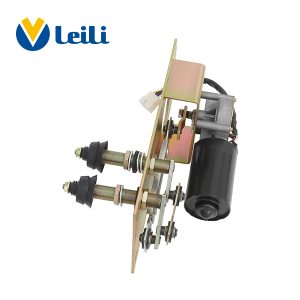
ZJC2631R/ZJC1631R Wiper Motor

ZJC2631R/ZJC1631R 60W 12V/24V 雨刷电机

How is a wiper arm manufactured?

Stamping. Wiper arms are stamped rather than machined. Operators cut steel sheet, then run it through a sequence of stamping steps that form the arm body and its mounting features. They then join sections by welding or riveting, depending on the arm design.

表面处理。. After forming comes electrophoretic coating and painting. The purpose is corrosion protection, not appearance — although buyers judge the second one. Wiper arms sit outdoors for the life of the vehicle, and any pinhole or skipped area in the coating becomes the exact point where corrosion begins.

Coating verification. After treatment, operators check adhesion and film thickness, because those two variables decide how the coating performs under UV and salt exposure. A thick but poorly bonded film fails faster than a thin, well-bonded one.
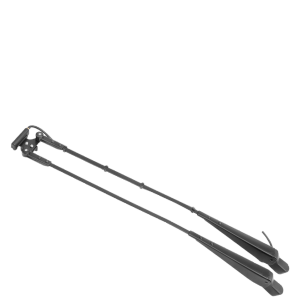
SG08-B Wiper Arm

SG08-B 雨刮器臂

How is a wiper blade manufactured?

Rubber extrusion. The rubber strip is formed by continuous extrusion. After compound mixing, the strip is pushed through an extruder, then vulcanized, set, and cut to length.

Two of those steps decide everything downstream. Specifically, mixing determines how uniform the compound is. Vulcanization determines elasticity and hardness. Poor control of either produces uneven hardness along the strip — and uneven hardness is what the driver experiences as blade chatter and water marks, months later, with no obvious cause.

Frame forming. For conventional blades, steel strips are stamped. For beam blades, the flexible steel strips need pre-forming to the windshield curvature, a step where spring rate consistency matters more than dimensional accuracy.

Assembly and conformity check. Operators assemble strip, frame, and clip, then press the blade onto a curved inspection fixture to confirm the rubber contacts the glass evenly along its full length. Any gap or over-compression shows up here, before shipping.
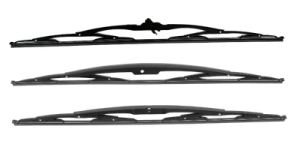
Windshield Wiper Blades

挡风玻璃雨刮片

How is a wiper linkage manufactured?

Tube and rod forming. The linkage body is typically tube or stamped steel. Tubes must be bent to match a specific vehicle layout, and the bend angle and bend position determine the wiper’s motion path. This is why positioning relies on dedicated fixtures rather than general-purpose benders.

Ball joint assembly. The ball joint is the linkage’s critical assembly point. The force with which the ball stud is pressed into the socket has to sit in a narrow window: too tight and rotational resistance climbs, overloading the motor; too loose and clearance develops, which becomes abnormal noise and eventually disengagement. A swing force test and a water resistance check follow assembly on every unit.
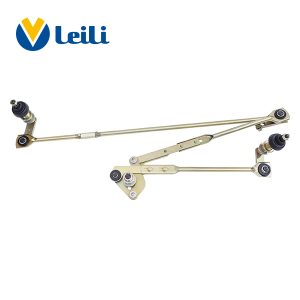
NLG-001 Wiper Linkage

NLG-001 雨刷连杆

How are the washer pump and bus lock manufactured?

Washer pump. The pump combines a pump body, impeller, motor, and seals. Post-assembly inspection concentrates on two things: flow rate stability and sealing under pressure. When spray volume drifts between units, the cause is a seal or impeller problem, not a nozzle problem.
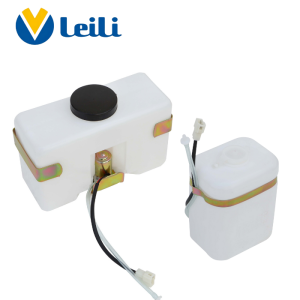
Washer Tank

雨刮洗涤器

Bus lock. Structurally simple, but demanding on latch fit precision. Every unit goes through repeated open-and-close cycles to confirm reliable locking, smooth release, and no seizing after cycling.
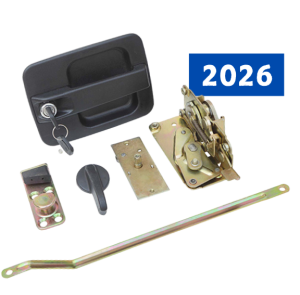
Bus Lock

巴士锁

Component-to-failure map

The table below is the fastest way to trace a field complaint back to a process step.

组件

Critical process

Typical failure if out of control

电机

Housing sealing (ring position, press force, sealant volume)

Water ingress, seizure, dead spot on commutator

电机

Winding tension and layout

Weak output, rough running, high current draw

Arm

Coating adhesion and film thickness

Pinhole corrosion, coating lift at the joint

Blade

Compound mixing uniformity

Uneven hardness, chatter, streaking

Blade

Vulcanization temperature and time

Loss of elasticity, hardened edge, noise

Linkage

Ball stud press force

High rotational drag, or clearance and noise

Linkage

Bend angle and position

Incorrect sweep arc, blade collision, wrong park position

总线锁

Latch fit precision

Difficult release, partial engagement

What happens at final assembly, and why does it decide consistency?

Once component production is complete, parts converge at final assembly. The step looks like simple joining. In reality, it is where the largest share of unit-to-unit variation is introduced or eliminated.

Linkage installation phase. The initial angular relationship between the crank and the linkage sets the synchronization of both blades and their park position. An angular deviation introduced at assembly does not correct itself — it shows up in the vehicle as a blade that stops short of its intended sweep, or one that interferes with the other.

Fastener torque. Under-torque loosens in service. Over-torque strips threads or deforms the joint. Torque-controlled tools with recorded values are the only reliable way to hold this, because operator feel cannot be audited.

Lubrication of moving parts. Grease type and quantity at ball joints and output shafts must be consistent across units. Excess grease migrates and collects dust, which turns into abrasive paste. By contrast, insufficient grease accelerates wear from the first cycle.

Routing and securing. Workers route washer tubing and electrical harnesses clear of moving parts and high-temperature zones, with defined spacing between fixing points. A harness that rubs through a tube wall at 80,000 km is a routing failure, not a material failure.

Why quality is built in production, not in inspection

A persistent misconception holds that quality comes from inspection. It does not. In fact, inspection can only screen. It cannot improve.

If the parameters of a given step are themselves unstable, inspection has exactly one lever: pull the nonconforming units out. That lever costs yield, and it costs rework, and it does nothing about the next batch.

Effective quality control works on the parameters instead. In practice it looks like five things:

  1. Documented parameters for key operations. The line records setpoints, and nobody adjusts them at a batch change or an operator change without a formal revision.
  1. First-article confirmation, every time. Not once per product — once per setup. This is what prevents a whole batch from being built to a directional error.
  1. Incoming material control. Rubber compound and steel are the two inputs where variation is nearly impossible to correct downstream. If the compound arrives with the wrong hardness distribution, no amount of careful extrusion recovers it.
  1. Traceable process data. When a field problem appears, the batch and the specific process step must be recoverable from records. Without traceability, root cause analysis becomes guesswork.
  1. Change control across shifts. The most common source of silent drift is the night shift running a slightly different setup than the day shift, with nobody recording it.

What should OEMs check when selecting a wiper assembly supplier?

As a tier-one or tier-two supplier, manufacturing capability ultimately shows up in delivery: batch-to-batch consistency, long-term supply stability, and the ability to trace a failure to its cause quickly.

Beyond specifications and price, four questions separate suppliers who understand their process from suppliers who assemble to a drawing:

  1. Which operations are your key control points, and why those? A supplier who names specific steps — housing seal press force, ball stud press fit, linkage phase angle — understands the failure modes. A supplier who says “all steps are controlled” does not.
  1. What problems have you had, and what did you change? Real manufacturers have a history of process failures and corrections. A clean answer is usually a rehearsed one.
  1. Can you show the process data for the last three batches? Traceability claims are cheap. Records are not.
  1. What happens when a parameter drifts out of window mid-batch? The answer reveals whether the line has a hold-and-quarantine procedure or relies on the operator noticing.

Answers to those four questions usually tell you more than a well-designed specification sheet.

常见问题解答

Why do wiper blades chatter after installation? Chatter almost always traces to uneven rubber hardness along the strip, caused by inconsistent compound mixing or vulcanization, or to a blade that does not conform to the glass curvature. It is rarely a wiper arm problem, and replacing the arm will not fix it.

What is the most common cause of wiper motor failure? Water ingress at the housing seal. Seal ring position, press-fit force, and sealant volume are the three variables that decide whether the motor survives years of rain exposure, and a seal pressed slightly off-center fails long before the winding does.

What is the difference between unit inspection and sampling verification? Unit inspection checks 100% of products for assembly defects and takes seconds per unit. Sampling verification tests a statistical sample for durability, thermal cycling, salt spray, vibration, and water ingress, and takes hours to weeks. One catches individual errors; the other catches batch drift.

How is wiper linkage phase angle controlled? The crank-to-linkage angular relationship is set at final assembly using dedicated fixtures, with the angle verified against the vehicle’s specified park position. A deviation of a few degrees is enough to make one blade stop short of its sweep or collide with the other.

What should OEMs ask a wiper assembly supplier? Ask which operations are the key control points and why, what process failures the supplier has corrected, whether process data from recent batches can be produced, and what happens when a parameter drifts mid-batch. These answers reveal real capability more reliably than a specification sheet.

结论

No single technology in wiper assembly manufacturing is especially advanced. Stamping, extrusion, winding, and press fitting are all mature processes. The difficulty is coordination — holding every stage to its parameters, batch after batch, so that the assembled system behaves the way the components promised.
A perfectly wound motor will not save a system whose linkage was phased wrong at assembly. That is the whole argument in one sentence: the assembly is only as good as its worst-controlled step.
For vehicles with high operating intensity — buses, construction machinery, commercial fleets — this consistency matters more than for passenger cars. These platforms run the wiper for hours at a time, in dust and weather, and they have very little margin to absorb process variation. A part that is “usually right” is not a part you can plan a fleet around.

该组件的产品页面: KG-001 雨刮器总成 · KG-006 雨刮器总成

您可能还会喜欢
linkages

雨刮器总成是如何制造的?

wiper linkage

如何选择雨刮器总成:完整的匹配流程

lock linkage washer

常被忽视的雨刮器总成部件:连杆、垫圈和总线锁