
Why are commercial vehicle wipers more prone to failure than passenger vehicle wipers?
The working environment for commercial vehicle wiper blades—buses, trucks, and engineering vehicles—is much harsher than for passenger cars:
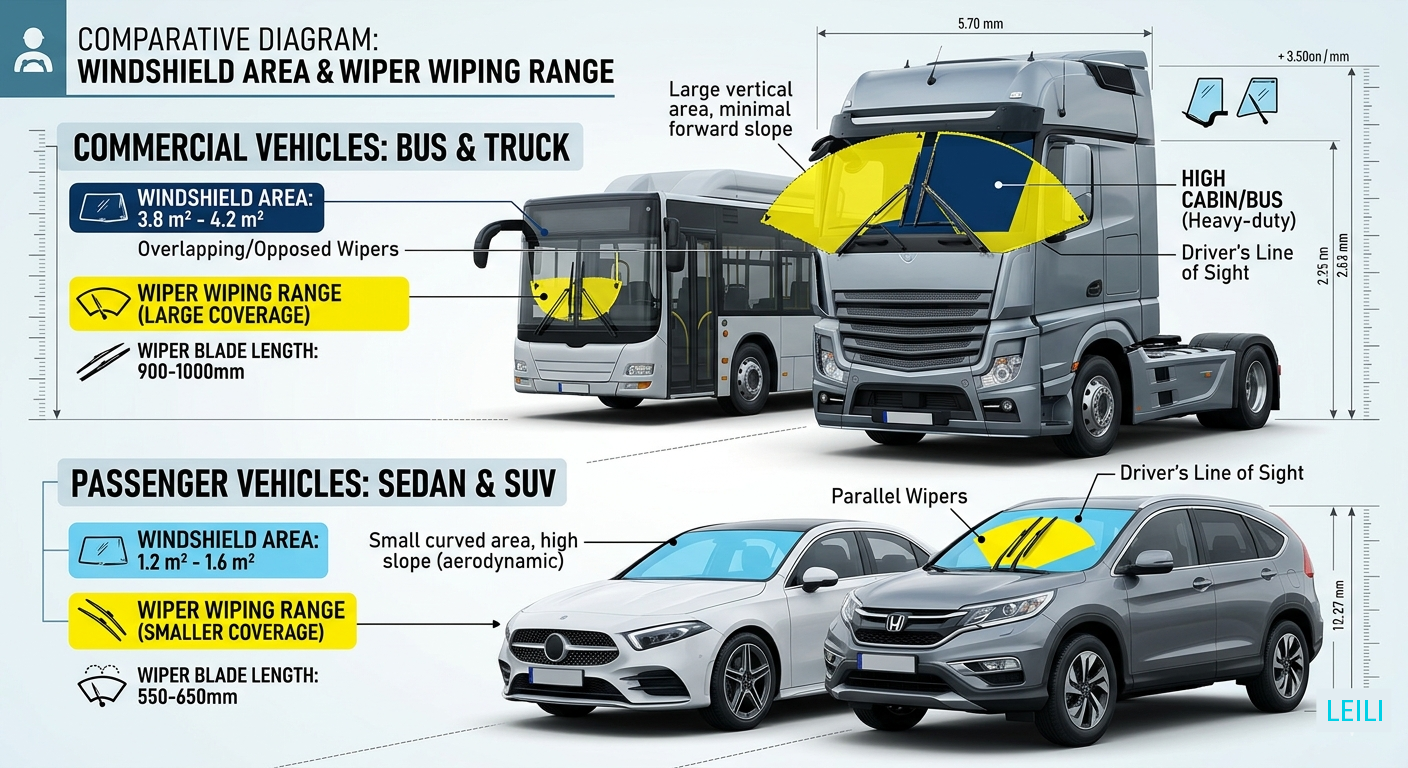
A 12-meter bus has a front windshield area over 3.5 square meters. That is two to three times larger than a typical car. The longer wiping path also speeds up rubber strip wear.
Long-distance logistics trucks run their wipers for four to six hours daily. Annual operation time reaches 800 to 1,200 hours. This continuous duty cycle significantly stresses the entire system.
Mining dust, construction site debris, insect residue, and diesel smoke all mix together on the glass. This sticky grime accelerates adhesive strip aging. It also speeds up cutting-edge wear on the wiper blade.
Northern winters drop to -30°C and harden the rubber strip. Southern summers heat windshields up to 70°C under direct sun. Ordinary rubber cracks within three months under such extremes.
According to market research, the global heavy truck wiper market will reach $412.5 million in 2026. Furthermore, it is expected to grow to $629 million by 2035, representing a CAGR of 4.8%. Meanwhile, the EU Green Deal’s F-Gas regulation and the U.S. FMVSS 1104 visibility standard are pushing fleet operators to shorten replacement cycles. Consequently, they are also upgrading gasket materials. As a result, commercial vehicle wiper blades are evolving from simple wear parts into key components that directly affect operational safety and regulatory compliance.

Comparison of dimensions
Comparison of three mainstream rubber strip material technologies
1. Natural rubber (Natural Rubber) – Best value for money, but limited weather resistance
Natural rubber is the most traditional rubber strip material for commercial vehicle wipers, with low cost, good elasticity, and excellent initial wiping effect.
| Performance indicators | Parameter range |
|---|
| Cost price | At the lowest, it is about 1/3 of silicone. |
| Applicable temperature | -20℃ ~ 60℃ |
| Recommended replacement cycle | 3-6 months |
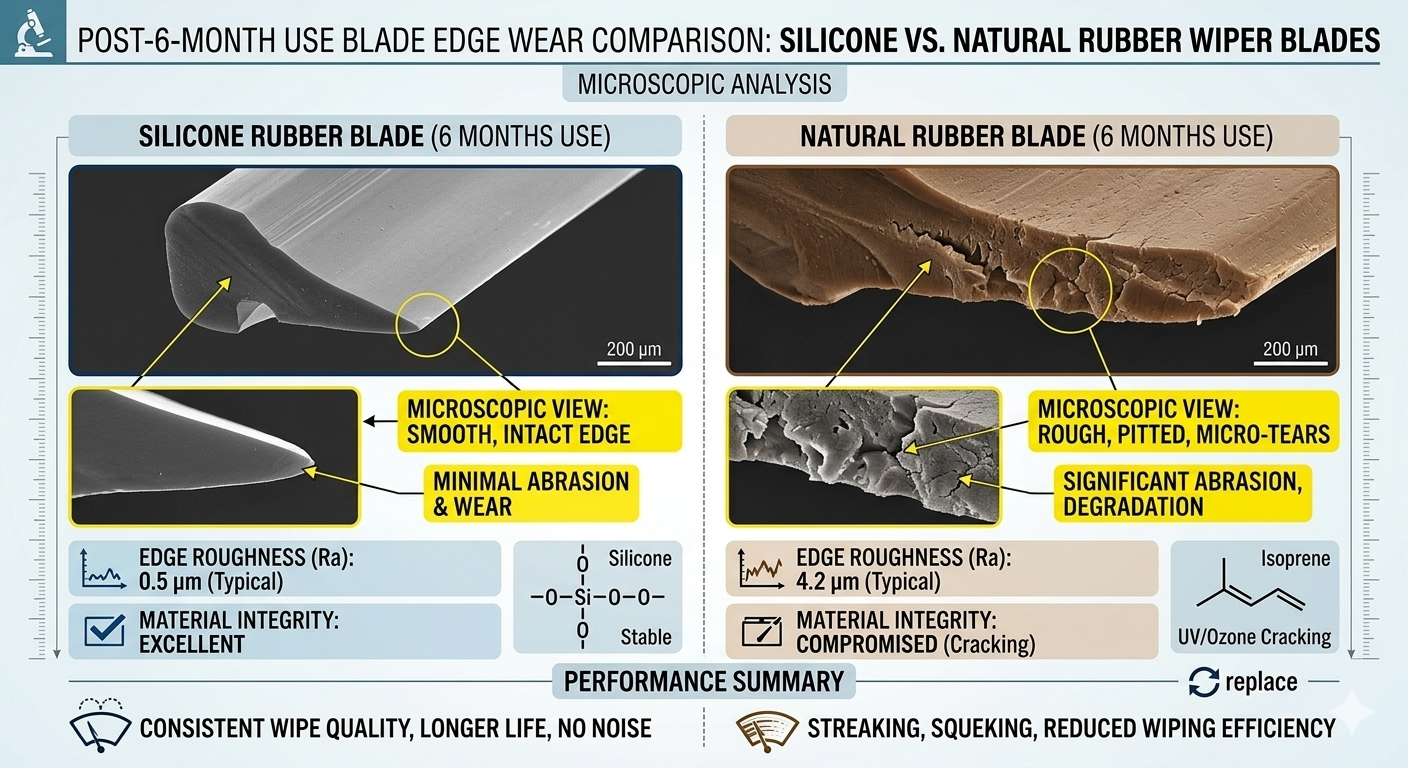
| Abrasion resistance | Medium, the blade wears out noticeably after 6 months. |
| Resistant to ozone/ultraviolet rays | Poor, long-term exposure may cause hardening and cracking. |
| Quiet performance | Excellent when newly installed, but noisy after aging |
Applicable scenarios: short-distance delivery vehicles, seasonal use (such as agricultural machinery), budget-sensitive fleets. The replacement cycle of 3-6 months should be strictly adhered to.
Industry trend in 2026: The EU Green Deal sets higher requirements for the sustainability of natural rubber, forcing the rubber strip industry to upgrade to natural rubber substitutes (such as bio-based rubber). At present, leading enterprises have begun to try to incorporate 15% to 30% of bio-based materials.
2. Silicone rubber (Silicone Rubber) – Long life + self-coating, lower total cost of ownership
Silicone material is the mainstream direction of upgrading commercial vehicle wipers in recent years.Its core advantage lies in its extremely wide temperature range (-50°C ~ 200°C) and its built-in coating effect.
| Performance indicators | Parameter range |
|---|
| Cost price | It is about 2-3 times that of natural rubber. |
| Applicable temperature | -50℃ ~ 200℃ |
| Recommended replacement cycle | 12-18 months |
| Abrasion resistance | Excellent, the surface hydrophobic layer continues to release |
| Resistant to ozone/ultraviolet rays | Excellent, not deformed after long-term outdoor exposure |
| Quiet performance | The whole process is low noise and there is no hardening noise. |
During the silicone scraping process, a small amount of silicone oil molecules are released onto the windshield surface, forming a hydrophobic film. When the speed is above 60 km/h, the rain will automatically roll off, which can reduce the frequency of using the wiper by 30% to 50%, and indirectly extend the life of the motor and the connecting rod.
Although the price of a single purchase is higher, the replacement cycle is 3-4 times that of natural rubber, and the total cost of ownership (TCO) is reduced by about 35%.

martial
3. Graphene coating – 2026 cutting-edge technology, revolutionary improvement in wear resistance
Graphene-coated wiper blades are a new category that has emerged in the past two years. Nanoscale graphene layers are coated on natural rubber or silicone base, which improves the wear resistance of the rubber strip by more than 40% and reduces the friction coefficient by 25%.
| Performance indicators | Parameter range |
|---|
| Cost price | It is about 3-4 times that of natural rubber. |
| Applicable temperature | -30℃ ~ 120℃ |
| Recommended replacement cycle | 18-24 months |
| Abrasion resistance | Excellent, the graphene layer acts as a “sacrificial layer” |
| Resistant to ozone/ultraviolet rays | Excellent |
| Quiet performance | At a minimum, the self-lubricating properties of graphene |
Technical principle: Graphene is a two-dimensional material made of single carbon atoms. Its hardness is 200 times that of steel. When coated on the rubber strip edge, it forms a 2-5μm nanoscale protective layer. As a result, it greatly reduces direct friction between the rubber matrix and the glass. Moreover, graphene has high thermal conductivity at about 5,000 W/m·K. Therefore, it quickly dissipates friction heat and prevents adhesive softening and deformation from high temperatures.
Industry News: In June 2026, Alibaba’s 1688 platform reported a 210% year-on-year surge in graphene wiper blade inquiries. Notably, these inquiries came mainly from cross-border e-commerce exports and high-end domestic fleet procurement. Meanwhile, the China Business Daily Research Institute also highlighted a key industry trend. Specifically, they noted that “requirements for weather resistance and noise reduction in wiper rubber materials have reached unprecedented levels.” Therefore, this shift is now widely recognized across the commercial vehicle sector.
Note: In June 2026, Alibaba’s 1688 platform recorded a 210% year-on-year jump in graphene wiper blade inquiries. These inquiries came mainly from cross-border e-commerce exports and high-end domestic fleet procurement. Meanwhile, the China Business Daily Research Institute pointed to an emerging industry trend. For instance, they emphasized that “demand for weather resistance and low noise in wiper rubber has hit new highs.” Consequently, this shift has gained broad recognition across the commercial vehicle industry.
Four-step method for selecting commercial vehicle wiper blades
Step 1: Confirm the interface specifications
The standard of the commercial vehicle wiper interface is different from that of the passenger car, and the common types are as follows:
| Interface type | Examples of applicable models |
|---|
| Hook type (Hook 9×3/9×4) | Most domestic trucks and buses |
| Side pin (16mm / 19mm) | Some models of Yutong and Jinlong |
| Dedicated clip-type | BYD electric buses, XCMG engineering vehicles |
| Bolted fixed type | Large-scale mining cards, marine wipers |
- Suggestion: Verify the VIN code (vehicle identification number) of the vehicle before purchasing, and match it precisely through the supplier database. Top brands in the industry have controlled the matching error rate to less than 0.3%.
Step 2: Choose the material according to the operation scene
| Operation scenario | Recommended material | reason |
|---|
| City bus (daily 8-12 hours) | Silicone / Graphene | Long service life reduces downtime maintenance |
| Long-distance logistics (20,000 km per month) | graphene | Best wear resistance, lowest TCO |
| Mining area engineering vehicle (high dust) | silica gel | Self-coating anti-dust, self-cleaning edge |
| Port/coastal area (high salt fog) | Silicone + stainless steel frame | Corrosion-resistant, IP55 or higher protection |
| Cold area operation (-30°C or below) | silica gel | -50°C still maintains elasticity |
Step 3: Inspect the factory and qualification
IATF 14949 is the global standard for quality management systems in the automotive industry, and batch consistency cannot be guaranteed for non-certified suppliers.
Do you have OEM supply records with main manufacturers such as Jinlong, BYD, Yutong, and Zongqi?
Whether the metal skeleton and joints are treated with cathodic electrophoresis - The industry's one-stop electrophoresis production line solution in 2026 can increase the corrosion resistance life of wiper components to more than 1000 hours of salt spray test
Step 4: Calculate the total cost of ownership (TCO)
Take a long-distance truck as an example (operating 300 days a year, driving 500km a day):
| texture of timber | Unit price (RMB/piece) | Number of replacements per year | Annual material cost | Annual downtime loss | TCO/year |
|---|
| natural rubber | 15-25 | 3-4 times | 45-100 | Approximately 200 (4 shutdowns) | 245-300 |
| silica gel | 45-65 | 1 time | 45-65 | Approximately 50 (1 stoppage) | 95-115 |
| graphene | 65-95 | 0.5 times | 32-48 | Approximately 25 | 57-73 |
Note: The shutdown loss includes the cost of repair work hours and the opportunity cost of vehicle downtime. The data is based on an average estimate for medium-sized fleets (more than 50 vehicles).
Frequently Asked Questions FAQ
Q1: How often should a commercial vehicle wiper blade be replaced?
The replacement cycle of commercial vehicle wiper blades depends on the material of the rubber strip and the intensity of operation. Natural rubber is recommended to be replaced every 3 to 6 months, silicone every 12 to 18 months, and graphene coating can last up to 18 to 24 months. Judgment basis: If there are obvious water marks, abnormal sounds, or the scraper jumps after scraping, it should be replaced immediately to avoid damaging the windshield.
Q2: What are the advantages of silicone wiper blades over natural rubber?
Silicone material has three irreplaceable advantages: wide temperature range (-50 ℃ ~ 200 ℃), suitable for extreme climate; It has a self-coating effect, forming a hydrophobic layer on the glass after scraping, and rain drops will roll off automatically, reducing the frequency of using the windshield wipers; The service life is 3-4 times that of natural rubber, although the unit price is high, the whole life cycle cost is lower by about 35%.
Q3: Is the graphene-coated windshield wiper a tax on intelligence?
No, but it needs to be verified. The real nanoscale graphene coating can indeed increase the wear resistance of the glue strip by more than 40% and reduce the friction coefficient by 25%. The problem is that there are many “conceptual” products on the market, with insufficient actual coating thickness or poor adhesion. When purchasing, please choose an OEM supplier with IATF 1 6949 certification and request a coating adhesion test report (recommended 1000 hours or more of salt spray test).
Q4: Can the same windshield wiper be used for buses and trucks?
Yes, but it needs to match the interface specifications and scraping pressure. The front windshield of the bus has a greater curvature, requiring a special non-ribbon or three-section wiper blade with a steel sheet curvature error within 0.2mm; The truck pays more attention to durability, and silicone material + high-strength bone structure is the first choice. There are special adapter models for buses and trucks, covering hooks, side plugs, and bolts.
Q5: Can a universal windshield wiper purchased from an e-commerce platform be used on a commercial vehicle?
The risk is high. The general type multi-adaptable interface is mainly developed for passenger cars. The windscreen area of commercial vehicles is large and the curvature is different. The general type often has the problem of the two ends rising and the middle leaking. It is recommended to match the VIN code accurately or directly contact the OEM supplier for customization to ensure compatibility.
Three major trends in the commercial vehicle wiper blade industry in 2026
The EU Green Deal promotes the replacement of natural rubber with bio-based rubber and silicone, and IATF 16 949 certified enterprises will have priority access to OEM spot orders.
Some high-end commercial vehicles are starting to integrate intelligent wiper blades with rain sensor interfaces, which can automatically adjust the wiping frequency and cooperate with the Internet of Vehicles to realize remote monitoring of rubber strip wear.
From "selling products" to "selling services", top suppliers provide a package model of regular inspection + on-demand replacement to reduce fleet management costs.
浙江雷利汽车零部件有限公司. has been focusing on the commercial vehicle wiper system for more than 20 years. The product line covers 雨刷电机, wiper arm, wiper blade, wiper link rod, washer, 和 公共汽车锁. It is compatible with mainstream original equipment manufacturers such as Jinlong, BYD, Yutong, XCMG, Chongqing Heavy Industry, and Higer. It has passed the IATF 1 6949 certification and undertakes OEM/ODM customization.
您可能还会喜欢

Summer Commercial Vehicle Wiper System Maintenance Guide: A Must-Read for Bus and Truck Safety in the Rainy Season

How to choose the material of commercial vehicle wiper blade? In-depth analysis of three technologies: natural rubber, silicone, and graphene coating


.png)